
Hampton, Virginia
Want to see how Hampton compares to other top cities in Virginia? Explore all city regulations in Virginia. →
Hampton, VA
Challenging To Investors
STR Regulations for Hampton, Virginia
Overview: STR Allowance in Hampton, VA
Yes, short-term rentals are explicitly allowed in Hampton, Virginia under a comprehensive regulatory framework that became effective September 1, 2024. The City Council adopted new regulations that permit short-term rentals (STRs) while implementing strict density and operational controls to maintain neighborhood character. STRs are defined as the provision of a room or space for lodging purposes for 30 days or less, commonly advertised on platforms like Airbnb and VRBO. These regulations represent a significant update to Hampton's approach to vacation rentals, balancing tourism opportunities with community preservation.
What do Airbnb hosts actually earn in Hampton?
Hampton hosts earn a median $36,106/year with $207 ADR and 66% occupancy.
Top performers pull in $46,481+ per year.
See the full Hampton market breakdownHow to Start a Short-Term Rental Business in Hampton, VA
Starting an STR business in Hampton requires careful navigation of the city's regulatory framework. The process begins with determining your property's eligibility within the city's 51 designated STR zones and continues through a formal permitting process.
Step 1: Determine Property Eligibility
Verify Zoning Compliance
- Confirm your property is located within one of the city's 51 designated STR zones using the interactive map
- Check if your zone has reached the 1% density cap (as of the documentation, Buckroe 2 and Phoebus 3 zones are at capacity)
- Ensure compliance with the 300-foot separation requirement from other STRs
Understand Separation Requirements
- STRs must maintain at least 300 feet of separation from each other, measured property line to property line
- Exceptions exist for adjacent properties (two STRs can be located directly next to each other on the side)
- Multifamily units are not subject to separation requirements
Step 2: Determine Required Permit Type
The city categorizes STR permits into two types based on property characteristics:
Zoning Administrator Permit (ZAP)
- Required for properties with adequate on-site parking
- Properties with 5 bedrooms or fewer
- Maximum 10 overnight guests
- Properties that will not host events
Use Permit
- Required for properties with insufficient on-site parking
- Properties exceeding 5 bedrooms or 10 overnight guests
- Properties that will host events
Step 3: Complete Application Process
Application Submission
- Submit applications through the city's online permitting system
- Pay the $200 application fee and $50 inspection fee
- Provide a detailed floor plan showing room dimensions, safety equipment locations, and evacuation routes
Floor Plan Requirements
- Dimensions or square footage of each room
- Location of safety equipment (fire extinguishers, smoke detectors)
- Evacuation routes for all occupants
Step 4: Property Inspection
- Schedule and complete a city inspection to verify safety and operational compliance
- Address any deficiencies before permit approval
- Ensure all safety equipment is properly installed and functional
Step 5: Obtain Business License
- Secure a Hampton business license for your STR operation
- Ensure the license is current and properly displayed
Step 6: Designate Responsible Local Person
- Assign a local person responsible for responding to issues at the property
- Provide their contact information to the city
- Post this information prominently on the property
Required Documents, Permits, Licenses, and Guidelines
Mandatory Permits and Licenses
Short-Term Rental Permit
- Either a Zoning Administrator Permit (ZAP) or Use Permit depending on property characteristics
- Application fee: $200
- Inspection fee: $50
Hampton Business License
- Required for all STR operations
- Must be current and displayed appropriately
Required Documentation
Floor Plan
- Detailed representation of the existing structure
- Room utilization plan
- Dimensions or square footage of each room
- Location of safety equipment (fire extinguishers, smoke detectors)
- Evacuation routes for all occupants
Responsible Party Information
- Contact details for local person designated to respond to issues
- Must be posted on the property and filed with the city
Safety and Operational Guidelines
Safety Equipment Requirements
- Smoke detectors in all required areas
- Fire extinguishers as specified by code
- Clear evacuation routes marked and accessible
Operational Standards
- Compliance with Virginia Uniform Statewide Building Code
- Adherence to guest limits based on permit type
- Proper parking arrangements as specified
Specific Regulations for Short-Term Rentals
Density and Distribution Controls
Zone Capacity Limitations
- Maximum 1% of residential dwellings per STR zone may operate as short-term rentals
- City divided into 51 designated STR zones with individual capacity limits
- Current capacity status changes as properties enter/exit the market
Separation Requirements
- 300-foot minimum distance between STRs (measured property line to property line)
- Adjacent properties exception: two STRs can be located directly next to each other on the side
- Multifamily units are exempt from separation requirements
- Grace-period STRs are exempt from separation buffers but create them once approved
Operational Requirements
Responsible Local Person
- Must designate someone who can respond in-person to issues
- Contact information must be posted on the property
- Information must be listed with the city
Guest and Event Limitations
- Standard permits limited to 5 bedrooms and 10 overnight guests
- Event hosting requires special permits
- Parking requirements vary by permit type
Grandfathering and Grace Period Provisions
Grandfathered Properties
- STRs with City Council-approved Use Permits before September 1, 2024
- May continue operating under existing permit conditions
- Not subject to new density caps but must maintain compliance
Grace Period Properties
- STRs with business licenses before December 14, 2022
- Deadline to comply with new regulations: December 31, 2024
- Will be approved upon submitting necessary application materials
- Exempt from separation requirements but create separation buffers once approved
Enforcement and Penalties
Violation Consequences
- $1,000 fine for illegal operations
- Fines can be issued every 10 days after abatement period
- Criminal summons possible for non-compliant operations
- Notice of violation procedures
Enforcement Timeline
- Phased enforcement began October 1, 2024
- Complete enforcement of illegal operations anticipated by summer 2025
Exempt Uses
The following uses are separately defined and permitted in Hampton's Zoning Ordinance and are not subject to STR requirements:
Hotels
- Operate with at least 10 bedrooms
- Subject to separate zoning approval
Bed & Breakfasts
- Operate with less than 10 bedrooms
- Require on-site management
- Must be open to the general public during designated business hours
Homestay Rentals
- Long-term resident rents a single bedroom for 30 days or less
- Resident must stay at the property during rental period
- Not subject to separation and density limits of short-term rentals
Contact Information for Local Authority
Primary STR Contact
Email: shorttermrentals@hampton.gov
Zoning Questions
Email: CDDZoning@hampton.gov
Community Development Department
Address: 22 Lincoln Street, 3rd & 5th Floors, Hampton, VA 23669
Phone: (757) 727-8311
Fax: (757) 728-2449
3-1-1 Citizen Contact Center
Phone: (757) 727-8311
Email: 311@hampton.gov
Website: Hampton 3-1-1 Center
Online Resources
Permit Application System: Online Permits & Inspections Center
Important Dates and Deadlines
- September 1, 2024: New STR regulations effective date
- October 1, 2024: Beginning of phased enforcement for pre-existing STRs
- December 31, 2024: Final deadline for grace-period STRs to obtain proper permits
Source Links
- Hampton Short-Term Rentals Official Page
- STR Regulations Summary Handout
- Interactive STR Zone Map
- PDF Version of STR Zones Map
- STR Map How-To Guide
- Online Permit Application System
- Grace-Period STR List
- Approved STRs List
- City Council Meeting Records on STR Regulations
- Additional Council Meeting Records
- STR Zones at Capacity Interest Form
- WHRO News Coverage
This comprehensive regulatory framework demonstrates Hampton's commitment to balancing tourism revenue opportunities with neighborhood character preservation. STR operators must navigate specific density, operational, and safety requirements while maintaining proper local oversight. The city's approach represents a carefully calibrated system designed to accommodate legitimate vacation rental businesses while protecting residential neighborhoods from over-saturation.
Next step
Found a property in Hampton?
Paste any address and get estimated revenue, cash-on-cash return, and comparable STR performance in under 5 minutes. 3 free analyses per day.
Free brief
Get the free Hampton STR Investment Brief
Revenue data, top neighborhoods, seasonal trends, and the key regulations for Hampton, Virginia in one email.
Hampton
Market Saturation Score
Photos of Hampton


Overview of Hampton
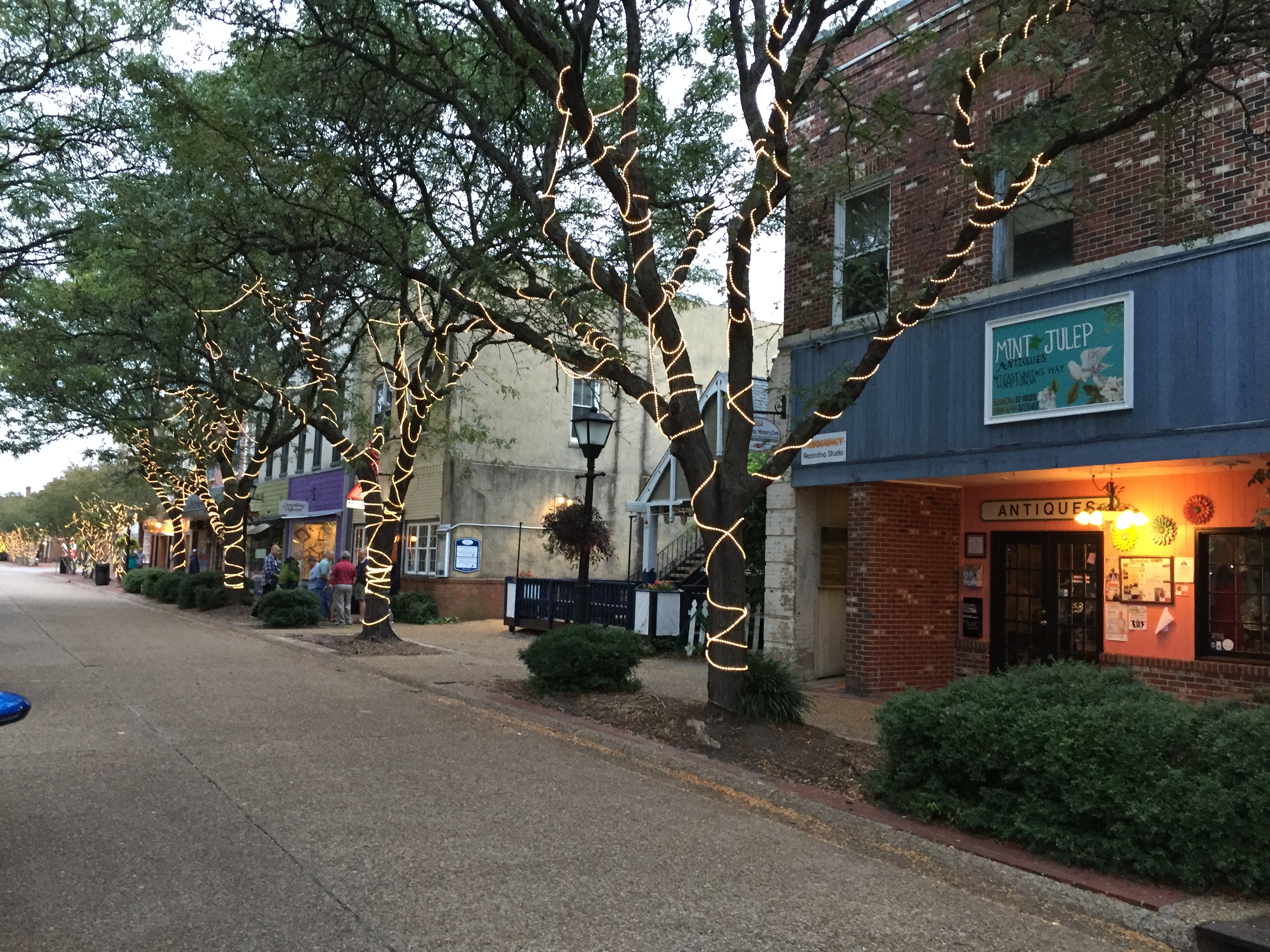
Hampton is an independent city in the Commonwealth of Virginia, situated on the southern end of the Virginia Peninsula where the James River meets the Chesapeake Bay. With a population of roughly 137,000 residents, it is one of the older continuously inhabited English-speaking settlements in the country and serves as the northern anchor of the Hampton Roads metropolitan area, which also includes Norfolk, Virginia Beach, and Newport News. The city carries a layered identity that blends military heritage, higher education, and waterfront recreation, and it functions as a practical gateway to both the historic triangle of Williamsburg and Yorktown and the Atlantic beaches of Virginia Beach, the latter lying roughly 30 miles to the southeast.
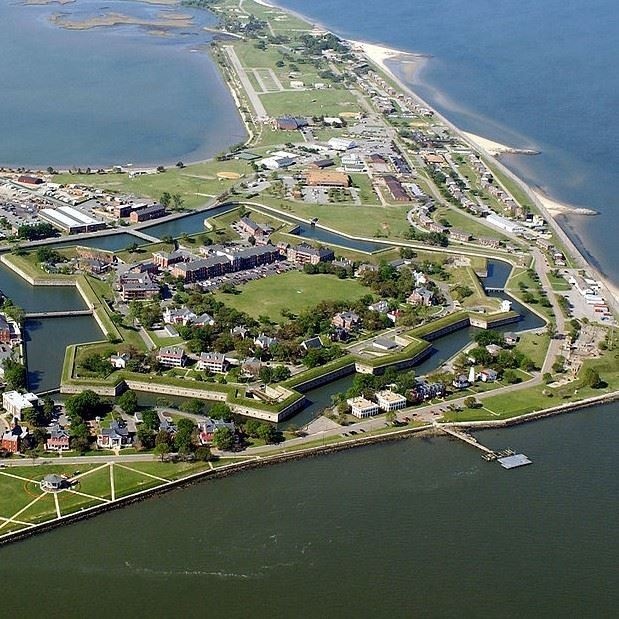
One of the city's most significant landmarks is Fort Monroe National Monument, a sprawling former Army installation at the mouth of the Hampton Roads harbor. The site is notable as the place where Jefferson Davis was briefly held following the Civil War and as the location of the "Contraband Decision," in which escaped enslaved people were declared contraband of war. Today the decommissioned fort features walking and biking trails, beaches, and interpretative signage about its long military and African American history. It sits just minutes from downtown Hampton and is a common anchor for visitors exploring the area's early American story.
A short drive inland brings visitors to the campus of Hampton University, a historically Black university founded in 1868 and known for its harbor-front setting, Georgian-style architecture, and the Hampton University Museum, which holds one of the country's most important collections of African American art and artifacts. Roughly five miles from the downtown waterfront, the campus doubles as a leafy green space and a cultural draw for guests interested in the region's educational legacy.
For travelers who want to stretch their legs indoors, the Virginia Air & Space Science Center in downtown Hampton offers interactive exhibits tied to NASA's Langley Research Center, the agency's first field installation, and to early aviation on the peninsula. The center appeals to families and is positioned conveniently near the harbor, where visitors can stroll the waterfront and catch views of the Hampton Roads Bridge-Tunnel.
The larger draw for many short-term visitors, however, lies just beyond the city limits. Colonial Williamsburg, the restored eighteenth-century capital of Virginia, is about a 30- to 40-minute drive up the interstate, and the Yorktown Battlefield at the close of the Colonial National Historical Parkway is similarly close, making Hampton a convenient base for travelers who want to pair history with beach time and city amenities without having to change lodging.
Hampton's appeal as a short-term rental market rests on this balance. It offers a less crowded, more affordable alternative to Virginia Beach while keeping the major draws of the Tidewater region within a short drive. Visitors can spend mornings on a Civil War-era parade ground, afternoons in a colonial capital, and evenings back on the Chesapeake Bay waterfront. The combination of a year-round university presence, military families connected to Joint Base Langley–Eustis, and steady tourism through the historical triangle gives the city a relatively consistent booking profile across the calendar.
Want to know if a property in Hampton is a good investment?
Enter an address to get instant revenue potential and comps.