
High Springs, Florida
Want to see how High Springs compares to other top cities in Florida? Explore all city regulations in Florida. →
High Springs, FL
Generally Investor Friendly
STR Regulations for High Springs, Florida
Overview: Are short‑term rentals allowed in High Springs, FL?
Yes. Short‑term rentals (STRs) are allowed in High Springs, Florida, subject to compliance with state, county, and any local requirements. There are no city‑specific ordinances cited in the provided materials; therefore, statewide Florida requirements apply in High Springs and, to the extent adopted locally, county‑level rules also apply. If Alachua County has adopted additional STR regulations, investors must also comply with them. As of the sources supplied, Alachua‑specific STR rules are not provided; use the statewide framework and the county contact information at the end of this guide to confirm locally.
What do Airbnb hosts actually earn in High Springs?
High Springs hosts earn a median $26,377/year with $151 ADR and 62% occupancy.
Top performers pull in $37,711+ per year.
See the full High Springs market breakdownHow to start a short‑term rental business in this market (investor‑ready roadmap)
Step 1: Confirm local allowances and zoning
- Determine whether the property is in High Springs city limits (municipal) and whether Alachua County has adopted any supplemental STR regulations.
- If within the city, verify zoning and any HOA or deed restrictions that could limit STR use.
- Action: Contact City Planning/Zoning and Alachua County Community Development (see Contacts).
Step 2: Secure the statewide license you must have in Florida
- License requirement: Any STR rented more than three times in a calendar year for stays less than 30 days or one calendar month requires a Florida vacation rental license through the Department of Business and Professional Regulation (DBPR).
- License types:
- Vacation Rental – Dwelling (single‑family homes; duplexes, triplexes, quadruplexes).
- Vacation Rental – Condominium (condo/coop units).
- Apply via the DBPR portal and renew annually.
- Note: If your STR is in a condominium or cooperative, also check condo/coop association bylaws; owners’ associations may restrict STRs even when state/city law allows them.
Step 3: Set up your state and local tax accounts
- Florida sales tax (6%): Register with the Florida Department of Revenue (DOR) and collect/remit on all STR stays.
- Discretionary sales surtax (0.5%–1.5% depending on county): Also remitted through DOR once enrolled.
- County transient rental (bed) tax: Determine if Alachua County imposes a tourist development tax or other transient rental taxes and, if so, enroll with the Alachua County Tax Collector and remit monthly.
- Action: Complete Florida DOR e‑Enrollment; enroll for any local transient taxes; keep monthly filing cadence even if no bookings occur.
Step 4: Designate a responsible party and prepare guest communications
- State law does not mandate a “local responsible party,” but county programs may. If Alachua County later adopts rules similar to Florida’s beach counties, you may need to assign a local contact who can respond quickly (within about one hour) to guest or county issues.
- Prepare your lease or guest agreement to include required disclosures and occupancy, parking, trash, and noise rules (see Required Postings/Agreements below). Even where not locally required, these elements reduce complaints and enforceability risk.
Step 5: Insurance and safety
- Standard homeowners insurance typically excludes short‑term rental business activity; consider a dedicated short‑term rental insurance policy with liability and property coverage.
- Safety: Install smoke detectors on each level, a multi‑purpose fire extinguisher (2A:10B:C) on each floor, and ensure pool safety compliance if applicable. Consider emergency lighting for the primary exit and safe balcony/railing conditions for multi‑story buildings per state standards.
Step 6: Platform compliance and advertising
- Collect and remit applicable taxes. If you use Airbnb/Vrbo, they may auto‑collect some taxes; you remain responsible for full compliance, including direct bookings.
- Advertising must accurately reflect maximum occupancy and parking and should include any required certificate numbers once established.
- If the county later requires certificate numbers on ads, add them (e.g., “STVR #XXXX; TDT #XXXX”).
Step 7: Governance watch and periodic renewals
- Track any Alachua County short‑term rental proposals (e.g., new taxes, licensing, posting, responsible‑party, or safety rules).
- Renew your DBPR license annually and maintain tax remittance filings monthly.
Required documents, permits, licenses, and guidelines
Licenses (state)
- Florida DBPR Vacation Rental License (Dwelling or Condominium)
- When required: More than three STR rentals per year with stays under 30 days or under one month.
- Application: Submit online; include property and owner details. DBPR may require additional documentation (e.g., balcony inspection for three‑plus story buildings).
- Renewal: Annually.
- Proof of DBPR license must be available on request.
Tax registrations (state and local)
- Florida Department of Revenue e‑Enrollment
- Collect/remit 6% Florida sales tax and any county discretionary sales surtax.
- File monthly (even if no activity).
- Alachua County transient rental taxes (if applicable)
- Contact the Tax Collector to confirm rates and remit monthly (even if no activity).
Operational documentation and postings (state guidance and local practice)
- Guest lease/agreement must include, at a minimum:
- Maximum occupancy (e.g., one person per 150 square feet of heated/cooled living area or a lower certified limit).
- Noise ordinance references and quiet hours (typical 10 p.m.–6 a.m.); consequences for violations.
- Trash and recycling pickup days; requirement to keep trash in provided containers.
- Evacuation notice that all occupants must leave upon official orders.
- Parking limit and a sketch of usable off‑street parking spaces; areas where parking is prohibited.
- If adopted locally: sea turtle protection/wildlife zone notices and beach safety information.
- Posted information inside the rental (recommended best practice, required in some Florida counties):
- Property address and emergency contact information.
- Maximum occupancy and the basis of calculation.
- On‑site parking limit and a sketch of parking spaces.
- Noise ordinance and potential fines.
- Trash/recycling schedule and storage rules.
- Nearest hospital and 911 notice.
- Evacuation instructions.
- If applicable: wildlife/sea turtle nesting restrictions and beach flag system.
- Safety requirements:
- Smoke detection, fire extinguisher (2A:10B:C) on each level.
- For buildings with three or more stories: balcony inspection certificate every three years and compliant railings; emergency lighting for the primary exit.
Local ordinance status
- As of the provided sources, no Alachua County‑specific STR ordinance is included. If adopted, expect requirements similar to other Florida counties (e.g., local registration certificate, responsible party designation, enhanced posting, occupancy/parking limits, and wildlife protection notices in designated zones).
Specific regulations for short‑term rentals (city, county, and state)
City of High Springs
- No city‑specific short‑term rental ordinance is included in the provided sources. You must verify with the City whether any local STR permits, zoning restrictions, or business tax receipts apply.
Alachua County
- The provided materials do not include Alachua County STR rules. Monitor county meetings and advisories; if rules are adopted, expect them to cover local registration, responsible party, occupancy/parking, posting requirements, and possibly wildlife zone notices if relevant to local geography.
State of Florida (applies statewide, including High Springs)
- Definition and licensing:
- A short‑term rental is a “transient public lodging establishment” (single‑family homes, duplexes, triplexes, quadruplexes, condos, coops) rented for less than 30 days or one calendar month.
- If you rent the property more than three times per year for less than 30 days per stay, you must obtain a DBPR vacation rental license (Dwelling or Condominium) and renew annually.
- Taxes:
- Florida sales tax (6%) applies to all STR rentals; remit monthly via DOR.
- County discretionary sales surtax (0.5%–1.5% depending on county) also remitted to DOR once enrolled.
- County transient rental (bed) taxes vary by county; verify applicability in Alachua County and enroll accordingly.
- Safety:
- Single‑ and two‑family dwellings used as public lodging must meet Florida fire/life‑safety standards (smoke detection, fire extinguisher, emergency lighting for the primary exit). For three‑plus stories, a balcony inspection certificate is required every three years.
- Advertising:
- Listings must accurately reflect the property’s certified maximum occupancy and parking. If the county later issues a local certificate, include that number in advertising (common local requirement in Florida counties).
- Sanitation and food service rules:
- If you provide dishware, glassware, kitchenware, or utensils without commercial‑grade sanitization, post the required guest notice indicating items are cleaned with ordinary household facilities and not sanitized to public food service standards.
- Kitchens must meet minimum standards (ventilation, lighting, sink with hot/cold water, proper refrigeration). Ice handling and dispensing must follow approved sanitation protocols.
- Inspection and enforcement:
- DBPR and county code enforcement may inspect for safety and compliance. Failure to comply can result in fines, license suspension, or other penalties.
Contact information (local authority in charge of STRs)
City of High Springs (general planning and zoning)
- Address: 23718 W US Highway 27, High Springs, FL 32643
- Phone: (386) 454‑1416
- Email: Not specified in provided sources
- Website: www.highsprings.us
Alachua County (short‑term rental oversight and taxation)
- Community Development Department (code/zoning)
- Phone: (352) 374‑5249
- Email: zoning@alachuacounty.us
- Website: www.alachuacounty.us
- Tax Collector (transient rental taxes and surtaxes, if applicable)
- Phone: (352) 338‑6204
- Website: www.alachuacountytaxcollector.com
State agencies (licensing and taxation)
- Department of Business and Professional Regulation (DBPR) — Vacation Rental Licensing
- Phone: (850) 487‑1395
- Licensing portal: www2.myfloridalicense.com/hotels-restaurants/licensing/vrtsp-guide/
- DBPR contact page: www.myfloridalicense.com/DBPR/contact-us/
- Florida Department of Revenue (DOR) — Sales and Surtax Enrollment
- Phone: Not listed in provided sources
- DOR e‑Enrollment (Taxes): taxapps.floridarevenue.com/EEnrollment/
- DOR general info: floridarevenue.com
Links to source pages (IMPORTANT)
- Florida DBPR Vacation Rental Licensing Guide
- Florida DOR e‑Enrollment (Sales Tax/Surtax Registration)
- City of High Springs Official Website
- Alachua County Official Website
- Alachua County Tax Collector
- DBPR Licensing Contact Page
- Florida Department of Revenue (general info)
- Rent Responsibly — Spring 2025 State Short‑Term Rental Bills to Watch (Florida TDC proposals)
Notes for investors
- The statewide framework is clear: obtain a DBPR vacation rental license if renting more than three times per year for stays under 30 days, collect/remit state sales tax and county surtaxes, and verify any county transient rental taxes.
- Because no Alachua County‑specific STR ordinance appears in the provided sources, treat the state rules as the current baseline and confirm any county overlays before listing.
- Treat compliance as an operating system: license, taxes, safety, responsible party (if required locally), postings, guest communications, and accurate advertising. That system minimizes fines, maximizes enforceability, and preserves profitability in High Springs’ STR market.
Next step
Found a property in High Springs?
Paste any address and get estimated revenue, cash-on-cash return, and comparable STR performance in under 5 minutes. 3 free analyses per day.
Free brief
Get the free High Springs STR Investment Brief
Revenue data, top neighborhoods, seasonal trends, and the key regulations for High Springs, Florida in one email.
High Springs
Market Saturation Score
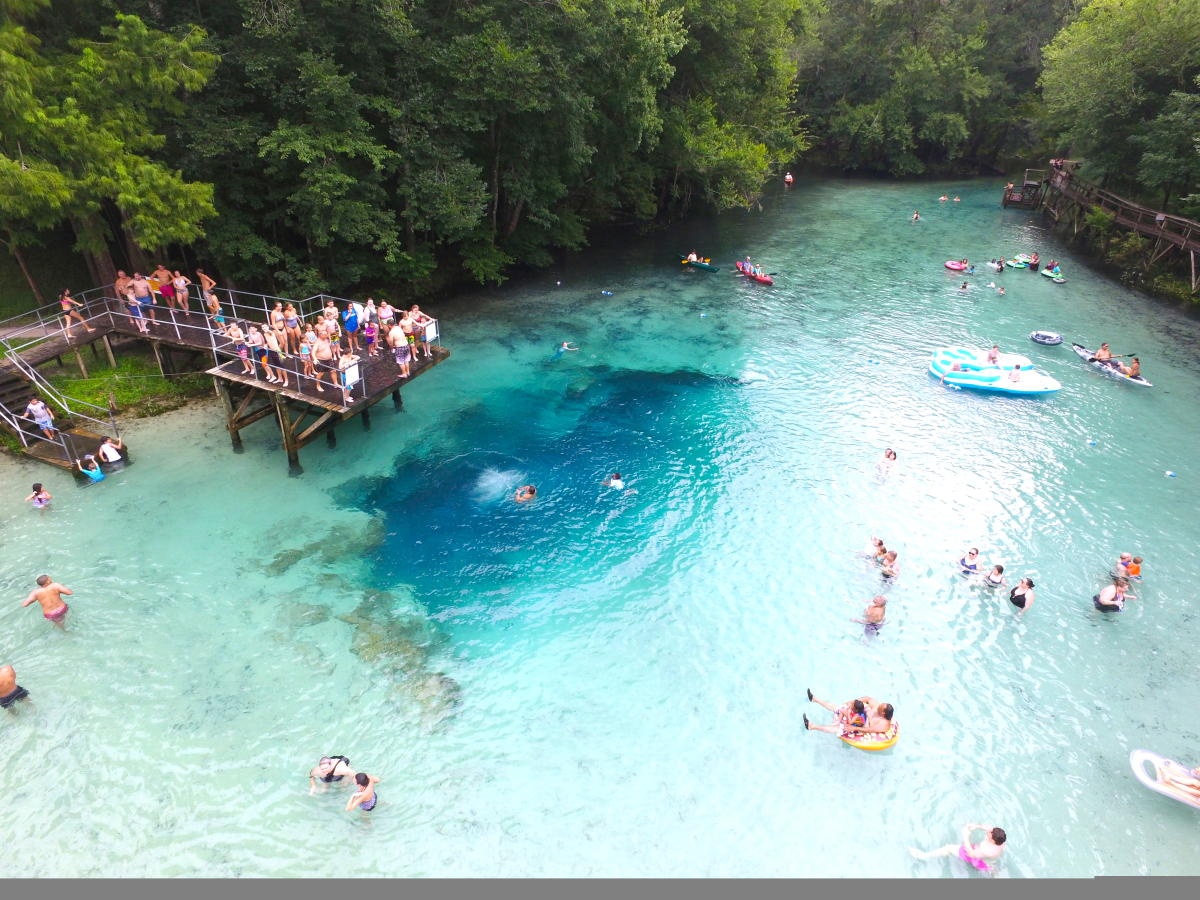
Photos of High Springs

Overview of High Springs
High Springs sits in Alachua County in north-central Florida, a small city of roughly 5,000 residents that has retained the unhurried pace and brick-front architecture of an old north-Florida railroad town. Long settled along the Santa Fe River, it serves as a natural gateway to some of the state's most celebrated spring-fed waterways, and lies about 20 miles northwest of Gainesville, the nearest major city and home of the University of Florida.
Just south of town, Ichetucknee Springs State Park is the marquee draw of the region, a tubing and snorkeling destination where the crystalline Ichetucknee River tumbles south through shaded hammocks and limestone bluffs. The park's main entrances are roughly 10 to 15 minutes from downtown High Springs along US-27, and in the warmer months the cool, spring-fed run draws families and groups from across the southeastern United States.
To the north, O'Leno State Park straddles the Santa Fe River, where the waterway famously slips underground and re-emerges a few miles downstream at the adjoining River Rise preserve. The park offers miles of hiking and biking trails, campgrounds, and a suspension bridge over the river, all within about a 10-minute drive of High Springs and a frequent stop for paddlers and campers.
The town itself revolves around its compact historic downtown, a few blocks of locally owned antique shops, cafes, and small storefronts housed in late-19th and early-20th century buildings. That walkable core gives the city an easygoing main-street feel and has made it a popular stop for antique hunters and weekenders exploring the wider north-central Florida region, with Gainesville's restaurants, museums, and University of Florida campus only a short drive to the southeast.
Together, the small-town character, the spring-fed rivers just beyond the city limits, and the easy access to a larger university town make High Springs a quietly compelling base for a short-term rental, particularly for travelers who want to pair full days of tubing, swimming, or paddling with quiet evenings on an old-Florida main street.
Want to know if a property in High Springs is a good investment?
Enter an address to get instant revenue potential and comps.