
Upson, Wisconsin
Want to see how Upson compares to other top cities in Wisconsin? Explore all city regulations in Wisconsin. →
Upson, WI
Generally Investor Friendly
STR Regulations for Upson, Wisconsin
Overview: Are Short-Term Rentals Allowed in Upson, WI?
Short-term rentals are allowed in Wisconsin. The state does not prohibit renting a residential property to transient guests for overnight stays. That said, operation of an STR in Upson is subject to layered state, county (Bayfield County), and any applicable town/city requirements. The information you provided does not include Upson-specific ordinances or contacts; therefore, this guide focuses on statewide Wisconsin requirements and Bayfield County frameworks. Investors should verify local (town of Upson) rules before acquiring or operating a property.
- State-level policy allows STRs under Wisconsin’s Tourist Rooming House (TRH) framework.
- Local governments may impose additional regulations (zoning, permits, caps, safety standards).
- A state-level legal guardrail: municipalities may not limit STR rentals to fewer than 180 days per 365-day period.
- Because no Upson-specific content was provided, this guide treats Upson through the lens of state and Bayfield County requirements and flags verification steps for local rules.
Sources: Wisconsin Hotel & Lodging Association (WHLA) resources and Wisconsin Department of Revenue (DOR) guidance; statewide STR overview and 180-day rule noted in Summer’s Wisconsin STR guide; Bayfield County Planning & Zoning FAQs.
What do Airbnb hosts actually earn in Upson?
Upson hosts earn a median $22,747/year with $374 ADR and 36% occupancy.
Top performers pull in $27,984+ per year.
See the full Upson market breakdownHow to Start an STR Business in Upson/Wisconsin
Starting an STR in this market requires a methodical, multi-step compliance process:
- Confirm zoning and land use
- Verify that STRs are permitted at your specific property (residential zoning, any overlay districts such as shoreland, wetland, or floodplain).
- Check if a conditional use permit (CUP) is required in Bayfield County for STRs in certain zoning districts or special areas.
- Obtain required licenses and registrations (order matters)
- State Tourist Rooming House (TRH) license through the Wisconsin Department of Agriculture, Trade and Consumer Protection (DATCP). Properties with 1–4 rooms fall under TRH; properties with 5+ rooms typically require a hotel license. TRH licenses are annual (July 1–June 30) and subject to inspection.
- County-level health licensing/inspection through Bayfield County Health Department (Public Health Madison & Dane County administers Dane County; Bayfield Health administers Bayfield County).
- Local room tax registration with the appropriate municipality/county to collect and remit room tax.
- Seller’s Permit from Wisconsin DOR if selling taxable goods or services beyond lodging or if required for state sales tax administration.
- Local zoning/STR permit if the town or county requires one (e.g., Bayfield County STR permit).
- Prepare for inspections and safety compliance
- Expect health and fire safety inspections. Common requirements include smoke and carbon monoxide detectors, fire extinguishers, safe egress, sanitation standards, water supply, and waste disposal.
- Maintain accurate floor plans and site plans showing occupancy limits and utilities.
- Insurance and risk management
- Maintain property damage and general liability insurance appropriate for a lodging business. While coverage specifics vary by jurisdiction, carrying robust liability protection is strongly recommended.
- Set up tax collection and remittance
- Collect and remit state sales tax and applicable local sales taxes where required.
- Register for, collect, and remit local room (transient) tax in the municipality/county where the property is located.
- Track income for federal and state income tax filings.
- Operational policies and documentation
- Create and maintain guest registers, house rules, occupancy limits, and emergency contact procedures.
- Post required permits or license numbers in advertisements and on the premises where required.
Sources: WHLA STR resources; Wisconsin DOR tax pages; Bayfield County Planning & Zoning FAQs; city-level examples in Summer’s statewide guide.
Required Documents, Permits, Licenses, and Guidelines
Although exact requirements vary by jurisdiction, STR operators in Wisconsin commonly need:
- Tourist Rooming House (TRH) License (DATCP, statewide)
- For 1–4 rooms; annual license valid July 1–June 30.
- Includes inspection; fee structure and details per DATCP.
- Hotel/Motel License (DATCP, statewide)
- For 5+ lodging rooms; separate licensing pathway.
- County Health License/Inspection
- Administered by the county health department (Bayfield County Health Department).
- May include plan review and pre-inspection fees.
- Local Room Tax Registration
- Registration with the municipality/county to collect local room tax.
- Zoning/Permitting
- Land Use Permit or STR Permit when required (Bayfield County Planning & Zoning; check if Upson has a local permit).
- Documentation often includes site plan, floor plan, proof of ownership, and utility/waste arrangements.
- Safety and Insurance Documentation
- Proof of insurance (property damage and liability).
- Safety compliance (smoke/CO detectors, fire extinguisher, egress, sanitation).
- Seller’s Permit (if applicable)
- Required by Wisconsin DOR for sales tax collection in certain circumstances (e.g., selling goods or taxable services).
- Additional Items (as applicable)
- CUP approval for special zoning scenarios.
- Floodplain, shoreland, or wetland permits/approvals for properties in those overlay districts.
Bayfield County STR Permit (one-time fee) and TRH License (annual) are distinct. The TRH license is issued by DATCP through the County Health Department and must be renewed annually; the county STR permit is a zoning artifact confirming local compliance and is generally not an annual fee unless changes occur (e.g., ownership).
Sources: WHLA STR resources; Wisconsin DOR pages; Bayfield County Planning & Zoning FAQs; DATCP references and county licensing frameworks.
Specific Regulations Affecting STRs: City, County, and State
State of Wisconsin (Statewide Rules)
- Definition: STRs are generally treated as Tourist Rooming Houses (TRHs). TRHs are lodging places where sleeping accommodations are offered for pay to tourists or transients. This definition excludes hotels, motels, bed and breakfasts, and private boarding or rooming houses that do not accommodate tourists/transients.
- Licensing: TRH licensing through DATCP is required for 1–4 room properties; hotel licensing for 5+ rooms. Annual license cycle is July 1–June 30.
- Municipal authority: Local governments may regulate STRs (zoning, permits, caps, safety standards) but may not limit rentals to fewer than 180 days per 365-day period.
- Taxes: STR operators collect and remit state sales tax (5%) and any applicable local sales taxes, plus local room (transient) taxes set by municipalities/counties.
Sources: WHLA STR resources; Wisconsin DOR; Summer’s statewide overview.
Bayfield County (County-level framework)
- STR definition: 1–4 units; residential dwelling rented for fewer than 29 consecutive days; must have pressurized potable water and indoor plumbing (flush toilet, sink, shower/bathtub).
- Permitting: STRs must obtain a county STR permit from Planning & Zoning and a DATCP TRH license via the County Health Department. The county STR permit fee is a one-time $500 fee; renewals are typically not required unless ownership or other significant changes occur.
- Documentation: Common application materials include a site plan, floor plans, proof of ownership, and evidence of compliance with health and safety standards. Additional requirements may apply for properties in floodplain, shoreland, or wetland overlays.
- Enforcement and ordinances: The county updated its STR ordinance in 2024/2025 to address operational standards and clarity in the permitting process. DATCP health licensing is annual; zoning permits are typically not annual unless rules change.
Source: Bayfield County Planning & Zoning FAQs.
City-level examples (indicative; check municipality rules)
While Upson-specific rules were not provided, Wisconsin’s city ordinances offer a useful comparative baseline:
- Madison
- TRH definition: rental for fewer than 30 nights.
- Primary residence requirement for operators; unhosted limit of 30 nights per year; hosted rentals have no night limit.
- Licensing sequence: County health TRH license; City room tax permit; Zoning TRH permit (application fee); annual cycle.
- Taxes: Dane County sales tax 5.5%; City room tax 10%.
- Lake Geneva
- STR definition: >6 and <29 consecutive days; permitted in all residential zoning districts.
- License: City STR license; minimum weekly stay; 180-day per 365-day limit; designated operator within 25 miles; off-street parking; noise/lighting controls.
- Fees: City STR license fee ($400); local sales tax 5.5%; city bed tax 3.0%.
- Green Bay
- STR definition: less than 28 consecutive days; no annual night cap if compliant.
- Licensing: County health registration; City room tax registration; City STR permit (application fee $500; renewal fee $250).
- Taxes: Combined sales tax 5.5%; room tax 10.0%.
- Wisconsin Dells
- Distinguishes TRH (commercial zoning; unlimited days) vs STR (residential zoning; primary residence required; up to 180 consecutive days).
- Licensing: City Overnight Lodging License; room tax permit; seller’s permit; TRH or hotel license; conditional use permit; inspection.
- Fees: $500; local taxes include premier resort tax where applicable.
These city models illustrate common patterns: multi-step licensing, health inspections, room tax registration, zoning permits, and potential occupancy/day limits. Use them to benchmark operational design while you verify the town of Upson’s specific rules.
Sources: Summer’s Wisconsin STR guide.
Taxes and Fees
- State Sales Tax: 5% on lodging and applicable taxable goods/services.
- Local Sales Taxes: Vary by county and municipality (e.g., 5.5% in several counties).
- Local Room (Transient) Tax: Varies widely by municipality/county (e.g., Madison 10%; Green Bay 10%; Lake Geneva 3%).
- TRH License (DATCP): Annual fee; license cycle July 1–June 30.
- County STR Permit (Bayfield County): One-time $500 fee; renewals generally not annual unless ownership changes or code updates occur.
- Health Department Fees: County-level licensing and inspections may involve pre-inspection and annual license fees (varies by county).
- Seller’s Permit: Wisconsin DOR permit may be required for sales tax administration; no specific fee noted in provided materials.
Note: Fee schedules and tax rates change; verify current amounts with local authorities.
Sources: Wisconsin DOR; WHLA; Bayfield County; Summer’s guide.
Contact Information (Phone, Email, Website)
Because no Upson-specific contacts were provided, use the following statewide and county resources. Where phone/email were not provided in the source content, the website is listed.
- Wisconsin Department of Revenue (DOR)
- Homeowners and Individuals Selling Short-Term Lodging guidance page
- Website: www.revenue.wi.gov/Pages/TaxPro/2021/Homeowners-and-Individuals-Selling-Short-Term-Lodging.aspx
- Wisconsin Hotel & Lodging Association (WHLA)
- 125 N. Executive Dr, Ste 206, Brookfield, WI 53005
- Phone: (262) 782-2851
- Email: [email protected] (WHLA contact form/email noted on site)
- Website: www.wisconsinlodging.org/short-term-rentals.html
- Bayfield County Health Department
- Physical address: 117 E. Sixth Street, Washburn, WI 54891
- Phone: (715) 373-6109
- Notes: Licensing/inspections for TRH; environmental health questions (water, wastewater, sanitation)
- Bayfield County Planning & Zoning Department
- Director: Ruth Hulstrom
- Email: ruth.hulstrom@bayfieldcounty.wi.gov
- Address: 117 E 5th Street, P.O. Box 58, Washburn, WI 54891
- Website (applications/forms): www.bayfieldcounty.wi.gov/1340/Applications-Forms
- Notes: STR zoning permits, land use permits, overlay district reviews (floodplain, shoreland, wetland)
- Town of Upson (verification required)
- Website and contact information were not provided in the source materials.
- Action item: Verify whether Upson has local STR licensing/ordinances (zoning, room tax registration, day limits, safety standards) through the town clerk or supervisor.
Sources: Wisconsin DOR; WHLA; Bayfield County Planning & Zoning; Bayfield County Health Department.
Source Links and Attribution
- Wisconsin Hotel & Lodging Association – Short-Term Rentals: www.wisconsinlodging.org/short-term-rentals.html
- Wisconsin Department of Revenue – Short-Term Lodging: www.revenue.wi.gov/Pages/TaxPro/2021/Homeowners-and-Individuals-Selling-Short-Term-Lodging.aspx
- Summer – Wisconsin Short-Term Rental Laws Guide: www.gosummer.com/post/wisconsin-short-term-rental-laws
- Bayfield County, WI – FAQ (Planning & Zoning STR clarifications): www.bayfieldcounty.wi.gov/faq
Practical Checklist for Upson Investors
- Confirm whether the town of Upson has an STR ordinance, zoning permit, or room tax registration requirement.
- Obtain DATCP TRH license via Bayfield County Health Department; schedule required inspections.
- If a county STR permit is applicable, submit application with site/floor plans, proof of ownership, and insurance documentation.
- Register for local room tax collection and remittance; set up state sales tax collection as needed.
- Verify overlay district compliance (floodplain, shoreland, wetland) if present on the property.
- Implement safety systems (detectors, extinguishers, egress), sanitation standards, and emergency procedures.
- Maintain guest registries and records; post permits or license numbers where required.
- Establish accounting processes for state/local taxes and annual renewals.
Caveats
- The content provided does not include Upson-specific regulations. Until the town’s rules are verified, investors should operate under the assumption that state and county requirements apply and that additional local rules may exist.
- Wisconsin law prevents municipalities from restricting STR rentals to fewer than 180 days in a 365-day period. Local rules may still impose caps beyond that threshold.
- Licensing requirements, fees, and tax rates change; confirm current requirements directly with DATCP, Bayfield County, and the town of Upson.
Summary for Investors
STRs are allowed in Wisconsin, and Bayfield County’s framework supports compliant STR operation through TRH licensing and zoning oversight. Upson may add local requirements, but none were included in the provided content. A diligent investor will verify town rules, secure the TRH license, complete county zoning steps, register for room tax, and maintain high safety and documentation standards. If you need Upson-specific contacts or ordinances, contact the town clerk or supervisor and Bayfield County Planning & Zoning to complete your compliance profile before acquiring or listing a property.
Next step
Found a property in Upson?
Paste any address and get estimated revenue, cash-on-cash return, and comparable STR performance in under 5 minutes. 3 free analyses per day.
Free brief
Get the free Upson STR Investment Brief
Revenue data, top neighborhoods, seasonal trends, and the key regulations for Upson, Wisconsin in one email.
Upson
Market Saturation Score
Photos of Upson


Overview of Upson
Upson is a tiny unincorporated community in Iron County, in Wisconsin's far northern reaches, tucked just inland from the Lake Superior shore and within a short drive of the Michigan border. With a population of only a few dozen people, it has the feel of a quiet way-stop rather than a destination in its own right, surrounded by dense forest, glacial terrain, and the rolling ridges of the Penokee-Gogebic Range. The community sits along U.S. Highway 2, the long east–west route that ties together the small towns of Wisconsin's Iron Belt, and it functions primarily as a launchpad for travelers exploring the surrounding lakes, forests, and ski hills. The nearest larger city is Duluth, Minnesota, roughly 160 miles to the west, while the small border towns of Ironwood, Michigan, and Hurley, Wisconsin, lie just a few miles to the east.
One of the region's defining natural assets is the Chequamegon-Nicolet National Forest, a vast expanse of more than 1.5 million acres of woodlands, rivers, and lakes that wraps around Upson on nearly every side. Visitors come for hiking, mountain biking, ATV and snowmobile trail riding, and quiet canoe trips on the forest's many waterways, with several trailheads and campgrounds within about a 20- to 30-minute drive of the community. The forest's mix of hardwood ridges and conifer lowlands reflects the same Northwoods character that defines Upson itself.
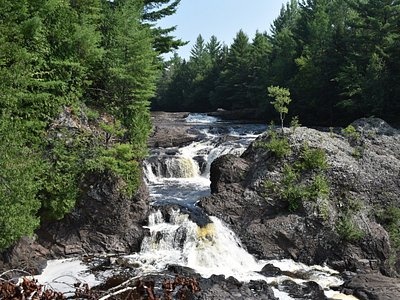
A second major draw is access to the Lake Superior shoreline, which lies only a short drive north. Saxon Harbor, about 10 miles west of Upson, offers a marina, beach, and campground where travelers can swim, launch a kayak, or simply watch Great Lakes freighters pass in the distance. The harbor is one of several small but scenic gateways along this stretch of the South Shore, where sandstone cliffs, waterfalls spilling into the lake, and broad sandy beaches reward those willing to wander the back roads.
In winter, the area transforms into a snow-sports destination, anchored by Whitecap Mountains ski resort, located roughly 15 minutes east of Upson near the Michigan state line. The resort offers downhill skiing, snowboarding, and Nordic trails, and it sits within the broader regional network of groomed snowmobile paths that connect northern Wisconsin and the Upper Peninsula. Just across the border, the historic Copper Peak ski flying hill in Ironwood, Michigan, adds another point of interest for visitors interested in the area's unusual athletic landmarks and mining-era history.
Taken together, Upson's blend of forest, lake, and mountain recreation, combined with its seclusion and easy access to the Highway 2 corridor, makes it a quietly appealing base for short-term rentals aimed at travelers seeking the outdoors without the crowds of Wisconsin's better-known resort towns.
Want to know if a property in Upson is a good investment?
Enter an address to get instant revenue potential and comps.