
Augusta, Wisconsin
Want to see how Augusta compares to other top cities in Wisconsin? Explore all city regulations in Wisconsin. →
Augusta, WI
Generally Investor Friendly
STR Regulations for Augusta, Wisconsin
Overview: Are short-term rentals allowed in Augusta, WI?
Yes—short-term rentals are allowed in Augusta, WI. Under the City of Augusta Zoning Ordinance (adopted June 9, 2015), lodging and boarding uses are recognized and regulated:
- In the Commercial (C) District, “boarding and lodging houses” are a principal permitted use (Section 3.5), which typically accommodates guest stays shorter than 30 days and may include basic hospitality services. Tourist homes are also referenced as a conditional use in the Commercial District when located on a state trunk or U.S. numbered highway (Section 4.6).
- In Residential Districts, home occupations are allowed as a conditional use (Section 4.5), but the ordinances also include specific allowances and limits tied to “boarders or lodgers” (e.g., “not over two (2) boarders or lodgers not members of the family” in R-1 and similar restrictions in RA). This signals a baseline occupancy limitation for rentals involving non-family guests in residential zones.
- Short-term rentals must comply with all building, fire, and life-safety codes and obtain a building permit prior to operation. They are also subject to statewide transient room tax (see State of Wisconsin section below).
- STRs are not permitted in industrial districts (I-1 and I-2), which are intended for manufacturing and related operations and not lodging.
Bottom line: STRs are permissible in the Commercial District under boarding/lodging uses (with conditional use requirements for tourist homes depending on highway location). In Residential Districts, hosting non-family guests may be permissible as a conditional home occupation, but must adhere to occupancy limits and conditional use approvals. In all cases, a building permit and compliance with safety codes are required.
What do Airbnb hosts actually earn in Augusta?
Augusta hosts earn a median $30,799/year with $308 ADR and 49% occupancy.
Top performers pull in $84,836+ per year.
See the full Augusta market breakdownHow to start a short-term rental business in Augusta, WI
-
Confirm your zoning and permissible use
- Identify your property’s zoning district (R-1, R-2, R-3, RA, A, C, I-1, I-2).
- STRs (boarding/lodging houses) are principally permitted in the Commercial District.
- In Residential Districts, hosting guests (boarders/lodgers) may require a conditional use permit as a home occupation, with strict occupancy limits; confirm with the Building Inspector or City Plan Commission.
-
Obtain the required building permit
- Submit a complete application to the Building Inspector:
- Property description (lot, block, subdivision or metes/bounds; address).
- Proposed use (boarding/lodging house or tourist home).
- Sewage and water plans (if municipal services are unavailable, approvals are required from the Public Works Superintendent).
- Site plan, floor plans, and any architectural documentation as needed.
- Fee: $200 permit fee plus $10 publication fee.
- The Building Inspector must grant or deny the permit within 30 days. The permit expires if substantial work does not commence within six months.
- Submit a complete application to the Building Inspector:
-
Comply with safety and life-safety standards
- Install and maintain smoke detectors, carbon monoxide detectors, and fire extinguishers as applicable.
- Ensure emergency exits are clearly marked and unobstructed.
- Maintain the property in good repair and comply with local building codes and health ordinances.
- Verify if additional inspections (fire, health, plumbing) are needed based on your use classification.
-
Register for state tax obligations (transient room tax)
- Register with the Wisconsin Department of Revenue (DOR) to collect and remit room tax on transient accommodations.
- File returns and remit taxes according to DOR schedules.
- For questions, contact the DOR at (608) 266-2776.
-
Set operating rules and protect your risk
- Adopt occupancy limits that align with your conditional use approval and zoning (especially in Residential Districts).
- Establish quiet hours (e.g., late evening to early morning) and neighbor-friendly policies.
- Consider obtaining short-term rental insurance to cover property damage, liability, and loss of income. Traditional homeowner’s policies often exclude short-term rental exposures.
Required documents, permits, licenses, and guidelines
-
Building permit application
- Required information: owner/applicant details, site description (lot/block/subdivision or metes/bounds), property address, proposed use, number of employees (if applicable), zoning district, sewage/water plans (if not served by municipal utilities), and any additional materials requested by inspectors.
- Fees: $200 building permit + $10 publication; submit fee receipt from the City Treasurer with the application.
- Validity: Permit expires in six months if substantial work has not commenced.
-
Conditional use permit (if required)
- Required for certain uses (e.g., tourist homes in the Commercial District on trunk or U.S. highways; home occupations in Residential Districts).
- Application must include names/addresses of applicant, owner, architect/engineer/contractor, site description, proposed operation/use, number of employees, zoning district, and notification to abutting property owners.
- Fee: $100 application fee.
- City Plan Commission holds a public hearing and may impose conditions (e.g., landscaping, architectural design, hours of operation, parking, lighting, traffic, deed restrictions).
-
Licensing and tax registration
- Obtain any necessary state-level transient room tax registration (DOR).
- Confirm whether a separate local business license is required for STR operations (contact the City Clerk).
-
Safety and maintenance standards
- Comply with building and housing codes, fire safety requirements, and health ordinances; plan for periodic inspections as required.
Specific regulations for short-term rentals (city, county, and state)
City of Augusta, WI — Zoning and operational requirements
-
Zoning allowances
- Commercial District: Boarding and lodging houses are a principal use (Section 3.5). Tourist homes are a conditional use when located on a state trunk or U.S. highway (Section 4.6).
- Residential Districts: “Home occupations” are conditional uses. Additional allowances for limited numbers of “boarders or lodgers not members of the family” (e.g., not over two) signal occupancy constraints; confirm specific limits with the City Plan Commission (Sections 3.3, 4.5).
- Industrial Districts: STRs are not a permitted use.
-
Building permits and inspections
- All STRs must obtain a building permit; the Building Inspector enforces zoning provisions and may coordinate with police for investigations.
- Sewage and water plans are required when municipal services are not available; approval from Public Works Superintendent is needed (Section 2.3).
-
Conditional uses and approvals
- Tourist homes (Commercial District) and home occupations (Residential Districts) require conditional use permits after review and a public hearing by the City Plan Commission. The Commission can impose conditions such as parking, landscaping, hours of operation, and deed restrictions (Section 4.0).
-
Performance standards
- Noise limits apply by district. Non-industrial districts have lower allowable sound levels than the I-2 Heavy Industrial District. All noise must be controlled to avoid nuisance conditions (Section 9.6).
- Additional performance standards cover glare/heat, odor, air pollution, vibration, and waste discharge (Sections 9.2–9.9).
-
Parking and traffic access
- Off-street parking must be provided at specified ratios and must meet dimensional, surfacing, and location standards (Section 5.3). Parking ratios for hotels/motels are 1 stall per guest room plus 1 stall per employee.
- Driveway and access standards apply, including minimum widths and visibility requirements (Sections 5.1–5.5).
-
Zoning violations and penalties
- Violations of the Zoning Ordinance may result in forfeitures of $10 to $200 plus costs; default may lead to imprisonment up to 30 days. Each day a violation continues constitutes a separate offense (Section 2.8).
- Enforcement may be pursued by the City Council, Building Inspector, City Plan Commission, or an affected property owner (Section 2.7).
-
Nonconforming uses
- Lawful nonconforming STRs may continue, but expansions or significant alterations are limited. Discontinuation for 12 months may eliminate nonconforming status; substantial damage (>50% assessed value) may require conformity (Section 8.0).
-
Board of Zoning Appeals
- The Board hears appeals, interprets zoning, and may grant variances or special exceptions as appropriate. Special exceptions generally expire after one year unless recertified (Section 10.0).
Eau Claire County (contextual references within Augusta’s ordinance)
- The City’s zoning references Wisconsin Statutes (Sections 61.35, 62.23(7)) and some standards tied to state codes (e.g., sewage disposal—Section H65 of the Wisconsin Administrative Code).
- Health-related approvals and inspections may involve Eau Claire County agencies; confirm whether county-level health permits or inspections are required for lodging operations.
State of Wisconsin — Taxes and general statutes
-
Transient room tax (room tax)
- Wisconsin imposes a room tax on the rental of transient accommodations (including STRs).
- Hosts must register with the Wisconsin Department of Revenue and collect and remit room tax according to state rules.
- Contact DOR at (608) 266-2776 for registration, filing guidance, and rates.
-
Wisconsin Administrative Code — sewage disposal
- On-site sewage disposal systems must comply with Section H65 of the Wisconsin Administrative Code; when public sewerage is not available, lot sizing and system design must meet state standards (Section 2.5).
Local authority contacts
-
City of Augusta — Building Inspector and Zoning Administration
- Phone: (715) 286-2555
- Mailing address: City of Augusta, 145 W. Lincoln St., Augusta, WI 54722
- Note: The Building Inspector enforces zoning, issues permits, and may coordinate with police on violations (Section 2.2).
-
City of Augusta — City Clerk
- Phone: (715) 286-2555
- Responsibilities: Permit records, zoning maps, public records, and license administration (as applicable).
-
City of Augusta — City Plan Commission and Zoning
- Phone: (715) 286-2555
- Role: Reviews conditional use permits, holds public hearings, and recommends conditions (Section 4.0).
-
Wisconsin Department of Revenue (DOR) — Room Tax
- Phone: (608) 266-2776
- Role: Registers transient accommodation providers, administers room tax.
Links to source pages
- Chapter 9 — Zoning Ordinance (City of Augusta, Eau Claire County, Wisconsin)
Practical notes for investors
- Prioritize the Commercial District for STRs if you seek fewer conditional use hurdles and a clear principal permitted use (boarding/lodging houses).
- In Residential Districts, prepare for a conditional use process and be prepared to operate within tight occupancy limits for non-family boarders/lodgers.
- Treat noise and parking as high-priority operational risks. Establish house rules and invest in sound insulation where appropriate.
- Maintain a compliance file with your building permit, conditional use approval (if applicable), safety certificates, tax registrations, and inspection reports. Renew or recertify approvals as required.
This guide relies on the City of Augusta Zoning Ordinance and statewide tax references. Because the ordinance was adopted in 2015 and subsequently amended (e.g., RA district updated in 2020), confirm any changes with the Building Inspector or City Plan Commission before investing.
Next step
Found a property in Augusta?
Paste any address and get estimated revenue, cash-on-cash return, and comparable STR performance in under 5 minutes. 3 free analyses per day.
Free brief
Get the free Augusta STR Investment Brief
Revenue data, top neighborhoods, seasonal trends, and the key regulations for Augusta, Wisconsin in one email.
Augusta
Market Saturation Score
Photos of Augusta
Overview of Augusta
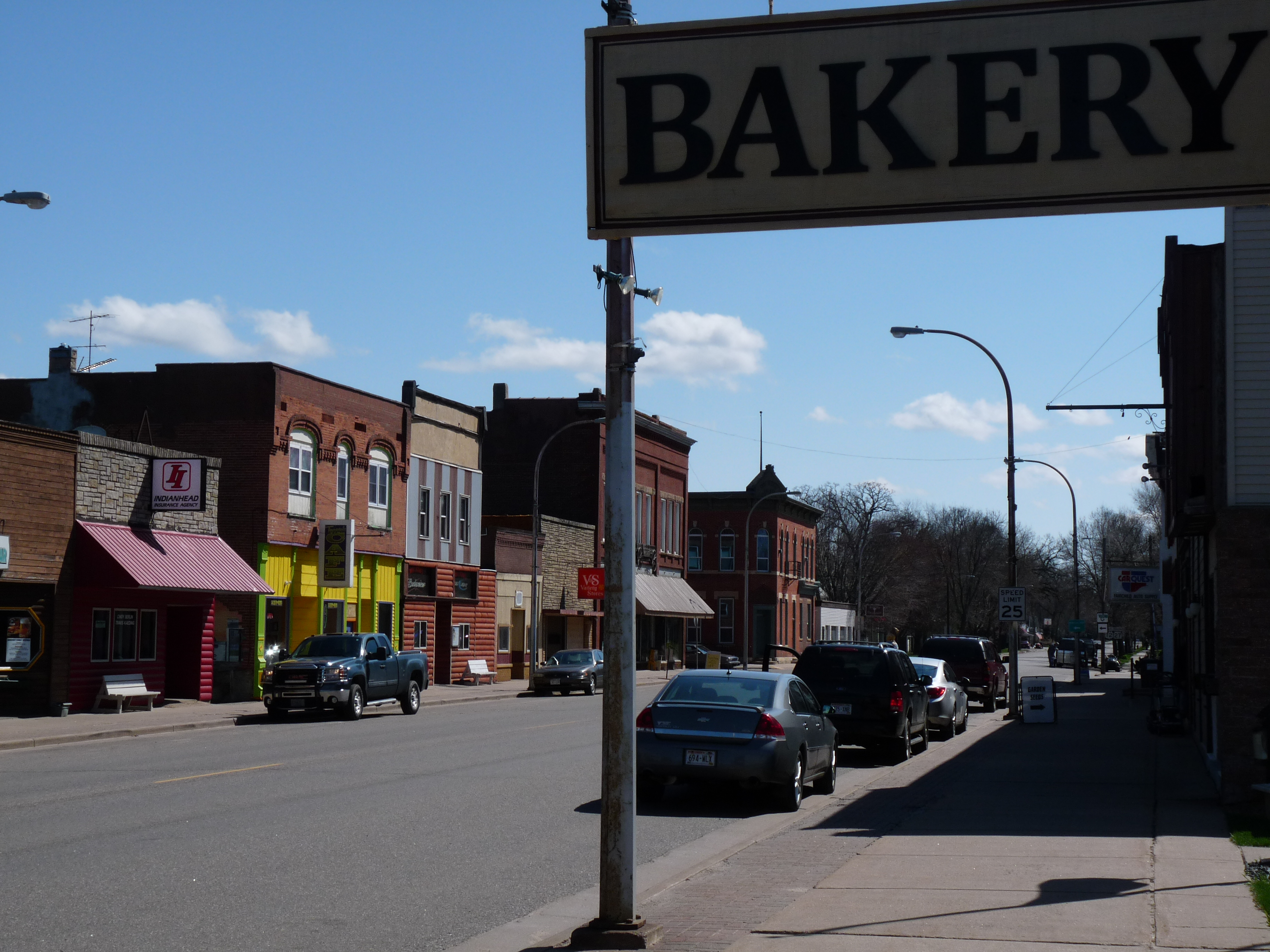
Augusta is a small city in Eau Claire County in west-central Wisconsin, with a population of roughly 1,500 residents. It sits in a rural, agricultural stretch of the Chippewa Valley, characterized by rolling farmland, wooded bluffs, and the meandering Eau Claire River. The community has a quiet, slow-paced character and is best known as a base for exploring the surrounding countryside rather than as a tourist destination in its own right. It lies approximately 25 miles southeast of Eau Claire, the nearest major city and the regional hub for shopping, dining, and cultural events in northwestern Wisconsin.
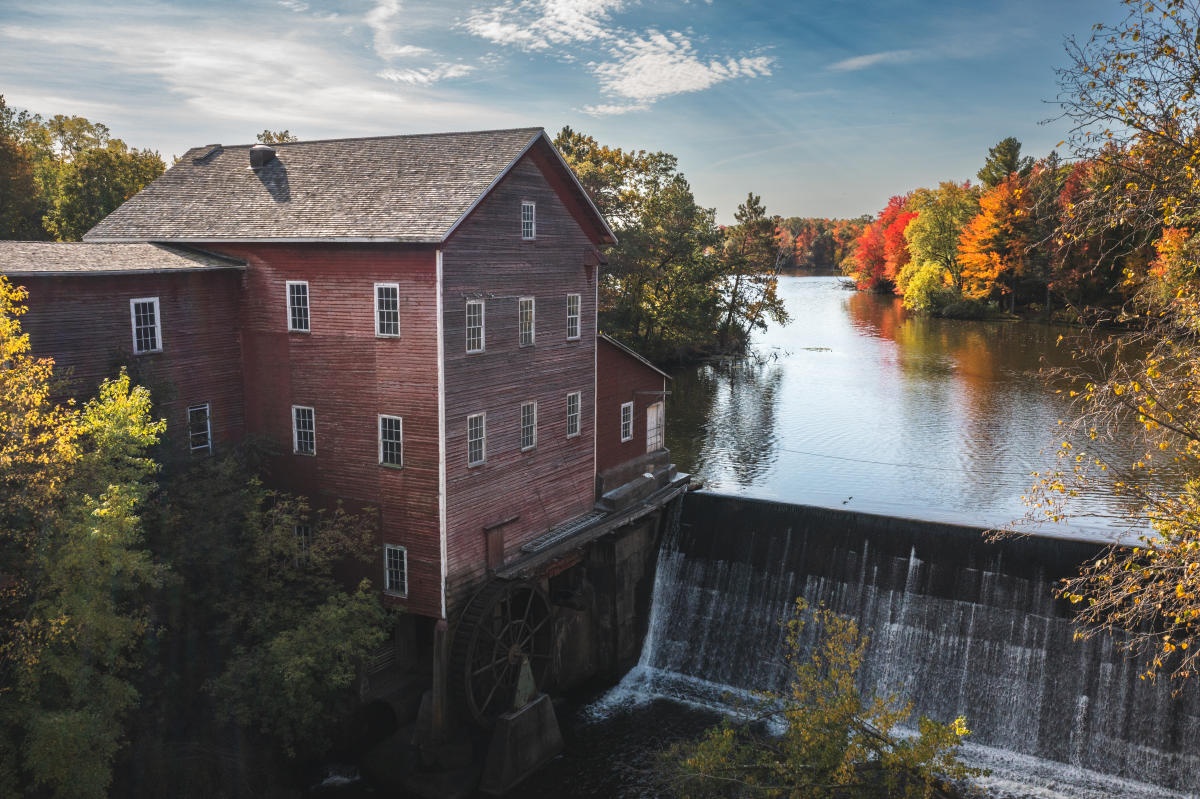
Dells Mill, located in the heart of Augusta, is one of the oldest operating gristmills in the state and serves as both a working museum and a living piece of nineteenth-century milling history. Visitors can tour the mill during the warmer months to see its original machinery in action and learn about the settlers who built the surrounding community. Because the mill sits just minutes from the city center, it is a natural anchor for guests staying in town.
Brunet Island State Park, situated along the Chippewa River roughly an hour's drive north of Augusta, offers camping, hiking, and paddling through a landscape of old-growth forest and quiet river islands. It draws visitors who want a more low-key alternative to Wisconsin's better-known state parks, and it pairs naturally with a stay in the Augusta area for travelers interested in fishing, canoeing, or simply being outdoors.
A short drive northwest brings guests to Eau Claire itself, a college town anchored by the University of Wisconsin–Eau Claire and a revitalized riverfront downtown. The Pablo Center at the Confluence hosts concerts, theater, and exhibitions year-round, while the city's bars, coffee shops, and bike trails along the Eau Claire River make it a popular side trip for visitors based in smaller communities like Augusta.
Augusta appeals to short-term rental owners because it offers an affordable, uncrowded slice of small-town Wisconsin within easy reach of the Chippewa Valley's larger attractions. Its rural setting, access to rivers and trails, and proximity to Eau Claire give travelers a comfortable home base for exploring the region, while the city's quiet character and modest cost of entry make it an approachable market for owners looking to serve guests who value space, scenery, and a slower pace.
Want to know if a property in Augusta is a good investment?
Enter an address to get instant revenue potential and comps.