
Goldendale, Washington
Want to see how Goldendale compares to other top cities in Washington? Explore all city regulations in Washington. →
Goldendale, WA
Challenging To Investors
STR Regulations for Goldendale, Washington
Overview: Are STRs allowed in Goldendale, WA?
- City-level rules: No city‑specific short‑term rental ordinance was identified in the provided material. Goldendale appears to have no local STR licensing or operating rules captured here.
- County/state implications: STRs are governed by Klickitat County zoning (if the property is in the county) and by Washington State law (taxes, consumer protection). Within Klickitat County, the zoning code contains “renting of rooms” allowances in many residential and rural districts (often limited to two roomers and only in an owner‑occupied dwelling). Whole‑unit STRs are not expressly identified as a permitted principal use in residential zones in the excerpt provided. In contrast, traditional lodging uses (hotels/motels, RV parks/campgrounds) are allowed by right in the Tourist Commercial (TC) zone. Investors must confirm the zoning of any prospective property and whether the intended STR operation is a principal use or a “room‑renting” accessory use.
- Bottom line: STRs are likely allowed under limited “room‑renting” scenarios in certain residential and rural zones when the owner occupies the dwelling and the operation stays within the two‑roomer limit. Whole‑unit STR operations generally fit within hotel/motel/campground categories in the TC zone (and not in multifamily residential R‑3), but investors should verify site‑specific zoning with Klickitat County before acquisition or conversion.
How to start a short‑term rental business in this market
- Confirm zoning and principal use status
- Identify whether the subject parcel lies inside the City of Goldendale or in unincorporated Klickitat County. If the City has no STR ordinance (as appears in the materials provided), verify whether county zoning applies.
- Determine if your STR concept qualifies as: a) “Renting of rooms” (an accessory use to a principal dwelling), typically limited to two roomers and in an owner‑occupied dwelling; or b) A principal lodging use (hotel/motel, RV park/campground) in the Tourist Commercial (TC) district.
- Confirm density, setbacks, height, and parking for the underlying zone (e.g., R‑1/R‑2/R‑3, SR, RR, GR, EA, FR, OS, RC, GC, TC).
- Verify compliance with residential intent and parking
- In residential zones, accessory room‑rental is the model used in the code. Expect residential character to be maintained (e.g., one off‑street parking space per dwelling unit as a baseline; some zones set specific standards).
- RV/camping activities and transient lodging do not align with residential district intents. If you plan a campground/RV park or hotel‑type use, the TC district is the proper zoning setting.
- Obtain required approvals if the use is conditional
- Some uses require a Board of Adjustment conditional use approval or a site plan (notably, certain Industrial Park uses and any use not expressly permitted outright).
- File state tax registrations and collect applicable lodging taxes
- Register with the Washington State Department of Revenue (DOR) for:
- Vacation rental tax (often called “transient rental tax” or lodging tax) and a tax registration endorsement; and
- State sales tax collection/remittance on gross receipts.
- City/county lodging taxes may also apply. Collect and remit any applicable local lodging taxes where your property is located.
- Register with the Washington State Department of Revenue (DOR) for:
- Implement consumer protection requirements (RCW 64.37)
- Post the unit address and contact information for the responsible party.
- Provide emergency information and rules (quiet hours, occupancy, parking).
- Install functioning smoke and carbon monoxide alarms and at least one ABC fire extinguisher.
- Display an evacuation plan. Do not rent for fewer than 30 days if the property lacks adequate life safety measures (sprinklers or alarms) per RCW 64.37.040.
- Confirm utilities, critical areas, and scenic overlays
- Check if the site lies within overlays such as the Columbia River Gorge National Scenic Area, Flood Hazardous, Scenic Design, View Protection, Illumination Control, or Airport Approach Zones. Some overlays impose special height, lighting, and development standards that affect STR development.
- Build a compliance file
- Keep zoning determination letters, tax registrations, posted notices, insurance, leases, guest rules, and a safety checklist on hand for county and state inspectors.
Documents, permits, licenses, and guidelines
- Zoning verification
- Written confirmation from Klickitat County Planning & Zoning that the intended use is permitted (either as an accessory room‑rental or as a principal lodging use in a proper zone).
- If the use is conditional, secure Board of Adjustment approval or site plan approval as required by the zoning district.
- Washington State requirements
- DOR registration for vacation rental (lodging) tax and a tax registration endorsement; sales tax registration if applicable.
- Consumer protection compliance per RCW 64.37 (postings, life‑safety equipment, emergency information).
- Business and tax administration
- Local business license (if the city requires one; not found in the provided materials).
- Lodging tax remittances (state and any local lodging taxes).
- Life safety and property standards
- Functioning smoke and CO alarms; at least one ABC fire extinguisher; an evacuation plan posted inside the unit.
- Insurance
- Maintain property and liability coverage appropriate for short‑term occupancy.
Klickitat County zoning constraints by district (high‑interest zones)
- Residential zones (R, R‑1/R‑2/R‑3)
- Accessory “renting of rooms” is explicitly allowed in R and R‑1/R‑2 (up to two roomers in the owner‑occupied dwelling). No provision here authorizes whole‑unit STRs as a principal use in these residential zones.
- R‑3 explicitly excludes “motels or other facilities offered on a transient tenancy basis.” This signals that STR operations conducted as a lodging business are inconsistent with the R‑3 residential intent.
- Suburban Residential (SR) and Rural Residential (RR)
- Accessory “renting of rooms” permitted in SR and RR (up to two roomers). No express allowance for whole‑unit STRs in the provided text.
- Extensive Agriculture (EA) and General Rural (GR)
- Accessory “renting of rooms” permitted (up to two roomers).
- Forest Resource (FR) and Open Space (OS)
- No explicit short‑term rental provisions; dwelling units are allowed under specific conditions (e.g., minimum lot size, number of dwellings). The provided text does not show an accessory room‑rental allowance in FR/OS.
- Rural Center (RC), General Commercial (GC), Tourist Commercial (TC)
- TC allows hotels/motels and RV parks/campgrounds (short‑term lodging) by right; this is the clearest pathway to a whole‑unit lodging operation. RC and GC provide many commercial/retail uses but do not contain explicit STR allowances in the excerpted material.
- Industrial Park (IP) and General Industrial (GI)
- Residential lodging uses are not permitted. IP explicitly prohibits human habitation except caretaker quarters. GI similarly restricts habitation to caretaker use.
- Parking and density
- Most residential districts set one off‑street parking space per dwelling unit as a baseline. Commercial and TC districts have parking ratios tied to floor area (e.g., TC at 2 square feet of parking per 1 square foot of floor space).
- Overlays and scenic areas
- Portions of Klickitat County are within the Columbia River Gorge National Scenic Area. Development there is subject to Gorge Commission rules that supersede county rules. Applicants are advised to consult the Commission directly for any ground‑disturbing or structural development related to an STR.
State‑level regulations for Washington (summary for STRs)
- Consumer protection (RCW 64.37)
- Responsible party contact must be posted inside and outside the unit.
- Guests must be provided emergency information and occupancy rules.
- Smoke and carbon monoxide alarms and at least one ABC fire extinguisher are required; an evacuation plan must be posted.
- Properties without sprinklers or alarms cannot be rented for fewer than 30 days.
- Taxation
- Vacation rental lodging tax (transient rental tax) and sales tax generally apply to short‑term rentals. Register and collect/remit through the Washington State Department of Revenue.
- Local lodging taxes may also apply; confirm with local authorities where the property is located.
- Municipal authority
- Washington cities and counties may adopt additional STR regulations (licensing, caps, safety standards). The provided materials do not include Goldendale‑specific rules; investors should verify whether Goldendale has adopted any since this guide’s knowledge cutoff.
Contact information
- Klickitat County Planning & Zoning
- Phone: 509‑773‑5703
- Address: 228 W. Main St., Suite B, Goldendale, WA 98620
- Official Zoning Ordinance: www.klickitatcounty.gov/DocumentCenter/View/15693/1-Zoning-Ordinance-Amended-11-21-2023
- Note: The Klickitat County page includes coverage for the City of Goldendale’s area of interest; however, Goldendale is an incorporated city and would adopt its own municipal regulations if any.
- Washington State Department of Revenue (DOR)
- Vacation rental (lodging) tax and tax registration endorsement information is maintained by DOR. Consult the DOR website for current instructions and forms.
- City of Goldendale (city-level confirmation)
- City Hall (general contact; verify any local licensing or lodging tax if applicable)
- Phone: 509‑773‑4403
- Address: 930 S. Roosevelt St., Goldendale, WA 98620
Links to source pages
- Klickitat County Zoning Ordinance (as amended 11/21/2023): www.klickitatcounty.gov/DocumentCenter/View/15693/1-Zoning-Ordinance-Amended-11-21-2023
Important notes
- This guide reflects the zoning code excerpt and general Washington State requirements available in the provided material. Goldendale’s city‑specific STR rules (if any) were not included here. Investors should obtain written zoning confirmation and current tax requirements before acquiring or operating an STR. If your intended STR is a whole‑unit lodging use rather than accessory room‑renting, the Tourist Commercial district is the primary viable pathway based on the county zoning text provided.
What do Airbnb hosts actually earn in Goldendale?
Goldendale hosts earn a median $30,538/year with $166 ADR and 61% occupancy.
Top performers pull in $41,548+ per year.
See the full Goldendale market breakdownNext step
Found a property in Goldendale?
Paste any address and get estimated revenue, cash-on-cash return, and comparable STR performance in under 5 minutes. 3 free analyses per day.
Free brief
Get the free Goldendale STR Investment Brief
Revenue data, top neighborhoods, seasonal trends, and the key regulations for Goldendale, Washington in one email.
Goldendale
Market Saturation Score
Photos of Goldendale


Overview of Goldendale
Goldendale is a small, sunny city in south-central Washington, serving as the county seat of Klickitat County. With a population of roughly 3,400, the town has the feel of a rural high-desert community, surrounded by rolling ranch land, basalt cliffs, and big open skies on the eastern slopes of the Cascades. It is best known as a gateway to the wider Columbia River Gorge and the surrounding wine country, and for the Goldendale Observatory, which draws visitors from across the Pacific Northwest. Goldendale sits about 110 miles east of Portland, Oregon, and roughly four hours southeast of Seattle, making it a convenient stopover for travelers exploring the Gorge or the Washington side of the Columbia.
One of the area's marquee attractions is the Goldendale Observatory State Park, a hilltop public observatory a short drive north of town that hosts evening star parties and daytime solar viewing. Built in the 1970s and recognized for its historically significant 24.5-inch telescope, the observatory remains a popular draw for families and amateur astronomers, and it gives the town a distinctive identity that sets it apart from other small Gorge communities.
Just downriver to the east, roughly a 20- to 30-minute drive from Goldendale, the Maryhill Museum of Art anchors a cluster of cultural and scenic stops along the Washington side of the Columbia. The museum, an early-20th-century mansion turned art museum, features rotating exhibitions, a collection of Native American artifacts, and works by European and American artists, all set on a bluff overlooking the river. Adjacent to the museum is the Maryhill Stonehenge, a full-scale concrete replica of the English original, built as a World War I memorial and now part of Washington State Parks. Travelers often pair the two with a stop at the adjacent Maryhill State Park, where the river widens and the basalt palisades of the Gorge come into view.
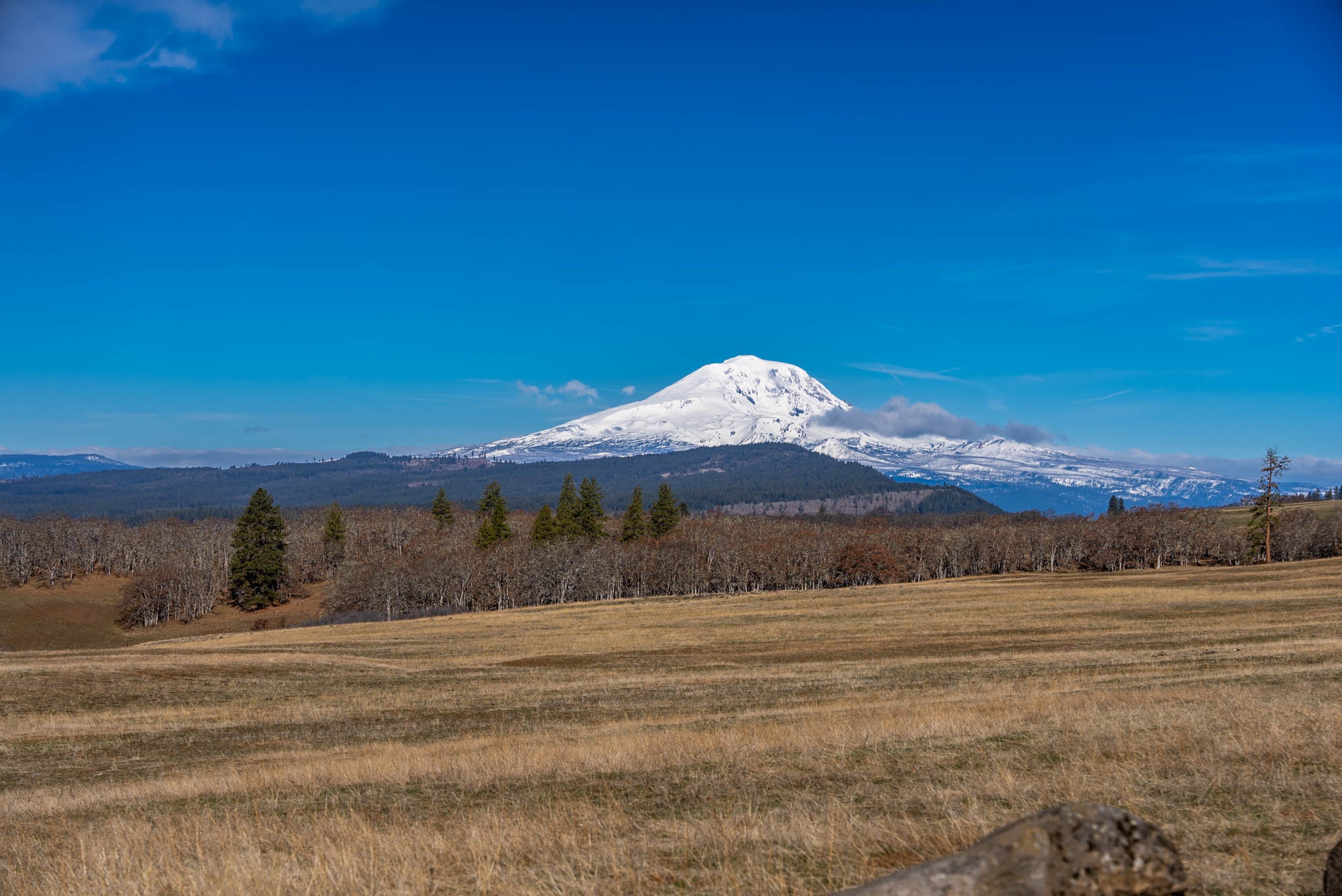
West of town, drivers descend into the heart of the Columbia River Gorge National Scenic Area, a roughly hour-long drive that passes waterfalls, windsurfing beaches, and the orchards and wineries of the lower Columbia. The route connects Goldendale to the larger tourist hubs of Hood River and Cascade Locks, while the highlands to the north rise toward the snowfields of Mount Adams, a popular destination for hiking and climbing in the warmer months.
Goldendale's combination of small-town quiet, surprisingly clear night skies, and proximity to some of the most distinctive cultural and natural sites in the Pacific Northwest makes it a natural base for short-term rentals. Visitors who stay in the area tend to use the town as a launching point for a broader Gorge itinerary, taking in observatory star parties, museum visits, river viewpoints, and wine-country drives before returning to a quieter pace at the end of the day.
Want to know if a property in Goldendale is a good investment?
Enter an address to get instant revenue potential and comps.