
White River Junction, Vermont
Want to see how White River Junction compares to other top cities in Vermont? Explore all city regulations in Vermont. →
White River Junction, VT
Generally Investor Friendly
STR Regulations for White River Junction, Vermont
Overview: Are short-term rentals allowed in White-River-Junction, VT?
Yes. Short-term rentals (STRs) are explicitly allowed in Vermont, including in the White-River-Junction area. Vermont defines a short-term rental as a furnished house, condominium, or other dwelling room or self-contained unit rented to the traveling or vacationing public for fewer than 30 consecutive days and more than 14 days per calendar year. A 3% Vermont short-term rental surcharge applies to these rentals, in addition to the 9% Vermont Rooms Tax and any applicable 1% Local Option Tax. The surcharge took effect for rents collected on or after August 1, 2024. Platforms and independent hosts have different compliance responsibilities.
State-level rules govern here; no city-specific STR ordinance was identified in the provided sources. Zoning, homeowners’ association rules, or municipal bylaws may still apply and should be verified locally before listing.
What do Airbnb hosts actually earn in White River Junction?
White River Junction hosts earn a median $35,008/year with $338 ADR and 49% occupancy.
Top performers pull in $57,542+ per year.
See the full White River Junction market breakdownHow to start a short-term rental business in this market
- Classify your operation
- Determine how many units/rooms you will offer and whether you will prepare food on-site.
- If you will offer three or more guest units or fewer than three units while preparing food for guests, you must obtain a lodging establishment license from the Vermont Department of Health (VDH) Food & Lodging Program. Short-term rentals offering one or two units and not preparing food do not need a VDH lodging license but must comply with the Vermont Rental Housing Health and Safety Code enforced by the Vermont Division of Fire Safety.
- Decide on distribution channels
- If you list exclusively on a platform (Airbnb, Vrbo, etc.), the platform must register with the Vermont Department of Taxes, collect Rooms Tax, any Local Option Tax, and the 3% STR surcharge, and remit those amounts. You do not need a separate tax account if you do not rent independently off-platform.
- If you take bookings outside of platforms (phone, direct website, walk-in), you must register with the Vermont Department of Taxes (free) and collect/remit the Rooms Tax, any Local Option Tax, and the 3% surcharge yourself via Form MRT-441.
- Set up state tax accounts
- Register your business with the Department of Taxes at www.myvtax.vermont.gov if you will rent independently off-platform.
- File and pay electronically using Form MRT-441; returns are due monthly by the 25th day following the reporting period.
- Obtain required health and safety authorizations
- If your property has a private water system, conduct total coliform and E. coli testing with a certified lab and provide acceptable results (< 1 year old) as part of any required licensing.
- Secure wastewater permits or exemptions as required; use the Department of Environmental Conservation (DEC) permit search tool or contact a DEC regional office.
- Confirm any fire safety, electrical, or plumbing inspections required for rental housing or lodging per state rules.
- Confirm local compliance
- Since no city-specific STR ordinance is provided here, verify zoning, business licensing, and any municipal registration requirements with Hartford (town) officials. If applicable, confirm whether a local option rooms tax applies and whether your listing requires local permits or business licenses.
Required documents, permits, licenses, and guidelines
- Lodging Establishment License (VDH)
- Required if you offer three or more guest units, or fewer units while preparing food for guests.
- Submit complete application at least 30 days before opening (online portal or paper application); pass an opening inspection; post the license at the physical location.
- Submit water test results for private water systems (total coliform and E. coli) less than one year old.
- Provide wastewater permit or exemption documentation in most cases.
- Short-Term Rental (no VDH lodging license)
- If you offer one or two units and do not prepare food on-site, you are not required to obtain a VDH lodging license, but you must comply with the Vermont Rental Housing Health and Safety Code and Fire Safety requirements for STRs.
- Tax obligations
- Form MRT-441 (Meals and Rooms Tax Return) to remit the 9% Rooms Tax, any applicable 1% Local Option Tax, and the 3% short-term rental surcharge.
- Register for a tax account if you rent independently off-platform.
- Electronic filing/payment via myVTax is mandatory for businesses remitting the STR surcharge.
- Health and safety documentation
- Water testing and wastewater permitting as described above.
- Fire Safety inspections/requirements per Vermont Division of Fire Safety.
- Follow the Licensed Lodging Establishment Rule if you operate a licensed lodging establishment.
- Food service licensing
- If you serve anything other than prepackaged items, whole fruit, or coffee, a separate retail food service license is required.
Specific regulations for short-term rentals (city, county, state)
- State of Vermont
- Definition and scope: STRs are dwellings rented to transients for fewer than 30 consecutive days, more than 14 days per calendar year; includes entire units and single rooms; a stay of 30+ consecutive days creates a permanent resident status under different rules.
- Rooms Tax: 9% on lodging; applies once rentals total more than 14 days in a calendar year.
- Short-term rental surcharge: 3% surcharge effective for rents collected on or after August 1, 2024; remitted on MRT-441; applies to non-licensed STRs (platform or independent).
- Local Option Tax: 1% in some municipalities; Vermont does not list specific towns in the provided sources; confirm locally for Hartford/Windsor County if applicable.
- Platforms vs independent rentals:
- Platforms must register and collect Rooms Tax, Local Option Tax, and the 3% surcharge; hosts renting only on platforms do not need a separate tax account.
- Independent operators must register with the Department of Taxes and file MRT-441 for the same taxes.
- Lodging license threshold: VDH lodging license required for three or more guest units or for fewer units if food is prepared on-site; STRs with one or two units and no on-site food are not required to have a VDH lodging license but must comply with health and safety standards enforced by the Division of Fire Safety.
- Health and safety codes: STRs are subject to the Vermont Rental Housing Health and Safety Code; the Division of Fire Safety investigates complaints and inspects STRs for compliance.
- Due dates and remittance: Monthly returns due by the 25th day of the month following the reporting period; electronic filing/payment required.
- Windsor County / Hartford (White-River-Junction)
- No city-specific STR ordinance or local authority for STRs was identified in the provided content. Confirm zoning and local registration with the town of Hartford. Local option rooms tax status should be verified with the Department of Taxes or Hartford officials.
- Taxation summary
- 9% Vermont Rooms Tax + 3% STR surcharge, plus 1% Local Option Tax if applicable.
- Rentals booked before August 1, 2024 but collected on or after that date are subject to the 3% surcharge; rents collected before August 1, 2024 are not subject to the surcharge even if stays occur after August 1.
Contact information
- Vermont Department of Taxes (Meals and Rooms Tax and STR surcharge)
- Phone: 802-828-2865 (Taxpayer Services; Mon, Tue, Thu, Fri 7:45 am–4:30 pm)
- Commissioner’s Office: 802-828-2505
- Address: Taxpayer Assistance Window, 1st Floor Lobby, 133 State Street, Montpelier, VT 05602
- Online: www.myvtax.vermont.gov
- Department Directory: tax.vermont.gov/directory
- Vermont Department of Health — Food & Lodging Program (lodging licensing)
- Phone: 802-863-7221 or 800-439-8550 (toll-free within Vermont)
- Email: [email protected]
- Mailing Address: VT Dept of Health, Environmental Health, Food & Lodging Program, 280 State Drive, Waterbury, VT 05671-8350
- Find your inspector: experience.arcgis.com/experience/d22b26b8a1cb418287b3717b6d662445
- Vermont Division of Fire Safety (STR health and safety compliance)
- Website: firesafety.vermont.gov/
- Department of Environmental Conservation (wastewater permits)
- Permit search: anrweb.vt.gov/DEC/WWDocs/Default.aspx
- Regional office contacts: dec.vermont.gov/water/ww-systems#romap
- Department of Taxes — Local Option Tax page (to confirm local applicability)
- Vermont Secretary of State (business name registration)
- Website: sos.vermont.gov/
- White-River-Junction Local Health Office (VDH)
- Website: www.healthvermont.gov/local/white-river-junction
- Phone: 800-464-4343 or 802-863-7200
- Note: This office provides local public health services; it does not administer STR permits or taxes.
Links to source pages
- Vermont Department of Taxes — Short-Term Rentals: tax.vermont.gov/business/industry/short-term-rentals
- Vermont Department of Health — Lodging Establishments: www.healthvermont.gov/environment/food-lodging-program/lodging-establishments
- Vermont Department of Health — Local Health Offices (White River Junction): www.healthvermont.gov/local/white-river-junction
Compliance checklist
- Confirm unit count and whether food will be prepared on-site to determine licensing pathway (VDH lodging license vs. STR health/safety compliance).
- Register with the Department of Taxes if you will rent independently off-platform.
- Set up electronic filing/payment for MRT-441 and the 3% surcharge.
- Verify if a local option tax applies and confirm any local zoning or registration requirements.
- Complete water testing (if on private water) and wastewater permitting.
- Review and comply with Vermont Rental Housing Health and Safety Code (Division of Fire Safety) and any fire/electrical/plumbing inspection requirements.
Next step
Found a property in White River Junction?
Paste any address and get estimated revenue, cash-on-cash return, and comparable STR performance in under 5 minutes. 3 free analyses per day.
Free brief
Get the free White River Junction STR Investment Brief
Revenue data, top neighborhoods, seasonal trends, and the key regulations for White River Junction, Vermont in one email.
White River Junction
Market Saturation Score
Photos of White River Junction


Overview of White River Junction
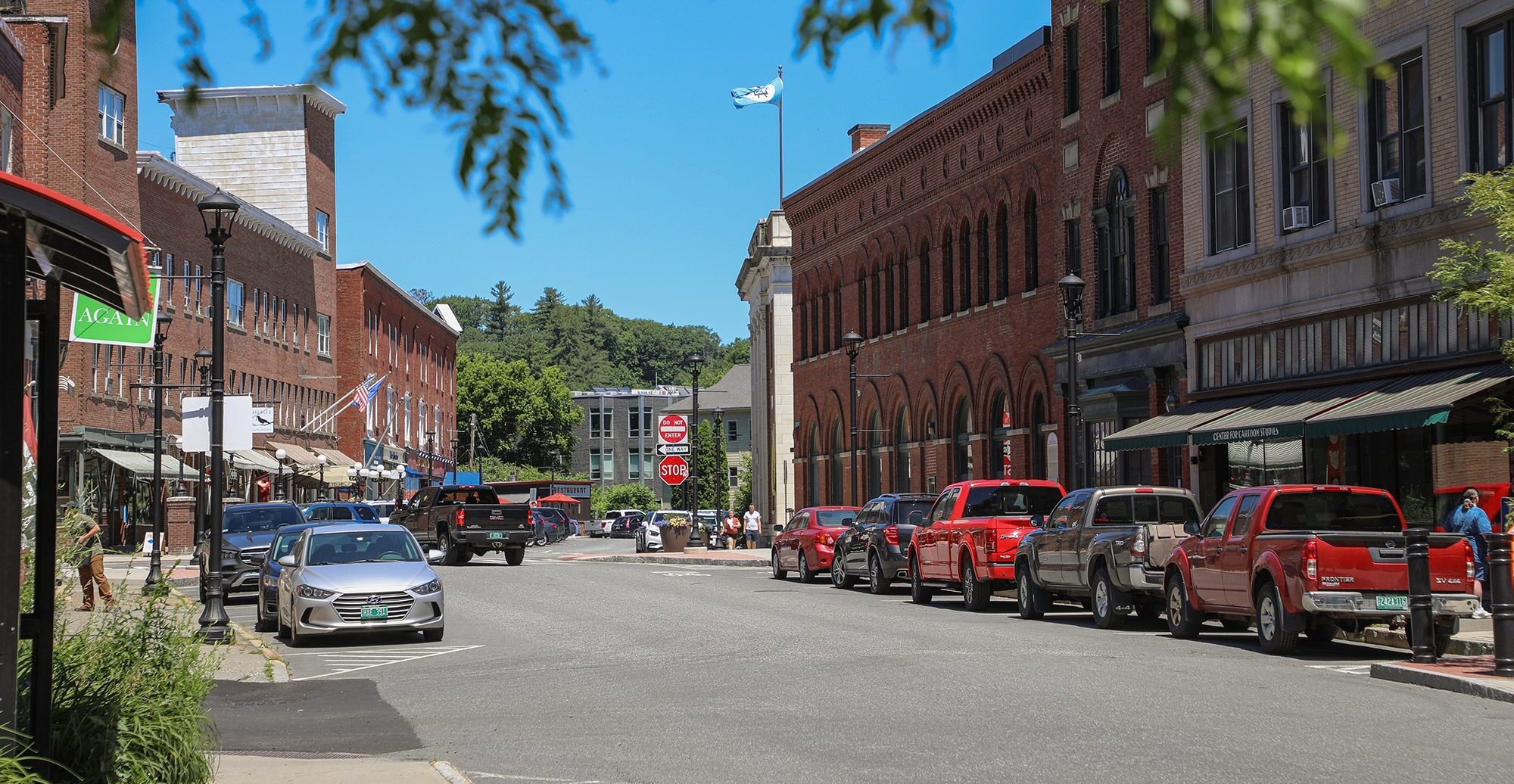
White River Junction is a small village in the town of Hartford, in Windsor County, Vermont, with a population of roughly 2,500 residents. Sitting at the confluence of the White River and the Connecticut River, it has the feel of a classic New England mill town that has been rediscovered as a creative hub, with a walkable Main Street lined with independent restaurants, galleries, a renovated opera house, and vintage shops. The village functions as the commercial and cultural heart of the Upper Valley, the cross-border region shared with New Hampshire, and it is often used as a gateway to Vermont's ski areas, covered bridges, and fall foliage routes. It lies about 130 miles northwest of Boston and roughly 50 miles south of Montpelier, sitting just across the river from Hanover, New Hampshire, home of Dartmouth College.
A short drive west leads to the Quechee Gorge, often called Vermont's Little Grand Canyon, where the Ottauquechee River cuts a dramatic 165-foot chasm through bedrock. Hiking trails rim the gorge and the village of Quechee, about 15 minutes from White River Junction, also hosts the Vermont Institute of Natural Science, a raptor rehabilitation center with outdoor exhibits and walking trails that are especially popular with families.
About 20 minutes north, the town of Woodstock offers a picture-perfect covered-bridge-and-green setting and is home to the Billings Farm & Museum, a working dairy farm and museum that preserves 19th-century Vermont agricultural life. Woodstock's main street, with its white-steepled churches and locally owned inns, anchors one of the most photographed towns in New England.
Just across the Connecticut River in Norwich, Vermont, the headquarters and café of King Arthur Baking Company draws food-focused visitors, while a few miles upriver in Hanover, the Dartmouth College campus offers a leafy walk along the river, the Hood Museum of Art, and a steady calendar of lectures, performances, and sporting events. In winter, several of Vermont's well-known ski areas, including Killington and Pico, are roughly 45 minutes to the west, with smaller hills like Suicide Six closer at hand.
For short-term rental owners, White River Junction offers a year-round draw: it is centrally located at the intersection of Interstates 89 and 91, putting guests within easy reach of skiing, hiking, fall foliage, and Dartmouth events, while the village itself provides the kind of walkable, locally flavored base that travelers increasingly prefer. The combination of small-town character, regional connectivity, and a deep bench of nearby attractions makes it a quietly compelling spot to invest in a vacation rental.
Want to know if a property in White River Junction is a good investment?
Enter an address to get instant revenue potential and comps.