
Carthage, Tennessee
Want to see how Carthage compares to other top cities in Tennessee? Explore all city regulations in Tennessee. →
Carthage, TN
Generally Investor Friendly
STR Regulations for Carthage, Tennessee
(Based solely on the municipal code excerpt you supplied and the statutory references it contains.)
1. Overview – Are Short‑Term Rentals Allowed?
Explicit answer: Yes – short‑term rentals are allowed in Carthage, Tennessee.
The Carthage Municipal Code (the most recent version you provided is Change 4, June 27, 2013) contains no specific prohibition against renting residential property for periods of less than 30 days. The only relevant provisions are the general‑business‑license requirements (Title 5, Chapter 3) and the fire‑code compliance rules (Title 7). Because a short‑term‑rental operation is a commercial activity, it must obtain the same business privilege license that any other “vocation, occupation, or business” must have, and it must satisfy all fire‑ and building‑safety standards that apply to lodging facilities.
Bottom‑line: If you obtain the required business license, meet zoning (Title 14, referenced but not detailed in the excerpt), and comply with the fire code and any applicable building‑code permits, you may operate a short‑term rental in Carthage.
What do Airbnb hosts actually earn in Carthage?
Carthage hosts earn a median $23,364/year with $141 ADR and 46% occupancy.
Top performers pull in $30,113+ per year.
See the full Carthage market breakdown2. How to Start a Short‑Term Rental Business in Carthage
| Step | What to Do | Why It Matters (Code‑Reference) | |------|------------|---------------------------------| | 1. Verify Zoning Eligibility | Confirm that the property is located in a zoning district that permits lodging or short‑term rental uses. Zoning is covered in Title 14 (referenced in the Table of Contents). | Title 14 is the authority that decides which land uses are allowed; you must be in a compatible zone. | | 2. Secure a Business Privilege License | Apply for the privilege license required by Title 5‑302. The City Recorder (Sara Davenport) issues the license after the privilege tax (Title 5‑301) is paid. | Any “vocation, occupation, or business” that is taxable by the municipality must hold a current privilege license. | | 3. Pay the Annual Privilege Tax | The privilege tax is levied at the maximum rate allowed by Tennessee law (Tennessee Code Annotated § 67‑4‑701 et seq., referenced in Title 5‑301). | Failure to pay eliminates the legal right to operate. | | 4. Obtain any Required Building Permits / Inspections | If you plan structural changes, additions, or changes of use, a building permit must be obtained from the Building Department (Title 12). The property must pass a Certificate of Occupancy (CO) inspection. | Short‑term rentals are “lodging facilities” and must meet all building‑code standards for habitable space, egress, fire safety, etc. | | 5. Meet Fire‑Code Requirements | Ensure compliance with the Fire Code (Title 7). The town’s fire district is defined as the entire corporate limits (Title 7‑101). Install smoke detectors, fire extinguishers, emergency egress lighting, and any other equipment mandated by the fire‑code provisions (Title 7‑2). | Failure to meet fire‑code standards can result in citations or closure. | | 6. Register for State‑Level Taxes | Tennessee levies sales tax (≈ 7 %) and a hotel‑occupancy tax on rentals of < 30 days (Tennessee Code Annotated §§ 67‑6‑101, 103). Register with the Tennessee Department of Revenue (TDR). | Required by state law for all transient‑accommodation businesses. | | 7. Comply with County Taxes | Smith County may impose an additional occupancy tax (county‑level; not detailed in the municipal code). Contact the Smith County Tax Collector’s Office for the current rate and filing procedures. | Most Tennessee counties charge a modest occupancy tax on short‑term stays. | | 8. Obtain Insurance | Purchase general liability and property‑damage insurance covering short‑term rentals. While not codified in the municipal code, it is a standard requirement for lenders and for protecting the business. | Provides financial protection and satisfies most platform (Airbnb, Vrbo) requirements. | | 9. Ongoing Compliance | • Renew the privilege license annually (Title 5‑302). <br>• File state sales‑tax and occupancy‑tax returns each reporting period. <br>• Keep fire‑safety equipment inspected as required by the fire marshal. | Ongoing compliance avoids fines or revocation of the license. |
3. Required Documents, Permits, Licenses & Guidelines
| Document / Permit | Issuing Authority | Code / Statute | Key Requirement | |-------------------|-------------------|----------------|-----------------| | Business Privilege License | City Recorder (Sara Davenport) | Title 5‑302 | Must be posted at the rental property; renewed yearly. | | Privilege Tax Payment | City Recorder / Town Treasurer | Title 5‑301 (max. rate per TCA § 67‑4‑701) | Pay the amount determined by the town’s tax schedule. | | Building Permit (if alterations) | Building Department (Title 12) | Title 12 (Building & Housing Codes) | Required for structural changes, new egress, or changes of use. | | Certificate of Occupancy (CO) | Building Department | Title 12 (CO issuance) | Verifies the unit meets habitability & safety standards. | | Fire‑Code Compliance Checklist | Fire Department / Fire Marshal (Title 7‑2) | Title 7‑2 (Fire Code) | Smoke detectors, fire extinguishers, emergency lighting, egress routes. | | Zoning Approval / Determination | Planning & Zoning (Title 14) | Title 14 (Zoning) | Confirms the property is in a zone that permits lodging/STR. | | State Sales‑Tax Registration | Tennessee Department of Revenue | TCA § 67‑6‑101 | Required to collect & remit sales tax on nightly rates. | | State Hotel‑Occupancy Tax Registration | Tennessee Department of Revenue | TCA § 67‑6‑103 | Required to collect & remit the 5 % state occupancy tax (applies to stays < 30 days). | | County Occupancy Tax (if applicable) | Smith County Tax Collector | County ordinance (outside municipal code) | Usually a modest per‑night surcharge (varies by county). | | Insurance Policy (General Liability, Property) | Private insurer (no statutory citation) | Standard business practice | Proof of coverage may be required by platforms and financing entities. |
4. Specific Regulations – City, County & State
4.1. City of Carthage (Municipal Code)
| Regulation | Code Section | Summary | |------------|--------------|---------| | Business Privilege License | Title 5‑302 | Any business operating in the town must obtain a current privilege license from the City Recorder. | | Privilege Tax | Title 5‑301 | The town levies an annual privilege tax at the maximum rate permitted by Tennessee law on all taxable businesses. | | Fire District | Title 7‑101 | The entire corporate limits constitute the fire district; all lodging facilities must meet the fire‑code requirements. | | Fire Code | Title 7‑2 (Fire Code) | Standards for fire‑safety equipment, egress, and emergency procedures apply to any building used for sleeping accommodations. | | Building & Housing Codes | Title 12 (referenced) | Requires building permits for construction or alteration and a Certificate of Occupancy for any change of use. | | Zoning | Title 14 (referenced) | Zoning ordinances determine land‑use compatibility; STRs must be located in a zone that permits lodging or residential‑commercial use. | | Penalties & Enforcement | Title 6‑101‑108 (Police & Arrest) | Violations of municipal ordinances may be prosecuted; non‑compliance can result in fines or closure. |
There is no dedicated “short‑term‑rental” ordinance in the provided code excerpt.
4.2. Smith County
The municipal code does not contain county‑level rules. Smith County typically levies an occupancy tax on transient stays (often 2 %–4 %). Investors should verify the current county rate and filing procedures with the Smith County Tax Collector (phone/email not provided in the excerpt).
4.3. State of Tennessee
| Statute | Relevance to STRs | |--------|-------------------| | TCA §§ 67‑6‑101 & 67‑6‑103 | Impose sales tax (~7 %) and a state hotel‑occupancy tax (5 % on gross receipts) on rentals of fewer than 30 days. | | TCA §§ 67‑4‑701 et seq. (Business Tax Act) | Establishes the framework for municipal privilege taxes that Carthage levies on all businesses, including STRs. | | TCA § 8‑50‑107 (Residency requirement for municipal employees) | Not directly applicable to STR operators, but illustrates state‑level municipal provisions. | | TCA § 6‑55‑201‑206 (Delinquent property tax collection) | If property taxes become delinquent, the town can pursue collection under state law. | | Tennessee Fire Code (adopted by reference in municipal code) | Mandates fire‑safety equipment and egress standards for lodging facilities. |
Key point: State law treats short‑term rentals as “transient accommodations,” requiring sales‑tax registration and occupancy‑tax filing with the Tennessee Department of Revenue. No state‑level registration for STRs exists (as of the latest code update), but compliance with tax statutes is mandatory.
5. Contact Information – Local Authority in Charge of STRs
| Office | Individual | Role / Responsibility | Contact (as available in code) | |--------|------------|-----------------------|--------------------------------| | Town Hall / City Recorder | Sara Davenport | Issues privilege licenses, collects privilege tax, maintains municipal records. | Address: Town Hall, Carthage, TN <br>Phone & email not listed in the code. | | Mayor | Sebra Hodge | Chief executive officer; can provide policy guidance or sign ordinances. | Phone & email not listed. | | City Attorney | David Bass | Legal counsel; can advise on zoning or fire‑code interpretations. | Phone & email not listed. | | Fire Department / Fire Marshal | (Not named in excerpt) | Enforces Fire Code (Title 7‑2) and conducts inspections for lodging facilities. | Phone & email not listed. | | Building Department | (Not named in excerpt) | Issues building permits and Certificates of Occupancy (Title 12). | Phone & email not listed. | | Smith County Tax Collector | (Not named in excerpt) | Administers county occupancy tax on transient stays. | Contact details not provided in the code. |
Note: The municipal code you supplied does **not include phone numbers
Next step
Found a property in Carthage?
Paste any address and get estimated revenue, cash-on-cash return, and comparable STR performance in under 5 minutes. 3 free analyses per day.
Free brief
Get the free Carthage STR Investment Brief
Revenue data, top neighborhoods, seasonal trends, and the key regulations for Carthage, Tennessee in one email.
Carthage
Market Saturation Score
Photos of Carthage

Overview of Carthage
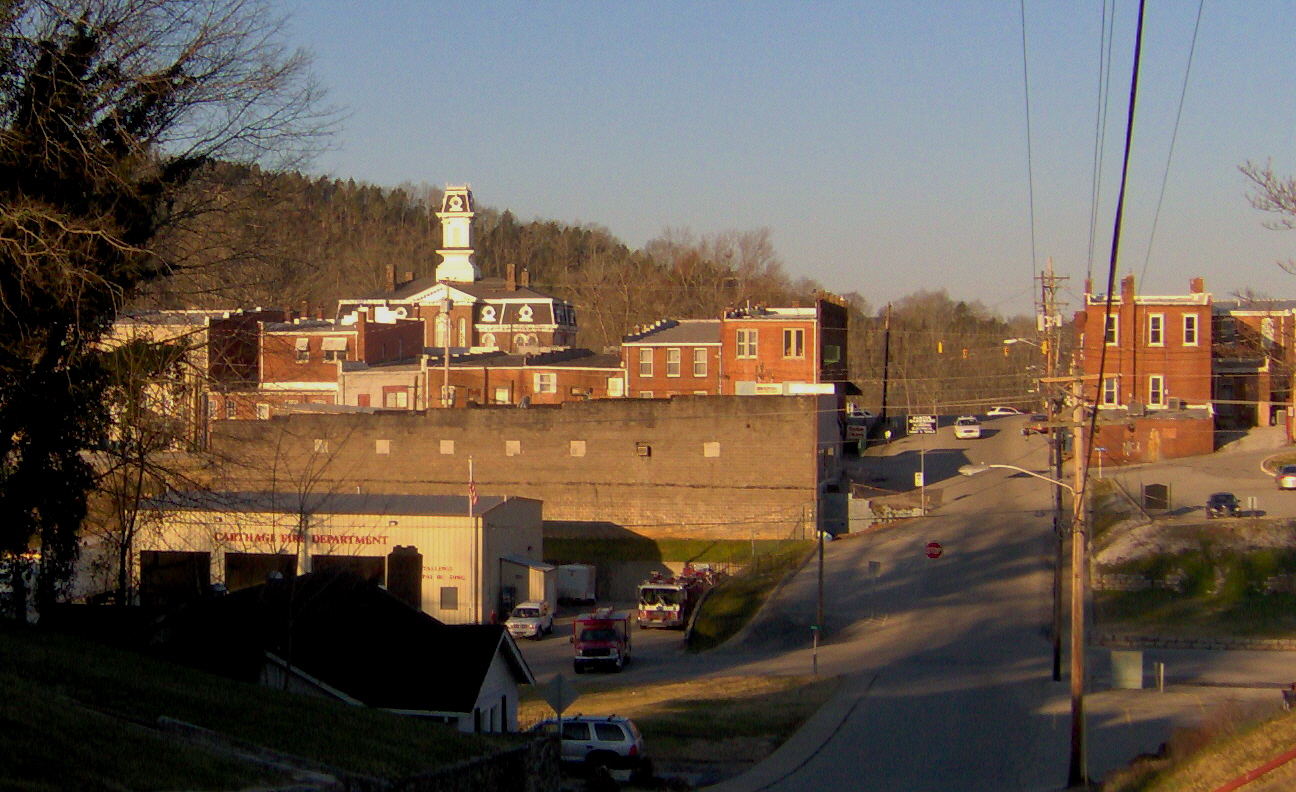
Carthage is a small town that serves as the county seat of Smith County, Tennessee, with a population of roughly 2,300 residents. Tucked into the rolling hills of Middle Tennessee along the Cumberland River, it has the unhurried feel of a rural county seat — a compact historic downtown anchored by a courthouse square, surrounded by farmland, forests, and the waters of a major federal reservoir. The town is best known as a gateway to Cordell Hull Lake and sits roughly 50 miles east of Nashville, making it a quiet retreat within easy reach of the state's largest metro area.
One of the area's defining features is Cordell Hull Lake, a wide, scenic reservoir on the Cumberland River created by the Cordell Hull Dam a few miles east of town. The lake covers thousands of acres and draws visitors for fishing, boating, and lakeside camping, with public access points and marinas spread along its wooded shoreline. It is a year-round draw, especially popular in the warmer months when houseboaters and anglers take to the water, and the surrounding public lands managed by the U.S. Army Corps of Engineers provide additional trails and day-use areas.
The town itself centers on the Smith County Courthouse, a stately building on the public square that has long anchored civic life in Carthage. Around it, a small grid of locally owned shops, diners, and churches gives the community its slow-paced, traditional character. The historic core is walkable and reflective of the kind of small-town Tennessee architecture that rewards a quiet afternoon of browsing, and the courthouse square remains a gathering place for community events throughout the year.
For outdoor recreation beyond the lake, the surrounding countryside offers a mix of public lands, riverfront stretches, and backroads that appeal to hikers, hunters, and cyclists. The transition from the Central Basin to the higher terrain of the Cumberland Plateau begins just east of the county, opening up additional natural areas and state parks within a reasonable drive. Carthage's location also places it within striking distance of Nashville's music, food, and entertainment scene, allowing visitors to combine a peaceful rural stay with day trips into the city.
What makes Carthage particularly compelling for short-term rental owners is the combination of an under-the-radar location with genuine natural appeal. The lake provides a steady seasonal pull of visitors, while the proximity to Nashville — under an hour's drive — gives the town potential as a weekend escape for travelers who want a quieter, more affordable alternative to staying in the metro area. Small, historic, and surrounded by water and woods, Carthage offers the kind of place-based identity that tends to resonate with guests looking for an authentic Tennessee experience.
Want to know if a property in Carthage is a good investment?
Enter an address to get instant revenue potential and comps.