
Block Island, Rhode Island
Want to see how Block Island compares to other top cities in Rhode Island? Explore all city regulations in Rhode Island. →
Block Island, RI
Challenging To Investors
STR Regulations for Block Island, Rhode Island
Overview: Are Short-Term Rentals Allowed in Block Island?
Yes, short-term rentals are explicitly allowed in Block Island (New Shoreham), Rhode Island, but they are heavily regulated through comprehensive municipal and state-level requirements. The Town of New Shoreham adopted a specific Residential Short-Term Rentals Ordinance on July 24, 2024, establishing a formal regulatory framework. Short-term rentals are defined as rentals, leases, or other contractual arrangements for the occupation or use of a dwelling unit for thirty (30) days or less. Notably, hotels, rooming houses, and licensed rental rooms are not considered short-term rentals under this definition.
The regulatory environment operates on two distinct levels: municipal requirements specific to New Shoreham/Block Island and statewide Rhode Island registration mandates. Property investors must comply with both layers of regulation to operate legally.
What do Airbnb hosts actually earn in Block Island?
Block Island hosts earn a median $52,165/year with $715 ADR and 53% occupancy.
Top performers pull in $94,442+ per year.
See the full Block Island market breakdownHow to Start a Short-Term Rental Business in Block Island
Step 1: Understand Eligibility and Property Compliance
Before pursuing registration, ensure your property meets basic eligibility requirements:
- Dwelling Unit Requirement: The property must be a residential dwelling unit
- Septic System Compliance: The number of bedrooms cannot exceed the number supported by the property's septic system or Onsite Waste Treatment System (OWTS) design
- Property Classification: Hotels, rooming houses, and licensed rental rooms are excluded from STR regulations and fall under different licensing categories
Step 2: Complete Municipal Registration (New Shoreham/Block Island)
Block Island requires annual registration with the Zoning Official before any renter occupies the dwelling unit. The registration process includes:
- Annual Registration Deadline: Must register on or before December 31st each year
- Registration Period: Valid for one year (January 1st to December 31st following year)
- Renewal Timing: Current registrations cannot be renewed until July 1st for the following year
- Registration Fee: $200 per dwelling unit
- Local Representative Designation: Must designate an individual physically present in New Shoreham during STR periods as the local representative
Step 3: Complete State Registration (Rhode Island)
Rhode Island mandates separate state registration for properties advertised on third-party hosting platforms:
- State Registration Fee: $25
- Registration Duration: Valid for one calendar year
- Platform Requirement: Registration required if advertising on third-party hosting sites (Airbnb, Vrbo, real estate brokerage websites, etc.)
- Definition Trigger: Properties rented for 30 nights or less and listed on hosting platforms
Step 4: Secure Required Insurance and Business Setup
While not explicitly mandated in the provided regulations, investors should consider:
- Liability insurance coverage
- Property insurance updates for rental use
- Business entity formation (LLC, corporation, etc.)
- Tax registration with Rhode Island Division of Taxation
Step 5: Prepare for Operations
- Obtain registration number for public postings
- Establish local representative arrangements
- Prepare compliance documentation
- Set up tax collection and remittance systems
Required Documents, Permits, Licenses, and Guidelines
Municipal Requirements (New Shoreham/Block Island)
-
Annual STR Registration Form
- Property address and bedroom count
- Owner information
- Designated local representative details
- Septic system compliance verification
-
Local Representative Documentation
- Designation of physically present local representative
- Authorization for process service
- Contact information for emergency response
-
Septic System Compliance
- Verification that bedroom count matches septic system capacity
- OWTS design compliance documentation
State Requirements (Rhode Island)
-
State STR Registration Application
- Principal place of business of owner (or agent if out-of-state)
- Phone number of owner and/or property manager
- Email address of owner and/or property manager
- Rental property address
- Number of rooms for rent
- Ownership/tenancy status confirmation
- Intended use (entire space, private room, shared space)
-
Business Entity Registration (if applicable)
- Rhode Island Secretary of State business registration
- Tax identification numbers
Licensing Categories to Avoid Confusion
Rooming House License: If renting 3+ rooms to non-family members, you may need a separate Rooming House License ($20 per room, expires December 1st annually). This is distinct from STR registration and includes boarding houses, inns, and hotels.
Specific Regulations for Block Island, Washington County, and Rhode Island
New Shoreham (Block Island) Specific Regulations
Maximum Occupancy Limits:
- Maximum occupancy: Two (2) persons per bedroom
- Person definition: Individual at least 3 years old
- Bedroom limit: Cannot exceed septic system capacity
Registration Requirements:
- Annual registration mandatory before renter occupancy
- $200 registration fee per dwelling unit
- Registration number required in all public rental postings
- Registration valid January 1st to December 31st annually
Local Representative Obligations:
- Must be physically present in New Shoreham during rental periods
- Must respond to town official inquiries within 2 hours
- Failure to respond timely constitutes a violation
- May be the property owner or designated third party
Advertising Restrictions:
- Public rental postings must include valid registration number
- Cannot advertise occupant capacity beyond permitted limits
- Must comply with all town ordinances and state laws
Enforcement Penalties:
- Municipal violations: $200 per day for each day violation continues
- Citations issued by police department or zoning official
- Violations heard in Town of New Shoreham Warden's Court
Washington County Level
No specific short-term rental regulations identified at the county level. Municipal and state regulations govern STR operations.
Rhode Island State Regulations
State Registration Requirements:
- Mandatory registration for STRs listed on third-party hosting platforms
- $25 registration fee
- Annual registration renewal required
- Public database with property address and registration status
Registration Triggers:
- Rentals ≤30 nights AND
- Advertising on third-party hosting platforms (Airbnb, Vrbo, real estate brokerage websites)
Definition Parameters:
- "Short-term rental": Utilization for transient lodging accommodations not exceeding 30 nights
- "Hosting platform": Electronic system providing means for owners to offer residential units for tourist/transient use
- "Owner": Property owner or lessee
Penalty Structure for Non-Compliance:
- $250 for first 30 days of non-compliance
- $500 for 31-60 days of non-compliance
- $1,000 for more than 60 days of non-compliance
Accessory Dwelling Unit (ADU) Restrictions:
- ADUs shall not be offered or rented for tourist/transient use
- Effective June 25, 2024, ADUs cannot be used as STRs through hosting platforms
Fire Safety Requirements:
- Local fire department requirements apply
- Contact local fire department for specific fire code compliance
Tax Obligations:
- State lodging tax: 5%
- State sales tax: 7%
- Combined potential rate: approximately 13%
- Local occupancy taxes may apply in some municipalities
- Registration with Rhode Island Division of Taxation may be required if platform doesn't handle tax collection
Contact Information for Local and State Authorities
New Shoreham (Block Island) Municipal Contacts
Town of New Shoreham
- Mailing Address: PO Box 220, Block Island, RI 02807
- Phone: (401) 466-3200
- Fax: (401) 466-3219
Zoning Official (STR Registration)
- Jennifer Brady, Zoning Official
- Email: jbrady@newshorehamri.gov
- Phone: (401) 466-3205
Administrative Support
-
Amanda Boulay, Admin Assistant
-
Email: aboulay@newshorehamri.gov
-
Phone: (401) 466-5419
-
Caren Ford, Admin Assistant
-
Email: cford@newshorehamri.gov
-
Phone: (401) 466-3216
Town Clerk (Rooming House Licenses)
- Email: mmcginnes@newshorehamri.gov
- Phone: (401) 466-3200
Rhode Island State Contacts
Department of Business Regulation (STR Registration)
- Address: 1511 Pontiac Avenue, Cranston, RI 02920
- Main Phone: (401) 462-9500
- Real Estate Section Contact: Jorge Bannister at (401) 408-1138
- Email: DBR.REInquiry@dbr.ri.gov
- Office Hours: Monday-Friday, 8:30 AM - 4:00 PM
- STR Registration Portal: elicensing.ri.gov
Online Resources
- STR Registration Search: elicensing.ri.gov/Lookup/OnlineReportExecute.aspx?queryIdnt=1298
- Block Island STR Registration: newshorehamri.portal.opengov.com/
Source Links
Municipal (New Shoreham/Block Island)
- New Shoreham Short-Term Rentals Ordinance
- Short-Term Rentals Ordinance Legal Document
- Online STR Registration Portal
- Rooming House License Information
- New Shoreham Code of Ordinances
Rhode Island State
- DBR Short-Term Rentals Page
- Short-Term Rentals FAQ
- STR Registration Database
- State Registration Application Portal
Legal References
- R.I. Gen. Laws § 42-63.1-14 (Hosting Platform Registration)
- R.I. Gen. Laws § 42-63.1-2 (Definitions)
- R.I. Gen. Laws § 42-63.1-14.1 (Platform Website Listings)
- 230-RICR-30-20-4 (State Regulations)
- ADU Restrictions Law
Additional Resources
- Rhode Island Fire Departments Directory
- Rhode Island Municipal Directory
- Division of Taxation STR FAQs
Investment Recommendation: Block Island represents a premium short-term rental market with established regulatory framework. The dual-layer compliance requirements (municipal + state) create barriers to entry but provide market stability. Success requires careful attention to occupancy limits, septic system compliance, and maintaining responsive local representative services. The $225 combined annual registration fees ($200 municipal + $25 state) represent a reasonable regulatory cost structure for this high-demand seasonal tourism market.
Next step
Found a property in Block Island?
Paste any address and get estimated revenue, cash-on-cash return, and comparable STR performance in under 5 minutes. 3 free analyses per day.
Free brief
Get the free Block Island STR Investment Brief
Revenue data, top neighborhoods, seasonal trends, and the key regulations for Block Island, Rhode Island in one email.
Block Island
Market Saturation Score
Photos of Block Island


Overview of Block Island
Block Island is a roughly eleven-square-mile island in Rhode Island, situated in Washington County about twelve miles offshore in the Atlantic. The island constitutes the Town of New Shoreham, the smallest and most remote town in the state, and supports a year-round population of approximately 1,000 residents that swells to many times that number during the summer months. The island is reached by ferry from Point Judith in Narragansett, with additional seasonal service from New London, Connecticut, and Montauk, New York; Providence, the nearest major city, lies roughly sixty miles to the northwest on the mainland. Block Island's character is defined by preserved open moors, freshwater ponds, Victorian-era architecture, and a rocky, dune-backed coastline, and it has long served as a tranquil summer escape known for cycling, beachgoing, and birdwatching.
The Block Island National Wildlife Refuge protects roughly the northern third of the island, encompassing salt marshes, freshwater ponds, dunes, and forested thickets that support migratory songbirds, nesting shorebirds, and waterfowl. A network of marked trails and unpaved back roads runs through the refuge, leading to remote beaches and elevated viewing points along the northern cliffs. It is interior to the island and easily reached from Old Harbor within a short drive or bike ride.
Southeast Light, an iconic red-brick Victorian lighthouse completed in 1875 and famously relocated back from the eroding Mohegan Bluffs in 1993, anchors the island's southeastern corner. The lighthouse and its adjoining outbuildings are open seasonally as a museum run by the Block Island Historical Society, and the adjacent bluff-top paths offer sweeping views of clay-colored cliffs and the open Atlantic. The site is approximately four miles southeast of the Old Harbor ferry landing.
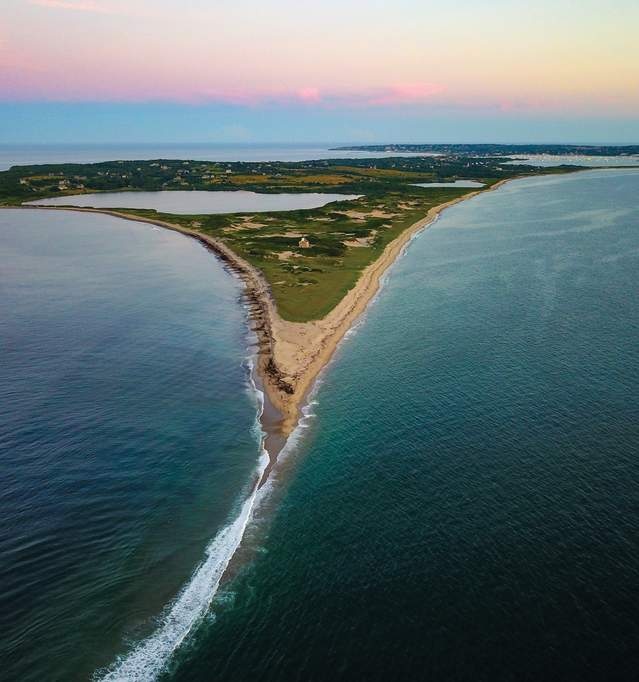
The island's other historic sentinel, [North Light](en.wikipedia.org/wiki/North_Light_(Block_Island), stands at the island's northern tip. Built in 1867 to mark Block Island's north end, it is reached by a quiet drive or bicycle ride of roughly six miles from Old Harbor along rural roads, with surrounding dunes and ocean viewpoints typical of the refuge lands nearby.
Block Island is a compelling base for short-term rentals because it pairs genuine isolation with reliable mainland access, drawing weekenders from the dense Northeast corridor while feeling distinctly separate from it. Lodging supply is constrained by the ferry-dependent geography, seasonal demand is strong and concentrated, and visitors are drawn by beaches, a large protected wildlife refuge, two historic lighthouses, and a walkable New England harbor town, all within a compact footprint that rewards stays of several nights rather than a day trip.
Want to know if a property in Block Island is a good investment?
Enter an address to get instant revenue potential and comps.