
Oregon City, Oregon
Want to see how Oregon City compares to other top cities in Oregon? Explore all city regulations in Oregon. →
Oregon City, OR
Challenging To Investors
STR Regulations for Oregon City, Oregon
Overview: Are STRs allowed in Oregon City, OR?
- Allowed: Yes. Short-term rentals (rentals fewer than 30 consecutive days) are allowed in Oregon City only through a conditional use approval in residential zones. Rentals of 30 days or more are allowed without special permitting in most residential areas.
- Definition and pathway: Oregon City Municipal Code defines rentals for “fewer than thirty consecutive days” as “Bed and breakfast inns and boarding houses,” which require a Conditional Use Permit (CUP) processed via a Type III land use review, considered by the Planning Commission at a public hearing.
- Zones and process: In all residential zones—Low-Density (R-6, R-8, R-10), Medium-Density (R-3.5, R-5), and High-Density (R-2)—short-term rentals require a CUP. The process starts with a Pre-Application Conference and is subject to Planning Review fees.
- Additional requirements: A City business license is required. You must also register/collect and remit the local transient room tax (TRT) via the Finance Department.
- ADUs: Accessory Dwelling Units (ADUs) may be used as short-term rentals, but they are treated the same way (CUP required) since STRs under 30 days fall under the “Bed and breakfast/boarding house” definition.
How to start a short-term rental business in Oregon City, OR
- Step 1 — Confirm eligibility and zoning:
- Verify your property’s zoning designation using City mapping tools or Planning staff. Most residential zones allow STRs with a CUP; confirm overlays (historic, flood, geologic hazards, natural resource, greenway) that can affect process type.
- If renting 30+ days, you generally do not need special permitting; confirm with the Planning Division.
- Step 2 — Begin with a Pre-Application Conference:
- Schedule a Pre-Application Conference with the Planning Division. This clarifies process, submittals, neighbors noticing, and timeline.
- Step 3 — Secure a Conditional Use Permit (Type III):
- Submit the CUP application and required fees. The Planning Commission holds a public hearing to decide approval.
- Step 4 — Obtain a business license:
- Complete City business licensing (required to operate a STR).
- Step 5 — Set up tax registration and collection:
- Contact the Finance Department for transient room tax registration and collection rules. Collect/remit TRT on applicable reservations.
- Step 6 — Prepare the property and finalize operations:
- Install/maintain required safety equipment (smoke alarms, CO detectors, fire extinguisher). Post any required notices and display business license.
- Step 7 — Maintain compliance:
- Keep records of guests/bookings for tax filings; renew licenses/permits as required; respond to neighborhood issues promptly.
Required documents, permits, licenses, and guidelines
- Conditional Use Permit (CUP) — Type III land use review:
- Purpose: Authorization to operate a short-term rental (fewer than 30 days) in residential zones.
- Process: Planning Commission public hearing following staff review.
- Pre-Application Conference:
- Required before formal submittals to confirm process and expectations.
- Planning Review fees:
- Application fees apply for both the Pre-Application Conference and the CUP. See the City’s Planning Fee Schedule.
- City Business License:
- Required to operate as a business in Oregon City.
- Transient Room Tax registration and filings:
- Finance Department issues tax account instructions and returns; ensure you collect/remit TRT on short stays.
- Technical submittals (typical for land use applications):
- Site plan, floor plans, parking layout, adjacency map, neighborhood noticing materials (as directed), and any studies required by overlays or code.
- Safety and operational best practices:
- Maintain functional smoke alarms in all bedrooms/hallways and CO detectors where required; provide fire extinguisher and clearly marked egress. Post house rules and STR contact information.
Regulations that apply in Oregon City, OR
- City zoning and land use:
- Oregon City Municipal Code defines STRs under 30 days as “Bed and breakfast inns and boarding houses.” STRs require a Conditional Use Permit in all residential zones and are reviewed via a Type III process with a Planning Commission hearing.
- 30+ day rentals are allowed without special permitting.
- Zoning map references:
- Residential Low-Density (R-6, R-8, R-10), Medium-Density (R-3.5, R-5), and High-Density (R-2) zones each require a CUP for STRs under 30 days.
- Overlay and special districts:
- Properties in Historic Districts, Flood Management Overlay, Geologic Hazards areas, Natural Resource Overlay, Willamette River Greenway, or with nonconforming status may trigger additional reviews or submittals and can affect process type (Type II/III).
- ADUs as STRs:
- ADUs may be used for STRs, but because the activity is under 30 days, it falls under the bed and breakfast/boarding house definition and requires a CUP.
- Taxes:
- You must register and remit the City’s local transient room tax on short-term reservations. Consult the Finance Department for current rate, filing frequency, and whether any local collections are handled via platforms or directly by hosts.
- State-level requirements:
- Oregon Transient Lodging Tax (TLT) applies statewide at 1.5% on lodging under 30 nights. Hosts must register with the Oregon Department of Revenue and file returns (often quarterly). Airbnb and other platforms may collect and remit in some jurisdictions; if you take direct bookings, you remain responsible for proper collection and remittance.
Specific regulations for Oregon City, Clackamas County, and Oregon State
- City of Oregon City (municipal code):
- STRs under 30 days = “Bed and breakfast inns and boarding houses”; require CUP via Type III public hearing in residential zones.
- 30+ day rentals do not require special permitting.
- Business license required; TRT registration and remittance required.
- Overlays may add review complexity and submittal requirements.
- Clackamas County (unincorporated areas outside Oregon City):
- Oregon City rules do not apply outside city limits. County STR rules vary and were not included in the provided sources; verify with Clackamas County if your property is outside city limits.
- State of Oregon:
- Transient Lodging Tax (TLT) at 1.5% for stays under 30 nights. Register and file returns with the Oregon Department of Revenue.
- Health and safety baseline (smoke and CO alarms) applies to rental dwellings; ensure compliance.
Local authority contacts
- Planning Division (land use and permits for STRs/CUPs):
- Email: ocplanning@orcity.org
- Phone: 503-722-3789
- Finance Department (transient room tax and business tax questions):
- Phone: 503-657-0891
- Address: Oregon City City Hall, 625 Center Street, Oregon City, OR 97045
- Building Permits:
- Email: permits@orcity.org
- Phone: 503-722-3789
- City Hall (general questions):
- Phone: 503-657-0891
- Hours: Monday–Friday, 8:00am–5:00pm
Links to official source pages
- City page: “Rent out My House as a Short-Term Rental”:
- Conditional Use Permit (overview):
- Pre-Application Conference:
- Type III Land Use Process (PDF):
- Planning Fee Schedule:
- Business Licensing:
- Oregon City Municipal Code Library (definitions and zoning):
- Definition: “Bed and breakfast inns and boarding houses”:
- Accessory Dwelling Unit (ADU) and STR cross-reference:
Notes for investors
- Cost and timing: The CUP fee and Pre-Application Conference fee must be paid, and the process includes a public hearing, so plan for longer lead times than “by-right” uses.
- Feasibility: Overlay constraints and neighborhood context can affect approval. Confirm feasibility before committing capital.
- Operations: After approval, maintain the license, collect/remit TRT, and keep strong neighbor relations to avoid code enforcement issues.
What do Airbnb hosts actually earn in Oregon City?
Oregon City hosts earn a median $28,065/year with $140 ADR and 72% occupancy.
Top performers pull in $38,580+ per year.
See the full Oregon City market breakdownNext step
Found a property in Oregon City?
Paste any address and get estimated revenue, cash-on-cash return, and comparable STR performance in under 5 minutes. 3 free analyses per day.
Free brief
Get the free Oregon City STR Investment Brief
Revenue data, top neighborhoods, seasonal trends, and the key regulations for Oregon City, Oregon in one email.
Oregon City
Market Saturation Score
Photos of Oregon City


Overview of Oregon City
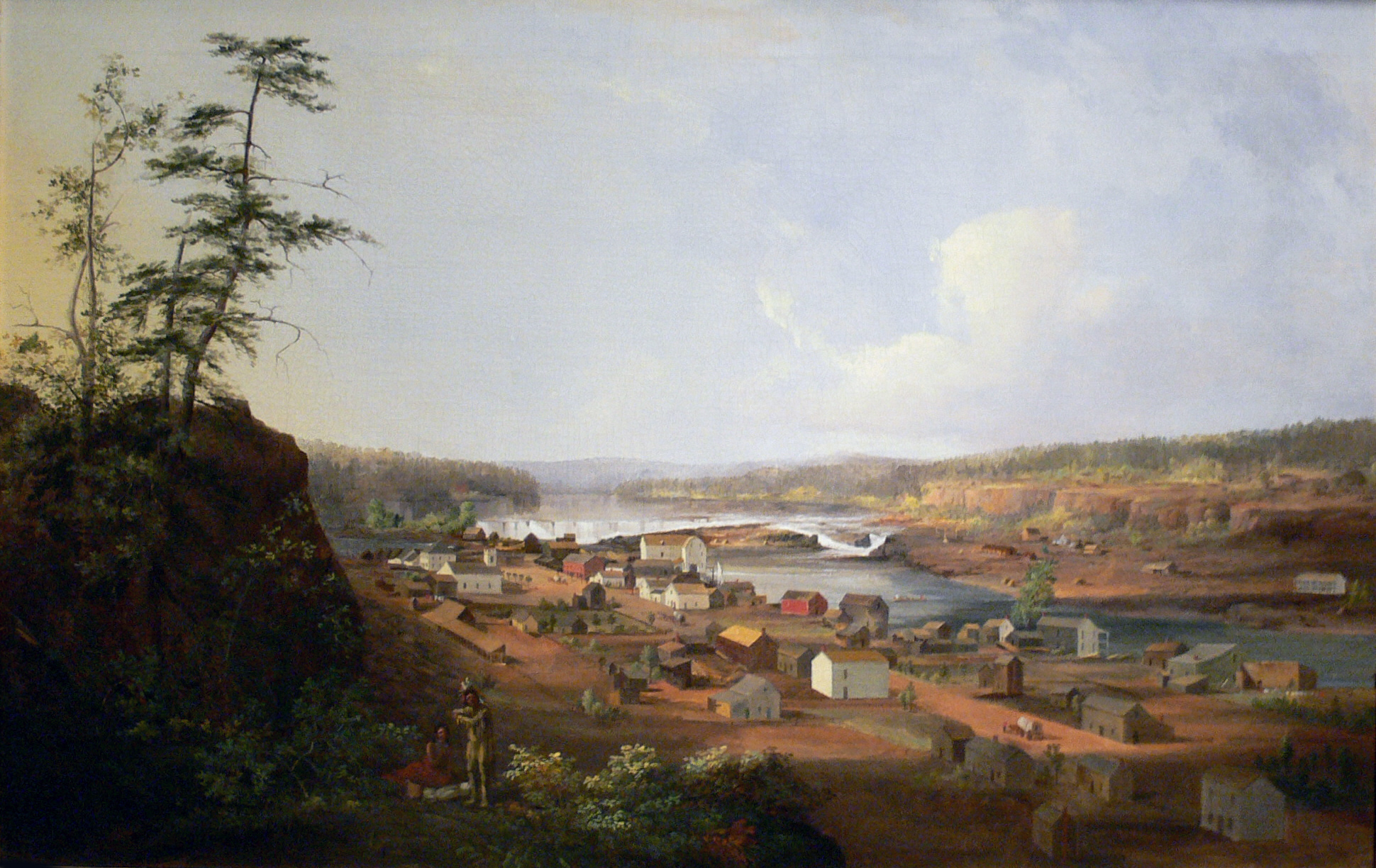
Oregon City sits along the Willamette River at its confluence with the Clackamas River, in Clackamas County, Oregon. With a population of roughly 37,000 residents, it carries the distinction of being the first incorporated city west of the Rocky Mountains and the former capital of the Oregon Territory. The community blends a quiet, small-town atmosphere with a deep pioneer-era past, and its position at the lower end of the Willamette Valley makes it a natural jumping-off point for travelers exploring both the Portland metro area and the Cascade Range to the east. Downtown Portland lies about 13 miles to the northwest, an easy drive of around 25 minutes.
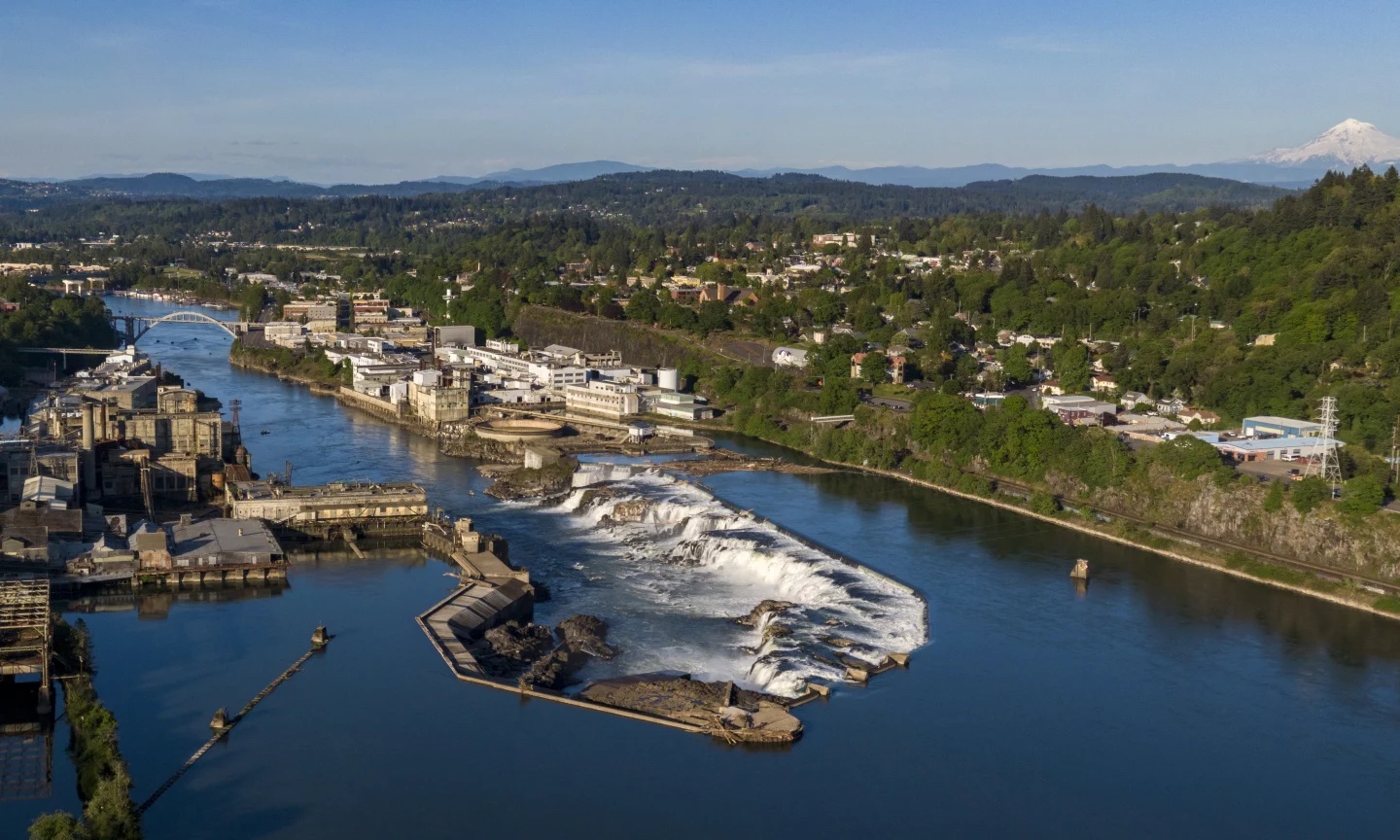
One of the most striking natural features in the metro region is Willamette Falls, which drops roughly 40 feet across a horseshoe-shaped basalt shelf just north of the city center. It is among the largest waterfalls in the United States by volume, and visitors can view it from overlooks in Willamette Falls State Park, just minutes from downtown. The area is undergoing a major public-access restoration, adding new walkways and viewpoints to a site that was once largely closed to the public.
The End of the Oregon Trail Interpretive Center anchors the city's heritage tourism scene, telling the story of the thousands of pioneers who completed their journey along the Oregon Trail in the surrounding Willamette Valley. The center sits within walking distance of the historic downtown core and pairs naturally with a stop at the McLoughlin House, the preserved home of Dr. John McLoughlin, the fur-trader-turned-chief-factor often called the "Father of Oregon." The McLoughlin House is administered as a National Historic Site by the National Park Service and is free to visit.
Roughly 60 to 75 miles east of Oregon City, the slopes of Mount Hood rise within the Mount Hood National Forest, offering year-round hiking, alpine skiing at Mt. Hood Skibowl and Timberline, and the famously scenic drive along the Historic Columbia River Highway. Timberline Lodge, a National Historic Landmark on the mountain, sits at about 6,000 feet of elevation and remains a popular day trip from the Willamette Valley.
For short-term rental owners, Oregon City offers a compelling mix: more affordable real estate than nearby Portland, a recognizable historical brand that draws heritage tourists, and quick access to the waterfalls, Willamette Valley wineries, and ski fields of northwest Oregon. Its walkable downtown, riverfront trails, and proximity to both the Portland metro and the Cascades give guests a base that feels grounded in Oregon history yet connected to the wider region's biggest draws.
Want to know if a property in Oregon City is a good investment?
Enter an address to get instant revenue potential and comps.