
Mitchell, Oregon
Want to see how Mitchell compares to other top cities in Oregon? Explore all city regulations in Oregon. →
Mitchell, OR
Generally Investor Friendly
STR Regulations for Mitchell, Oregon
Short‑Term Rental Investor’s Guide: Mitchell, Oregon (and Oregon State-Level Rules)
Overview and Allowance of Short‑Term Rentals in Mitchell, OR
Because no city‑specific ordinance for short‑term rentals (STRs) in Mitchell, Oregon was provided in the source materials, this guide defaults to Oregon statewide rules that apply uniformly across the state, including Mitchell. Oregon allows STRs to operate as lodging businesses. Hosts are generally treated as lodging providers and must meet health, safety, tax, and (where applicable) land use rules. Investors should expect to obtain a state lodging license, register for state/local taxes, and follow local land use and nuisance standards when applicable. If Mitchell adopts local STR rules later, those would add to, not replace, state requirements.
Note: The URLs below are provided for investor reference; we did not retrieve or verify them as part of this analysis and therefore cannot guarantee content.
What do Airbnb hosts actually earn in Mitchell?
Mitchell hosts earn a median $33,302/year with $251 ADR and 52% occupancy.
Top performers pull in $36,956+ per year.
See the full Mitchell market breakdownHow to Start a Short‑Term Rental Business in This Market
- Choose the property type and confirm land use feasibility.
- Confirm whether the property is in an area where STR use is permitted (e.g., residential, mixed-use). If the parcel lies within a homeowners’ association, review CC&Rs and rental policies.
- Check setback, occupancy, parking, and building standards for the dwelling type.
- Establish business registration and lodging licensure.
- Register your business with Oregon state and county as required (if operating under an LLC or other entity).
- Apply for lodging provider licensure/registration from the Oregon Health Authority (OHA) where applicable. This applies to lodging operations such as vacation rentals; details, fees, and renewal cadence are set by OHA and may vary by property configuration.
- Set up tax compliance.
- Obtain any necessary state/local tax registrations for lodging taxes and transient lodging taxes.
- Configure tax collection, filing, and remittance processes for state and applicable local taxes.
- Consider accounts receivable/reporting workflows for platform bookings and direct reservations.
- Design for safety, accessibility, and guest experience.
- Meet building, fire, and life safety standards applicable to lodging (e.g., smoke/CO detectors, egress, fire extinguishers, posted emergency info).
- Provide clearly posted house rules, contact information for the host/manager, and check-in procedures.
- Secure adequate insurance and risk management.
- Carry appropriate liability coverage (e.g., at least $1M where required by platforms or lenders).
- Consider loss-of-use, property damage, and guest incident coverage.
- Operational setup.
- Determine whether you’ll use a property manager or operate remotely.
- Implement guest screening policies, occupancy limits, and house rules consistent with local standards.
- Set up turn-over, cleaning, and maintenance protocols to maintain property condition and good neighbor relations.
- Launch, monitor, and maintain compliance.
- List on platforms (Airbnb, VRBO, direct channel) only after licensure and tax setup are in place.
- Keep records of licenses, inspections, tax filings, guest logs, and communications.
- Respond promptly to code complaints and maintain compliance to avoid fines or license actions.
Required Documents, Permits, Licenses, and Guidelines
Because no Mitchell-specific requirements were found in the provided content, this list reflects Oregon statewide needs commonly required for lodging providers/STRs.
-
Lodging provider license/registration (OHA). Typical details include:
- Application form and fee
- Proof of ownership or right to operate
- Property and safety information (e.g., number of rooms/sleeping spaces, fire and life safety equipment, posted emergency info)
- Compliance with OHA lodging rules; inspection may be required
-
Business registrations:
- State business registry (for entities), county tax registrations as applicable
-
Tax registrations and compliance setup:
- State lodging/tax account setup
- Local transient lodging tax registration (if applicable to Mitchell’s county or region)
-
Operational and guest-facing materials:
- Posted house rules
- Emergency contact information (host/manager)
- Guest policies consistent with state/local rules (occupancy, quiet hours, parking)
-
Insurance:
- Liability coverage and any additional policies recommended by lenders, platforms, or HOAs
-
Land use and zoning compliance (if local rules are adopted in the future):
- Building/fire inspections as applicable
- Parking plans, signage approvals, and local nuisance standards
Important: Because no Mitchell-specific checklist was provided in the source content, investors should confirm any city or county rules in Wheeler County that may apply, as well as HOA restrictions.
Specific Regulations for Short‑Term Rentals (Mitchell, City/County, and Oregon State)
Oregon State Regulations (Apply to Mitchell)
- Operating framework: STRs are treated as lodging. Hosts must comply with state lodging regulations, including OHA licensing/registration and applicable safety requirements.
- Taxes: Hosts must collect and remit state lodging/transient lodging taxes and any applicable local lodging taxes through proper registration and filing.
- Safety and guest information: Expect requirements for posted house rules and emergency contact information and for meeting applicable fire/life safety standards.
- Records: Maintain guest logs, financial records, and proof of compliance to satisfy audits or inspections.
- Platform considerations: Common industry practice is for platforms to require proof of licensing and tax compliance before listing.
Note: The rules above reflect general Oregon lodging/STR requirements. Specific regulatory text, fee schedules, and inspection procedures are set by OHA and local tax authorities; always consult the latest official guidance.
Wheeler County (Mitchell’s County)
- No county-specific STR provisions were provided in the source content. It is likely that county land use, building, and fire standards apply to the physical operation of the dwelling. Investors should verify whether Wheeler County has adopted any STR or lodging-related rules that apply in unincorporated areas or through intergovernmental agreements with Mitchell.
City of Mitchell
- No city-specific STR ordinance was provided in the source content. If Mitchell adopts local STR rules in the future, they will likely address:
- Licensing and registration requirements
- Occupancy and quiet hours
- Parking and signage standards
- Notification and complaint procedures
- Enforcement and penalties
Contact Information (Phone, Email, Website Where Available)
Because the provided sources do not include Mitchell- or Wheeler County–specific STR contacts, investors should reach out to the following state-level authorities and confirm local contacts with the city or county:
-
Oregon Health Authority (OHA) – Lodging Provider Licensing
- Use the OHA website to find current lodging provider licensing contacts, forms, and instructions.
- Phone/email: Consult OHA’s current public listings (not provided in the sources).
-
Oregon Department of Revenue – Lodging/Transient Taxes
- Use the Department of Revenue website for lodging tax registration, filing instructions, and local tax coordination.
- Phone/email: Consult the Department of Revenue’s current public listings (not provided in the sources).
-
City of Mitchell (for future local STR rules)
- Website, phone, and email: Not provided in the sources. Contact the city directly for current planning, building, and code enforcement contacts.
-
Wheeler County (for potential county-level provisions)
- Website, phone, and email: Not provided in the sources. Contact the county for planning, building, and tax administration information.
Links to Source Pages
Important: These links are provided for investor reference. The content of the linked pages was not retrieved or verified for this guide.
-
Bismarck regulates STRs (North Dakota context; not applicable to Oregon)
-
Video related to Bismarck STRs (North Dakota context; not applicable to Oregon)
-
Gilpin County, Colorado STR page (Colorado regulations; not applicable to Oregon)
-
Franklin County, Virginia Planning Commission Minutes (Virginia regulations; not applicable to Oregon)
-
Regulations.gov (placeholder; no applicable STR document identified)
Practical Notes for Investors
- No local Mitchell ordinance was provided. Expect to rely on Oregon statewide lodging rules, including OHA licensing and tax compliance. If Mitchell or Wheeler County later adopts STR ordinances, obtain those directly from the city or county.
- Because STRs are lodging operations, life safety and guest information requirements are likely to be strictly enforced. Prioritize clear, posted rules, emergency contacts, and documented compliance.
- Maintain meticulous records (licenses, tax filings, guest logs, inspections). This discipline reduces audit risk and speeds issue resolution with authorities and platforms.
- Early engagement with OHA and the Department of Revenue will streamline your go‑to‑market timeline and prevent listing delays.
Disclaimer: This guide summarizes Oregon’s typical STR lodging framework in the absence of Mitchell‑specific rules in the provided content. Always consult current state statutes, OHA regulations, local tax guidance, and any future city/county ordinances before operating.
Next step
Found a property in Mitchell?
Paste any address and get estimated revenue, cash-on-cash return, and comparable STR performance in under 5 minutes. 3 free analyses per day.
Free brief
Get the free Mitchell STR Investment Brief
Revenue data, top neighborhoods, seasonal trends, and the key regulations for Mitchell, Oregon in one email.
Mitchell
Market Saturation Score
Photos of Mitchell


Overview of Mitchell
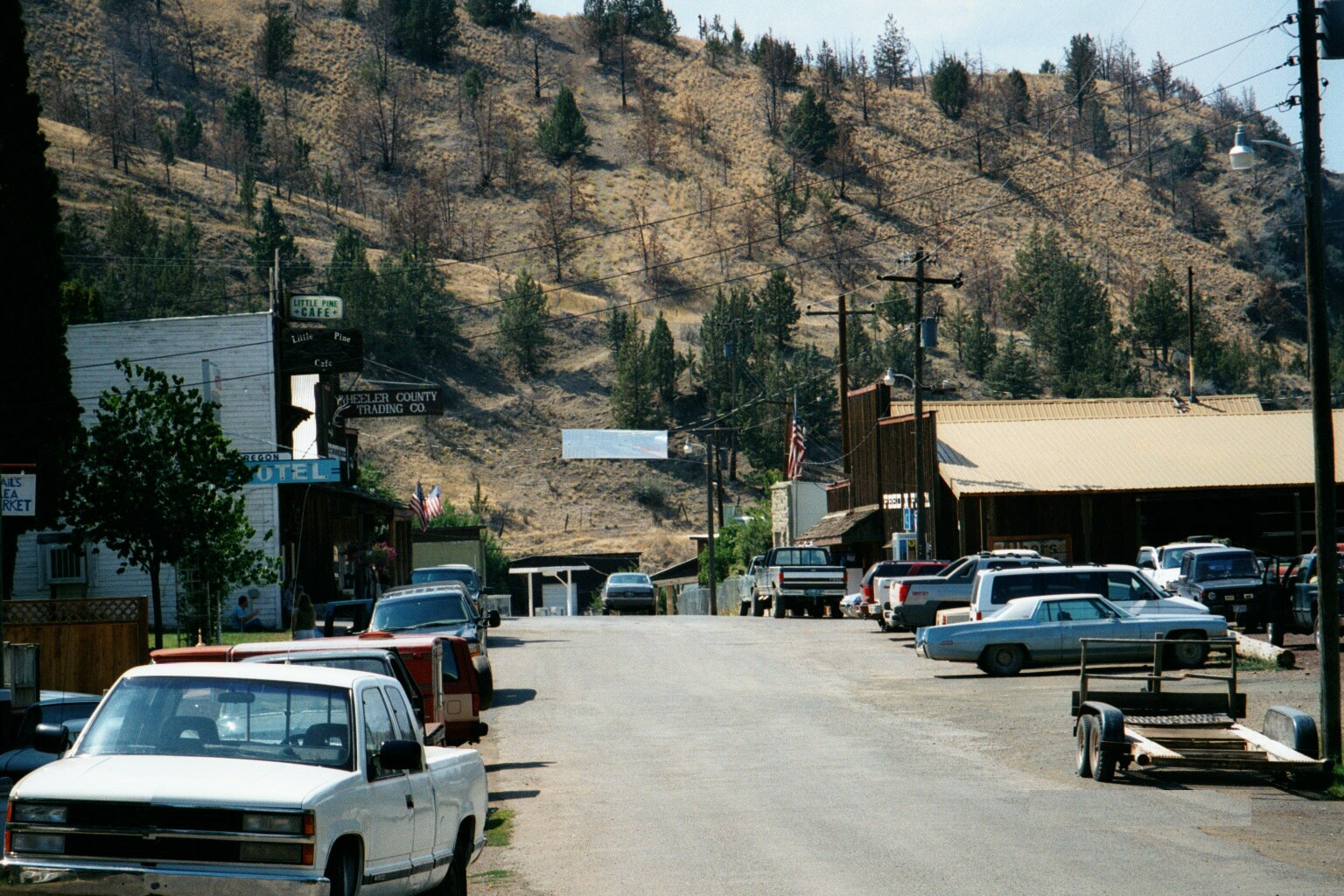
Mitchell is a tiny city in Wheeler County, in the rugged high-desert and canyon country of central Oregon. With a population of roughly 120 residents, it functions less as a destination in its own right and more as a quiet, historic stop along U.S. Route 26 and a gateway to one of Oregon's most photographed landscapes. The town carries the feel of a 19th-century ranching and mining settlement, with weathered brick storefronts and an unhurried pace that contrasts with the busier resort towns farther west. Mitchell sits about 130 miles east of Bend and roughly 230 miles southeast of Portland, making it a natural pause for travelers crossing between the Cascades and the John Day River basin. Despite its small size, the surrounding region draws a steady stream of road-trippers, photographers, and paleontology enthusiasts, which gives the town a modest but reliable flow of visitors.
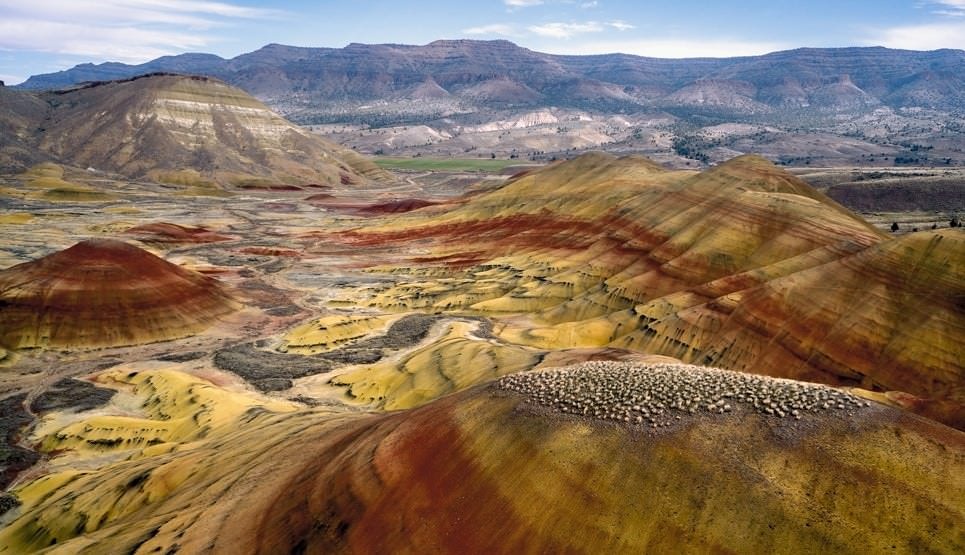
The headline attraction is the Painted Hills, one of three units of the John Day Fossil Beds National Monument. Just under ten miles west of Mitchell, the Painted Hills are bands of red, gold, and black clay that shift in color with the angle of the sun and the moisture in the soil. Short walking trails lead to overlooks such as Painted Cove, Carroll Rim, and the Leaf Hill Trail, where visitors can take in the striated ridges without long hikes. The unit is small, easy to explore in a half day, and tends to be most striking in late afternoon light, which encourages visitors to linger in Mitchell overnight rather than push on to the next town.
Roughly an hour's drive east of Mitchell along the scenic Journey Through Time Scenic Byway lies the small town of Dayville, gateway to the Sheep Rock Unit of the same national monument. That unit includes the Thomas Condon Paleontology Center and the historic James Cant Ranch, both of which offer context for the 40-million-year-old fossil record preserved in the region's colorful rock layers. The road between Mitchell and Dayville follows the John Day River through ranch country, with side canyons, basalt palisades, and occasional viewpoints that reward drivers who slow down.
To the west, the Ochoco Mountains and the national forest of the same name begin within a short drive, offering pine-shaded campgrounds, hiking trails, and cooler temperatures in summer. Closer to town, the Mitchell area itself is threaded with quiet backroads that lead to the John Day River, where small gravel bars and informal campsites attract fly anglers and floaters during the warmer months.
For short-term-rental owners, Mitchell occupies an unusual niche: it is small, remote, and seasonally quiet, yet it sits at the doorstep of one of Oregon's signature geological attractions. Travelers who want to catch the Painted Hills at sunrise or sunset, explore the broader John Day Fossil Beds, or simply break up a long cross-state drive have few lodging options, which keeps demand for clean, comfortable places to stay consistently firm during the spring-through-fall travel season.
Want to know if a property in Mitchell is a good investment?
Enter an address to get instant revenue potential and comps.