
Coos Bay, Oregon
Want to see how Coos Bay compares to other top cities in Oregon? Explore all city regulations in Oregon. →
STR Regulations for Coos Bay, Oregon
Short-term rentals (STRs) are allowed in Oregon. State law (ORS 90.243, ORS 90.245, ORS 90.247) prevents local governments from banning STRs and restricts the extent to which local rules can limit STRs. However, all STR operators in Oregon are subject to statewide licensing and registration, as well as state taxes and compliance with building, fire, life-safety, and disability access requirements. Based on the content provided, no Coos Bay–specific STR regulations were identified; therefore, this guide defaults to Oregon state-level requirements and notes any applicable county-level notes where available. Investors should verify local ordinances and contacts directly with the City of Coos Bay and Coos County.
Important limitations:
- No City of Coos Bay or Coos County STR-specific bylaws, permits, or contacts were provided in the source content. State-level references are included; for city/county specifics, confirm directly with local authorities.
How to Start a Short-Term Rental Business in This Market (Oregon, no city-specific details found)
- Determine the regulatory framework
- Operating structure: Assess whether you will operate as a traditional STR (entire dwelling or rooms), a hosted bed-and-breakfast (if applicable), or a manufactured dwelling / floating home rental, each with differing legal baselines under Oregon law.
- Jurisdiction: Confirm that the property is not in a restricted category (e.g., parts of the coastal shoreline zone under OAR 660-037-0000 et seq., where lodging can be regulated differently). If the subject property is in a special coastal overlay or resource area, verify coastal commission or state land use compatibility.
- Secure property entitlements and legal basis
- Verify allowed uses: Confirm zoning and property entitlements for lodging use; the Oregon framework prevents outright bans, but some land use overlays may still affect coastal lodging. Obtain written confirmation from planning or building departments if needed.
- CC&Rs and leases: Review any covenants, CC&Rs, HOA rules, or lease terms that may restrict STR use. Oregon law preempts some local restrictions, but private agreements can still limit STR operations.
- Obtain state-level STR registration and licensing
- State STR Registry (OregonHousingAndCommunityServices.gov/Short-TermRentals):
- All hosts must register before listing or operating.
- Platforms must collect and remit certain taxes and share host registration data with the state.
- Complete the application, upload any required documentation, pay registration fees, and renew annually.
- Licensing and life-safety: For properties with three or more guest rooms or 10+ occupants, obtain a commercial lodging license through Oregon State Fire Marshal (OSFM) per OAR 837-012-0000 et seq. A fire and life safety inspection is typically required.
- Tax registration and compliance
- Oregon transient lodging tax: Register through the Oregon Department of Revenue (DOR) and obtain a TLT account. File and pay TLT monthly or per DOR instruction.
- Local lodging taxes: Confirm whether Coos County or the City of Coos Bay imposes any additional transient room taxes or county lodging assessments. If so, register with the applicable collector and remit accordingly.
- Building, zoning, safety, and accessibility
- Building code: Confirm compliance with Oregon Residential and Commercial Codes for the intended occupancy. ADA/AB123476 compliance applies to common areas in new construction or substantial alterations; it does not require retrofits in existing residential units.
- Fire/life safety: Meet OSFM commercial lodging standards for properties meeting thresholds (3+ rooms or 10+ occupants). Obtain required inspections and maintain certificates (e.g., fire suppression and detection systems as applicable).
- Utilities and infrastructure: Ensure wastewater and water service are legal and adequate. If using onsite systems, confirm capacity and compliance.
- Recordkeeping and platform obligations
- Maintain records: Retain guest logs (names, addresses, check-in/out dates), occupancy counts, and proof of tax remittance.
- Platform compliance: STR listings must display required host information (e.g., state-issued STR registration number). Platforms must remove noncompliant listings.
- Establish operational protocols
- House rules: Implement occupancy limits, quiet hours, parking, smoking, pets, waste/recycling procedures, and occupancy tax remittance policies.
- Guest communication: Provide clear check-in instructions, local emergency information, and rules.
- Insurance: Carry appropriate liability coverage, and ensure coverage is STR-compatible.
Required Documents, Permits, Licenses, and Guidelines
- State STR registration/permit (Oregon Housing and Community Services).
- Commercial lodging license (OSFM) for qualifying properties (3+ guest rooms or 10+ occupants) with fire/life safety inspection.
- Oregon transient lodging tax registration and account (Oregon Department of Revenue).
- Fire and life safety inspection reports/certificates (if applicable).
- Zoning confirmation/approval (if local overlay applies).
- ADA/AB123476 design documentation for newly constructed or substantially altered common areas.
- Property insurance demonstrating adequate STR coverage.
- Guest registry and records (occupancy logs).
- Marketing content (listings must display required disclosures/registration numbers where required by law).
- Utility and infrastructure capacity confirmation (septic/well or wastewater service compatibility).
Specific Regulations: Short-Term Rentals in Oregon (City-specific rules unknown)
- State regulatory framework (ORS 90.243/245/247):
- STRs are permitted statewide; local governments cannot ban them, but may regulate safety, occupancy, and parking, and may implement registration or licensing if consistent with state law.
- Hosting “nontransient” rentals of 30 days or more is generally treated as a tenancy under the Oregon Residential Tenancies Act.
- Coastal and special land use overlays:
- Lodging in coastal shoreline zones and certain resource areas may be subject to additional review under OAR 660-037-0000 et seq. Verify site-specific compatibility with coastal commission requirements.
- Commercial lodging and fire/life safety (OAR 837-012-0000 et seq.):
- Properties with three or more guest rooms or that accommodate 10 or more persons require OSFM commercial lodging licensing and inspections.
- Taxes:
- Oregon transient lodging tax is collected at the state level; certain local lodging taxes may also apply.
- Accessibility (ADA/AB123476):
- Newly constructed or substantially altered common areas must comply with accessibility standards. Existing residential units are not required to retrofit for accessibility.
County-level notes:
- No county-specific STR regulatory details were provided. Coos County may administer land use, building, and fire inspections in unincorporated areas; contact the county directly for details.
City-specific notes:
- No City of Coos Bay STR-specific ordinance or contact details were provided. Confirm any municipal registration, parking, occupancy, or business license requirements directly with Coos Bay City Hall.
Contact Information (State-Level)
- Oregon Housing and Community Services — STR Registration:
- Website: OregonHousingAndCommunityServices.gov/Short-TermRentals
- Oregon State Fire Marshal — Commercial Lodging Licensing:
- Phone: 503-373-1548
- Website: Oregon.gov/osp/sfm
- Oregon Department of Revenue — Transient Lodging Tax:
- Phone: 503-945-8115
- Website: Oregon.gov/dor
- Oregon Department of Land Conservation and Development (coastal/shoreland overlays):
- Website: Oregon.gov/DLCD
City/County:
- City of Coos Bay: Contact City Hall (website and phone not provided in source content). Verify whether a city business license, registration, or local lodging tax applies.
- Coos County: Contact Coos County Planning and Building Department (phone/email not provided in source content) for zoning and building/fire requirements in unincorporated areas.
Links to Source Pages
- STR registration and overview: www.oregon.gov/ohcs/housing/programs/Pages/short-term-rentals.aspx
- Oregon Department of Revenue (Transient Lodging Tax): www.oregon.gov/dor
- Oregon State Fire Marshal (Commercial Lodging Licensing): www.oregon.gov/osp/sfm
- Oregon DLCD (Coastal Shoreland Guidelines): www.oregon.gov/dled/programs/LR/CoastalLandUseProgram/Pages/default.aspx
Practical next steps:
- Obtain state STR registration and, if applicable, OSFM lodging license.
- Confirm coastal or land use overlays with DLCD and the City/County.
- Register for and remit state and applicable local lodging taxes.
- Complete any necessary inspections, maintain safety records, and display required disclosures on listings.
- For city/county specifics (business license, local taxes, parking or occupancy caps), contact Coos Bay City Hall and Coos County directly.
What do Airbnb hosts actually earn in Coos Bay?
Coos Bay hosts earn a median $29,525/year with $195 ADR and 55% occupancy.
Top performers pull in $43,925+ per year.
See the full Coos Bay market breakdownNext step
Found a property in Coos Bay?
Paste any address and get estimated revenue, cash-on-cash return, and comparable STR performance in under 5 minutes. 3 free analyses per day.
Free brief
Get the free Coos Bay STR Investment Brief
Revenue data, top neighborhoods, seasonal trends, and the key regulations for Coos Bay, Oregon in one email.
Coos Bay
Market Saturation Score
Photos of Coos Bay


Overview of Coos Bay
Coos Bay is a coastal city in Coos County on the southern Oregon coast, with a population of approximately 16,000, making it the largest community along Oregon's shoreline. Set along the protected waters of Coos Bay, a broad natural harbor on the Pacific, the city has a working-port character shaped by its long timber and fishing heritage, paired with a growing reputation as a base for outdoor recreation. Travelers tend to know it as a gateway to the spectacular dunes, beaches, and headlands of the southern Oregon coast. It sits roughly 220 miles southwest of Portland, a drive of about four hours, and is roughly two hours north of the California border at Crescent City.
Just north of the city, the Oregon Dunes National Recreation Area stretches for more than forty miles along the coast, offering one of the largest expanses of coastal sand dunes in North America. Visitors come for off-highway vehicle riding, horseback tours, dune buggy adventures, and quiet stretches of freshwater lakes hemmed in by sand. The recreation area's main access points sit within a short drive of downtown Coos Bay, making it a defining attraction for anyone staying in the area.
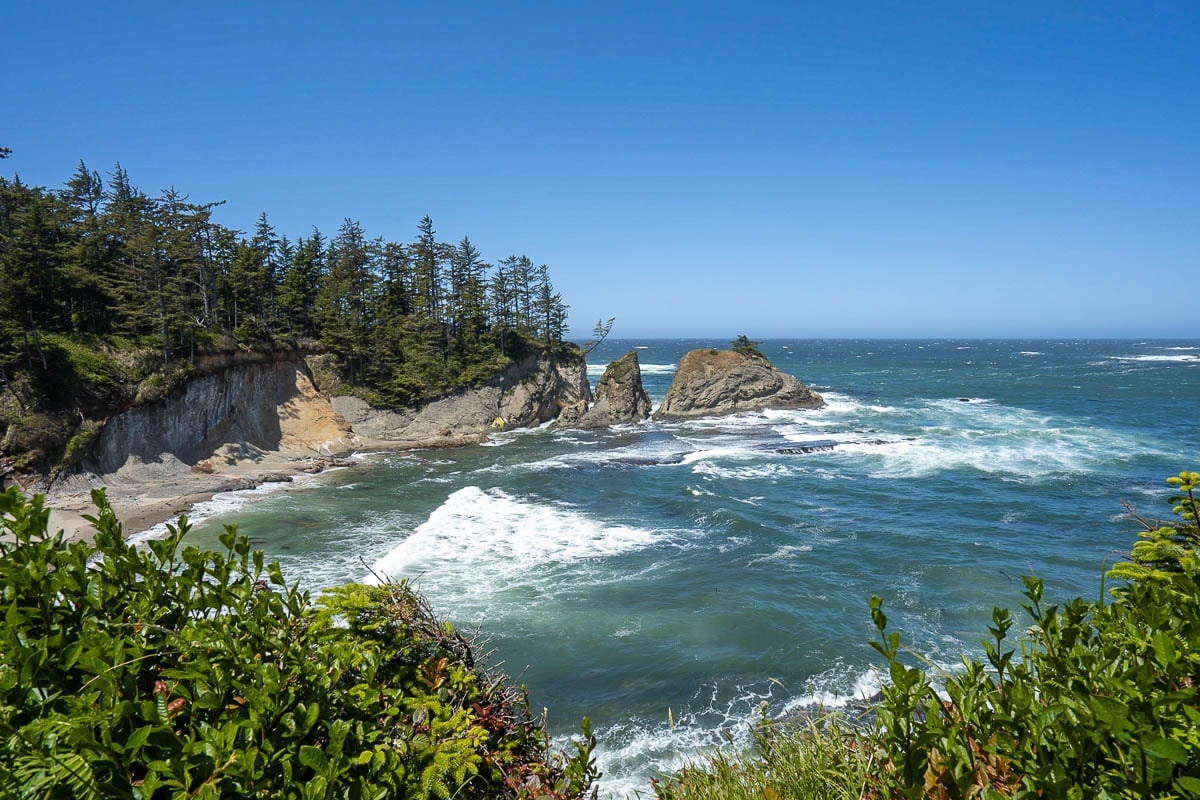
A short drive southwest of town, Shore Acres State Park perches on a rugged bluff above the Pacific and is widely regarded as one of Oregon's most scenic state parks. The grounds include a formal botanical garden once belonging to a lumber baron, with seasonal flower displays and year-round coastal viewpoints, while the cliffside trails deliver dramatic views of surf and sea stacks. A holiday lights display in December draws visitors from across the region.
About twenty-five miles south along the coast lies the small town of Bandon, known for its cranberry heritage, working harbor, and a celebrated stretch of public golf courses that has made it a recognized destination for golfers. The Old Town district offers galleries, seafood spots, and a picturesque marina. Face Rock State Scenic Viewpoint and other ocean overlooks give visitors easy access to beaches known for sea stacks and tide pooling.
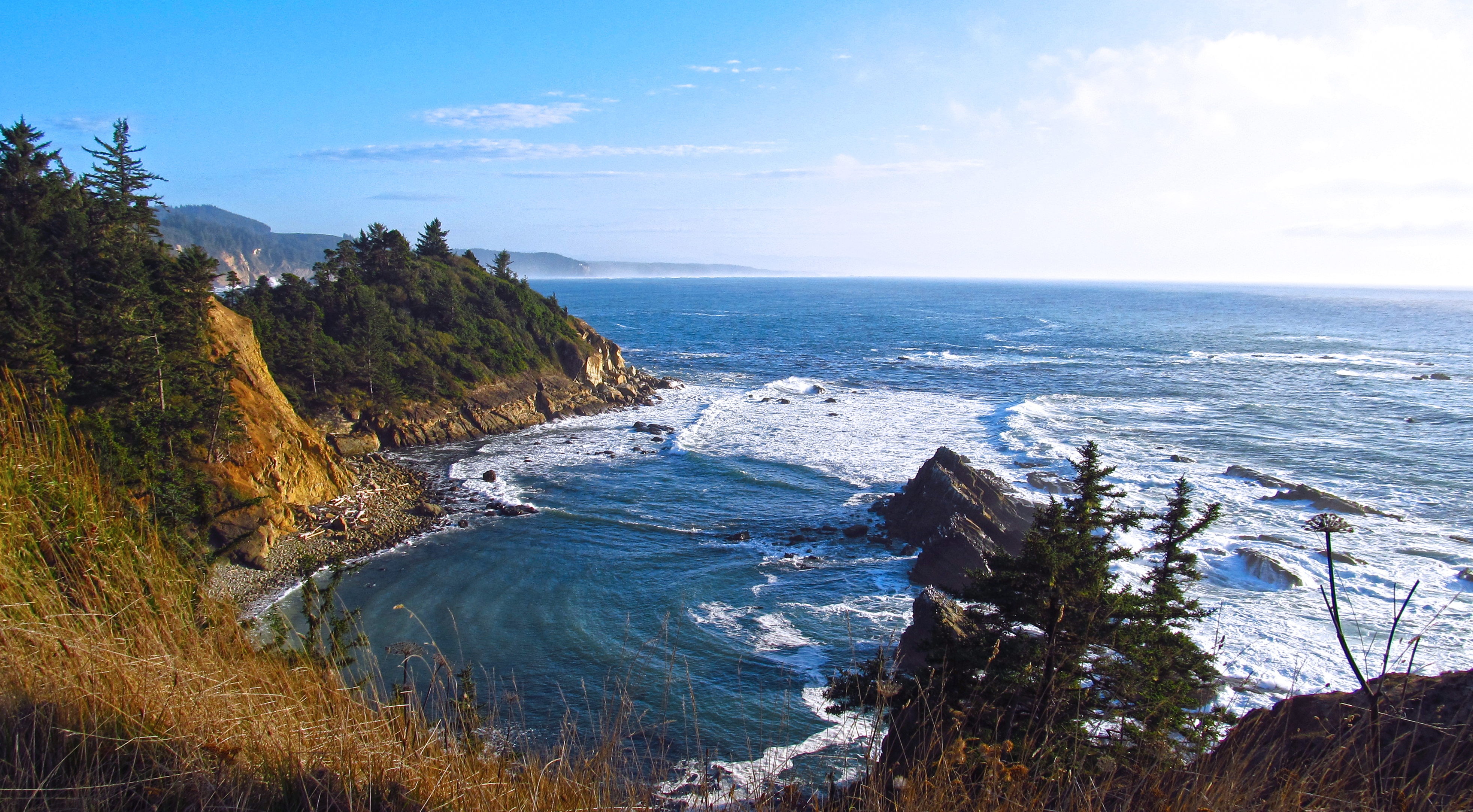
To the south of Coos Bay, the unincorporated community of Charleston serves as a working fishing port and the gateway to Cape Arago State Park, a scenic headland with a paved scenic drive, a sheltered cove, and one of the best spots on the coast for observing seals, sea lions, and migrating whales from shore. The short drive from town makes it an easy half-day excursion for visitors based in Coos Bay.
Coos Bay's appeal as a short-term rental base comes from the way it pairs small-city convenience with quick access to some of the most varied coastal landscapes in the Pacific Northwest. Guests can spend mornings wandering the waterfront and the Coos History Museum, afternoons on the dunes or at Shore Acres, and evenings sampling the local seafood, all without the crowds that flock to the more famous beaches farther north. The combination of year-round outdoor recreation, dramatic scenery, and an under-the-radar feel makes the area a natural fit for travelers looking to explore the southern Oregon coast.
Want to know if a property in Coos Bay is a good investment?
Enter an address to get instant revenue potential and comps.