
Hyde Park, New York
Want to see how Hyde Park compares to other top cities in New York? Explore all city regulations in New York. →
Hyde Park, NY
Generally Investor Friendly
STR Regulations for Hyde Park, New York
Overview: Are Short-Term Rentals Allowed in Hyde Park?
- Yes, short-term rentals (STRs) are allowed to operate in Hyde Park, NY today.
- As of the latest countywide assessment, Hyde Park hosts approximately 50 STR units (count reflects known listings via compliance-data partners).
- Hyde Park does not currently have town-specific STR regulations; the town’s website indicates standard zoning and health/safety requirements apply to rentals, and the market operates under general New York State and Dutchess County rules.
- New York State requires collection of a 4% occupancy tax on STR stays; Dutchess County’s hotel occupancy tax applies as well (county has an Airbnb remittance agreement), and a statewide STR registry system is rolling out via counties through 2026.
References:
- Town-level operational guidance and no specific STR law confirmation: “Vacation Rental Management in Hyde Park, New York” (SummerOS)
- Countywide STR presence and Hyde Park count: Dutchess County Planning Federation eNewsletter (Sept/Oct 2019)
- NYS policy on STR registry and tax: NYS DOS Local Government presentation (Short-Term Rental Regulation)
What do Airbnb hosts actually earn in Hyde Park?
Hyde Park hosts earn a median $35,538/year with $257 ADR and 56% occupancy.
Top performers pull in $56,640+ per year.
See the full Hyde Park market breakdownHow to Start a Short-Term Rental Business in Hyde Park
- Confirm zoning and property eligibility
- Operate in a residential zone. Ensure the structure is a lawful dwelling; avoid illegal conversions and confirm that accessory apartments or additions are properly permitted.
- If the property is a multiple dwelling (3+ families), review Multiple Dwelling Law restrictions for sub-30-day rentals (see “State Regulations,” below).
- Plan for taxes and the registry
- Obtain a NYS Certificate of Authority (COA) to collect and remit the NYS 4% occupancy tax; register via the Tax Department’s Online Services or by calling the NYS Taxpayer Assistance Center.
- Dutchess County’s hotel occupancy tax applies to STRs; county has a voluntary agreement with Airbnb to collect and remit county tax for platform bookings, and the county contracts with Host Compliance to identify STRs and notify hosts of tax obligations.
- Prepare for the NYS Short-Term Rental Registry: counties may create registries by June 26, 2026. Hosts or hosting services will need to register; non-compliant hosts and booking agencies can face fines enforced with the Attorney General’s office.
- Protect the business and property
- Secure adequate insurance. Many standard homeowner policies exclude or limit short-term rental activity; obtain appropriate coverage or endorsements.
- Choose a guest screening and house rules strategy; require quiet hours, trash handling, parking, and occupancy limits.
- Operationalize the listing
- Collect and remit taxes; include tax registration and permit numbers (if required) in advertisements.
- Prepare safety equipment, emergency information, and a guest welcome guide.
- Build a local response plan: designate a local contact or property manager able to respond quickly to complaints.
References:
- Registration and registry policy: NYS DOS Local Government presentation
- County compliance and tax context: Dutchess County Planning Federation eNewsletter (Sept/Oct 2019)
- NYS COA registration: NYS Department of Taxation and Finance (general procedures)
Required Documents, Permits, Licenses, and Guidelines
- Certificate of Authority (NY Sales/Use Tax—Hotel/Motel Room Occupancy Tax)
- Purpose: collect the 4% state occupancy tax and related county taxes.
- Where to get: NYS Tax Department Online Services (create an account, select “Sales Tax,” then “Hotel/Motel Room Occupancy Tax”); alternate filing: Form DTF-9 or DTF-9.1 if filing by paper; assistance via the NYS Taxpayer Assistance Center (518) 457-0578.
- Local permit status
- Hyde Park does not have a specific STR operating permit today; standard building, fire, and zoning compliance apply. If any new local rules are adopted, expect an annual permit process with health/safety verification and advertising requirements.
- Health and safety best practices
- Operational smoke and carbon monoxide detectors; fire extinguisher; clear egress; exterior exit or rescue windows in sleeping rooms; operational electrical systems; weekly garbage removal during stays; posted quiet hours (e.g., 10 p.m.–8 a.m.); parking plans; emergency information and rules for guests; clear contact information for on-call issues.
- Advertising compliance
- Include any required permit number or registration details in listings once local rules take effect or county registry requirements are active.
- Insurance
- Obtain adequate coverage recognizing STR use; standard homeowner policies may exclude or limit coverage.
References:
- County guidance on permits and safety: Dutchess County Planning Federation eNewsletter (Sept/Oct 2019)
- NYS registry timeline: NYS DOS Local Government presentation
- NYS COA procedures: NYS Department of Taxation and Finance
Specific Regulations (Town, County, State)
Town of Hyde Park (Dutchess County)
- No STR-specific law in force as of the latest guidance.
- General requirements:
- Property must be zoned for residential use.
- Health and safety standards apply (smoke/CO detection, fire safety, egress).
- Standard nuisance rules (noise, trash, parking) apply.
- Multi-family dwellings and building code compliance must be respected.
- Caveat: Municipalities across Dutchess County have been exploring STR rules; monitor local code updates. Nearby villages (e.g., Rhinebeck) have enacted stricter rules—these apply only within the village limits, not Hyde Park town.
References:
- Town-level confirmation: “Vacation Rental Management in Hyde Park, New York” (SummerOS)
Dutchess County
- Hotel occupancy tax applies to STRs.
- Airbnb has a voluntary agreement to collect and remit county occupancy tax for platform bookings.
- The county uses Host Compliance to identify STRs and notify hosts of tax obligations; beginning in 2020, the county offered to cover certain compliance monitoring modules for municipalities that adopt STR regulations.
Reference:
- Dutchess County Planning Federation eNewsletter (Sept/Oct 2019)
New York State
- Short-Term Rental Registry: counties can create registries by June 26, 2026; hosts or hosting services must register. Non-compliant hosts and booking agencies can be fined, with enforcement assistance from the Attorney General.
- Multiple Dwelling Law:
- Rentals of less than 30 days in “Class A” multiple dwellings (3+ families living independently) are prohibited unless the host is present.
- NYC has additional restrictions (changes to use/occupancy/egress are illegal absent explicit authorization).
- Occupancy tax: NYS requires 4% hotel/motel room occupancy tax on STR stays.
- Municipal authority: outside NYC, municipalities can define, prohibit, and regulate STRs as they see fit; local rules can be stricter.
- Case law trends: courts have upheld bans and rejections of certain residency-based restrictions (e.g., equal protection and commerce clause issues).
Reference:
- NYS DOS Local Government presentation (Short-Term Rental Regulation)
Neighboring example (for context only—village-specific, not Hyde Park)
- Village of Rhinebeck (in Dutchess County) requires annual permits, caps permits, limits guest count and rental days, requires a local property manager for unhosted rentals, and prohibits on-premise advertising. These rules apply only inside the village; they are illustrative of what a nearby municipality has enacted.
Reference:
- NYS DOS Local Government presentation (Village of Rhinebeck case summary)
Contact Information (Phone, Email, Website)
- Dutchess County Department of Planning & Development
- Email: DCPlanningFederation@dutchessny.gov
- Phone: (845) 486-3600
- Website: dutchessny.gov/Departments/Planning
- NYS Department of Taxation and Finance (Hotel/Motel Occupancy Tax help)
- Phone: (518) 457-0578
- Online: NY Tax—Online Services (search “Hotel/Motel Room Occupancy Tax” and “Certificate of Authority”)
References:
- County contact and compliance context: Dutchess County Planning Federation eNewsletter (Sept/Oct 2019)
- NYS COA contact: NYS Department of Taxation and Finance
Links to Source Pages
- Dutchess County Planning Federation eNewsletter (Sept/Oct 2019) – Understanding Short-Term Rentals: www.dutchessny.gov/Departments/Planning/Docs/SeptOct2019eNewsletter-ShortTermRentals-printerfriendly.pdf
- NYS DOS Short-Term Rental Regulation (2025) – Local Government Overview, Definitions, Registry: www.dutchessny.gov/Departments/Planning/Docs/Short_Term_Rentals_DOS_042925.pdf
- Home Sweet Hudson – Hudson Valley STR Regulation Resources (county/town links overview): homesweethudson.com/str-regulation-resources/
- Summer – Vacation Rental Management in Hyde Park, New York (town-level overview and no specific STR law confirmation): www.gosummer.com/vacation-rental-management/hyde-park-new-york
Key compliance checklist for Hyde Park STRs
- Confirm zoning and lawful use; do not operate illegal dwelling conversions.
- Register for NYS Certificate of Authority to collect the 4% occupancy tax; prepare for county hotel occupancy tax and state registry via Dutchess County when active.
- Maintain health/safety equipment; establish and enforce guest rules (quiet hours, trash, parking, occupancy limits).
- Post emergency information and on-call contact details; consider a local property manager for rapid response.
- Carry adequate insurance recognizing STR use; avoid relying on platform protections as a substitute for separate coverage.
- Monitor Hyde Park code updates and county communications to stay ahead of new local rules.
Next step
Found a property in Hyde Park?
Paste any address and get estimated revenue, cash-on-cash return, and comparable STR performance in under 5 minutes. 3 free analyses per day.
Free brief
Get the free Hyde Park STR Investment Brief
Revenue data, top neighborhoods, seasonal trends, and the key regulations for Hyde Park, New York in one email.
Hyde Park
Market Saturation Score
Photos of Hyde Park


Overview of Hyde Park
Hyde Park is a town in Dutchess County, New York, set along the eastern bank of the Hudson River in the heart of the Hudson Valley. With a population of roughly 21,000 residents spread across the town and its hamlets, Hyde Park carries the quiet, leafy character of a Hudson Valley river town, a place of country roads, working farms, and nineteenth-century estates. It is best known as the home of President Franklin Delano Roosevelt, and it functions as a gateway to the broader Hudson Valley's historic estates and riverfront recreation. From New York City, Hyde Park sits about 85 miles to the north, typically a two-hour drive depending on traffic along the Taconic State Parkway or Route 9.
The most prominent draw in Hyde Park is the Home of Franklin D. Roosevelt National Historic Site, which preserves Springwood, the lifelong home of the thirty-second president. The estate includes the first presidential library ever built in the United States, a working farm, walking trails, and the graves of Franklin and Eleanor Roosevelt, all on a landscaped property overlooking the Hudson. Just a few minutes down the road, the Vanderbilt Mansion National Historic Site offers a contrasting Gilded Age experience, with a 54-room Beaux-Arts mansion, formal gardens, and riverfront grounds that once hosted presidents and European royalty. Both sites are within a short drive of the town center.
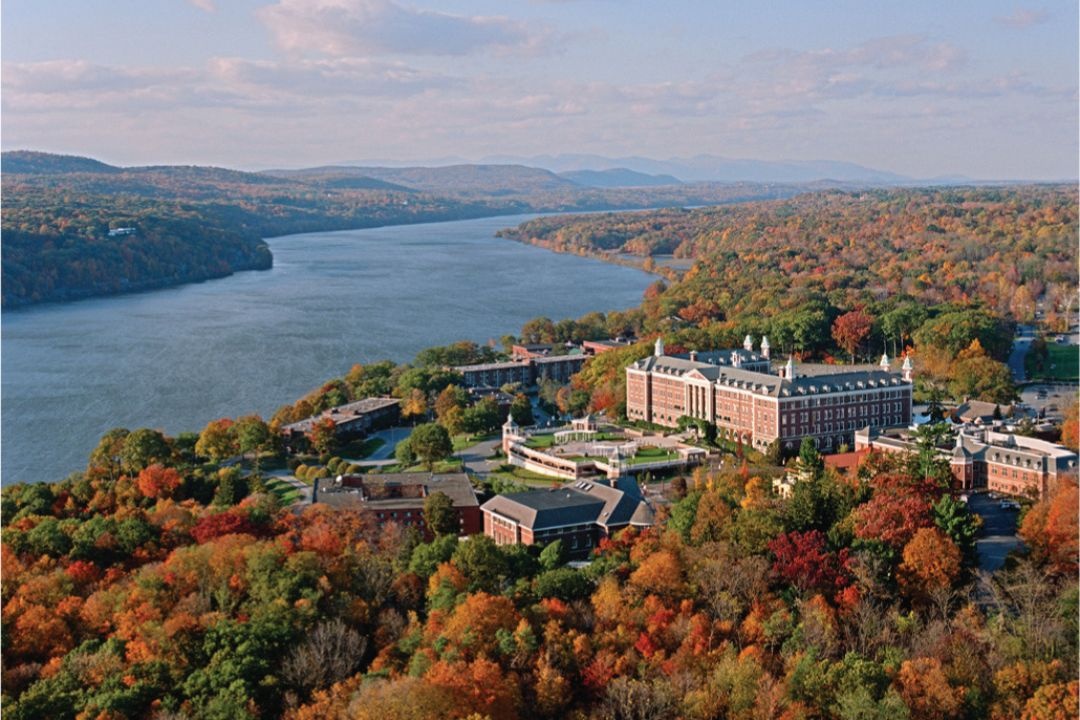
A short distance southeast of the historic estates sits the Culinary Institute of America, housed in a former Jesuit monastery on a hilltop overlooking the river. The school's student-run restaurants — including the Apple Pie Bakery Café and the more formal American Bounty — are open to the public and have helped make Hyde Park a destination for food lovers. Nearby, the Eleanor Roosevelt National Historic Site at Val-Kill, the only National Historic Site dedicated to a first lady, rounds out the Roosevelt story with the cottage and stone factory building where Eleanor entertained friends, gardened, and worked on her post-White House writing.
Roughly fifteen minutes south of Hyde Park, the Walkway Over the Hudson State Historic Park in Poughkeepsie spans the river on a converted nineteenth-century railroad bridge, offering more than a mile of elevated pedestrian and cycling views over the water and the surrounding valley.
For short-term rental investors, Hyde Park offers a rare combination: a steady stream of history-minded visitors drawn by three National Park Service sites within a few miles of one another, the year-round pull of the Culinary Institute, and easy access to the wider Hudson Valley's river towns, wineries, and the Walkway. Its proximity to New York City, manageable drive times from the tri-state area, and concentration of marquee attractions make it a natural base for travelers looking to explore this stretch of the Hudson.
Want to know if a property in Hyde Park is a good investment?
Enter an address to get instant revenue potential and comps.