
Wrightsville Beach, North Carolina
Want to see how Wrightsville Beach compares to other top cities in North Carolina? Explore all city regulations in North Carolina. →
Wrightsville Beach, NC
Very Investor Friendly
STR Regulations for Wrightsville Beach, North Carolina
Overview: Are Short-Term Rentals Allowed in Wrightsville Beach?
Yes—short-term rentals are allowed in North Carolina and within the greater Wilmington/Wrightsville Beach market. State law does not ban short‑term rentals. Local governments may regulate them, and New Hanover County (which encompasses Wrightsville Beach) administers room occupancy taxes and other tax requirements for lodging operators. Investors should note that certain North Carolina cities have adopted their own permitting, occupancy, parking, and zoning rules, and that these regulations are evolving.
Important caveat: As of writing, North Carolina Senate Bill 667 (2023)—a bill that would have pre‑empted and reshaped many local STR ordinances—has stalled after its first reading and has not become law. Investors should therefore rely on current, city- and county-level rules and monitor legislative developments.
- Are STRs allowed? Yes, STRs are allowed in North Carolina; there is no statewide ban.
- What is a short‑term rental in NC? A rental of a residential property for fewer than 90 days, for recreational/leisure/vacation purposes, where the tenant has another permanent residence to return to.
- Pre‑emption status: Senate Bill 667 stalled; it has not been enacted as of writing.
- Links to sources:
What do Airbnb hosts actually earn in Wrightsville Beach?
Wrightsville Beach hosts earn a median $75,226/year with $473 ADR and 62% occupancy.
Top performers pull in $102,650+ per year.
See the full Wrightsville Beach market breakdownHow to Start a Short-Term Rental Business in the Wrightsville Beach Market
- Check zoning and HOA/condo rules first.
- Confirm your property’s zoning permits short‑term rental use. Even if the state/county allow STRs, zoning or your HOA/condo association can restrict or prohibit rentals.
- Review HOA governing documents for minimum lease length caps, occupancy/guest limits, parking rules, or other STR constraints.
- If you belong to an HOA, obtain written confirmation that STRs are permitted and gather any required approval or documentation.
- Decide your operating model.
- Entire-home rental vs. shared home/homestay (different rules may apply).
- Use of third‑party marketplaces (Airbnb, VRBO) vs. direct bookings (affects tax registration and remittance workflows).
- Register for and collect taxes.
- You will be responsible for state sales tax, local sales tax, and local room occupancy (lodging) tax.
- If you transact exclusively via marketplaces that collect and remit taxes on your behalf, you may not need to register with the state; if not, you must register with the North Carolina Department of Revenue (NCDOR) and file returns.
- New Hanover County administers room occupancy tax. Register with the County’s Finance Department to set up your local lodging tax account and access the payment portal.
- Maintain accurate records: gross receipts, taxes collected, and remitted.
- Implement compliance controls and guest communications.
-
Align with any applicable local ordinances for noise, parking, waste, and occupancy.
-
Include city/county ordinance summaries or references in your rental agreements and guest welcome materials.
-
Monitor legislative updates (e.g., SB 667 status) and adjust policies accordingly.
-
Sources:
Required Documents, Permits, Licenses, and Guidelines
State requirements
- Tax registration: If you accept direct bookings and a marketplace does not collect/remit taxes for you, register with NCDOR to obtain a Sales and Use Tax Certificate of Registration.
- Business registration: Complete the NCDOR Business Registration Application (Form NC‑BR) for income tax withholding, sales and use tax, and related obligations.
- Collection/remittance: Collect and remit state sales tax (4.75% state rate) plus applicable local sales tax (2.00–2.75%) and local room occupancy tax.
- Vacation Rental Act: North Carolina law requires a written rental agreement for short‑term rentals; ensure your lease/booking documents satisfy this requirement.
County requirements (New Hanover County)
- Room occupancy tax: Register with New Hanover County Finance; file returns and pay local lodging taxes per the County’s schedule.
- Payment portal: Use the County’s online room occupancy tax portal for filings and payments.
City/town-specific considerations (Wrightsville Beach, Wilmington, New Hanover County)
- Wrightsville Beach: No city‑specific STR permitting requirements were identified in the provided content. Treat County/state rules as primary and verify with the Town for any updates.
- Wilmington: Separate, city‑level rules may apply if you operate within city limits, including potential registration/permitting, occupancy caps, separation/distancing rules, and neighborhood caps that have been litigated (e.g., Schroeder v. City of Wilmington).
- Always review and comply with local ordinances for noise, parking, occupancy limits, and safety.
Documentation and records
-
Maintain rental agreements, tax filings, and correspondence with the County/State.
-
Include city/county ordinance summaries in contracts and guest materials where applicable.
-
Sources:
Specific Regulations for Short-Term Rentals
North Carolina (State level)
- No statewide ban on STRs.
- Short‑term rental defined as a rental for fewer than 90 days, for vacation/leisure purposes, with the guest maintaining a permanent residence elsewhere.
- Local governments may regulate STRs in various ways (e.g., permits, occupancy/parking limits, safety standards).
- Senate Bill 667 (2023) proposed unified state rules and would have prohibited cities from banning STRs, limiting rental nights, requiring owner occupancy, classifying STRs as commercial, or restricting marketplace operations; however, the bill stalled after the first reading.
- As of writing, city ordinances (including any in Wilmington) remain in effect.
Local considerations (New Hanover County and nearby cities)
- New Hanover County administers room occupancy tax for lodging providers, including short‑term rentals.
- City-level rules (e.g., Wilmington) may include:
- Occupancy caps (often 2 per bedroom plus a small number of extra guests).
- Parking restrictions based on bedrooms or required on‑site parking.
- Noise/sound restrictions (especially late‑night hours).
- Zoning permits/registration and, in some cases, separation/distancing rules and neighborhood caps (the latter have been subject to litigation).
- Wrightsville Beach: No city‑specific STR permitting requirements were identified in the provided content. Confirm with the Town for any updates.
HOA/condo considerations
- HOAs can impose private restrictions on STRs (e.g., prohibit rentals, set minimum lease terms, limit guests, regulate parking), as long as those rules are included in the governing documents.
- HOA restrictions are separate from state/county rules and can be more restrictive than municipal ordinances.
Taxes
-
Sales tax: 4.75% state sales tax plus 2.00–2.75% local sales tax.
-
Room occupancy (lodging) tax: Remitted to the County; register with the New Hanover County Finance Department and file according to County requirements.
-
If you transact exclusively through marketplaces that collect/remit these taxes for you, you may not need to register with the state; otherwise, you must register and file.
-
Sources:
Contact Information (Local Authority)
New Hanover County – Finance Department (Room Occupancy Tax)
- Email: rot@nhcgov.com
- Phone: (910) 798‑7113
- Physical Address: NHC Finance, 230 Government Center Dr., Suite 165, Wilmington, NC 28403
- Online Room Occupancy Tax Portal: newhanovercounty.hdlgov.com/Home/SignIn
- Website: www.nhcgov.com/408/Short-Term-Rental-Taxes
Town of Wrightsville Beach (general municipal information)
- Website (quick link via New Hanover County): www.townofwrightsvillebeach.com/
Note: For city-specific permitting questions (e.g., Wilmington), contact the appropriate city department. No Wrightsville Beach–specific STR permit office was identified in the provided content.
Source Links
- NC Short-Term Rentals Regulation – Cedar Management Group: www.cedarmanagementgroup.com/nc-short-term-rental-regulation/
- North Carolina Short-Term Rental Regulations – Hostfully: www.hostfully.com/regulations/north-carolina/
- Short-Term Rental Taxes – New Hanover County: www.nhcgov.com/408/Short-Term-Rental-Taxes
- New Hanover County Online Room Occupancy Tax Portal: newhanovercounty.hdlgov.com/Home/SignIn
- Town of Wrightsville Beach (Quick Link via NHC): www.townofwrightsvillebeach.com/
- Is My Property Eligible for Short-Term Rentals? – Wilmington Rental Properties (informational blog): wilmingtonrentalproperties.com/blog/is-my-property-eligible-for-short-term-rentals/
Bottom line for investors: In the Wrightsville Beach area, state law does not prohibit short‑term rentals, County-level lodging tax compliance is required, and nearby cities may impose additional local rules. Confirm zoning and HOA restrictions, register for applicable taxes with New Hanover County and the State (if you accept direct bookings), and build a compliance operating system that covers occupancy, parking, noise, and guest communications. Monitor ongoing legislation and municipal updates—especially given the dynamic nature of NC STR policy.
Next step
Found a property in Wrightsville Beach?
Paste any address and get estimated revenue, cash-on-cash return, and comparable STR performance in under 5 minutes. 3 free analyses per day.
Free brief
Get the free Wrightsville Beach STR Investment Brief
Revenue data, top neighborhoods, seasonal trends, and the key regulations for Wrightsville Beach, North Carolina in one email.
Wrightsville Beach
Market Saturation Score
Photos of Wrightsville Beach


Overview of Wrightsville Beach
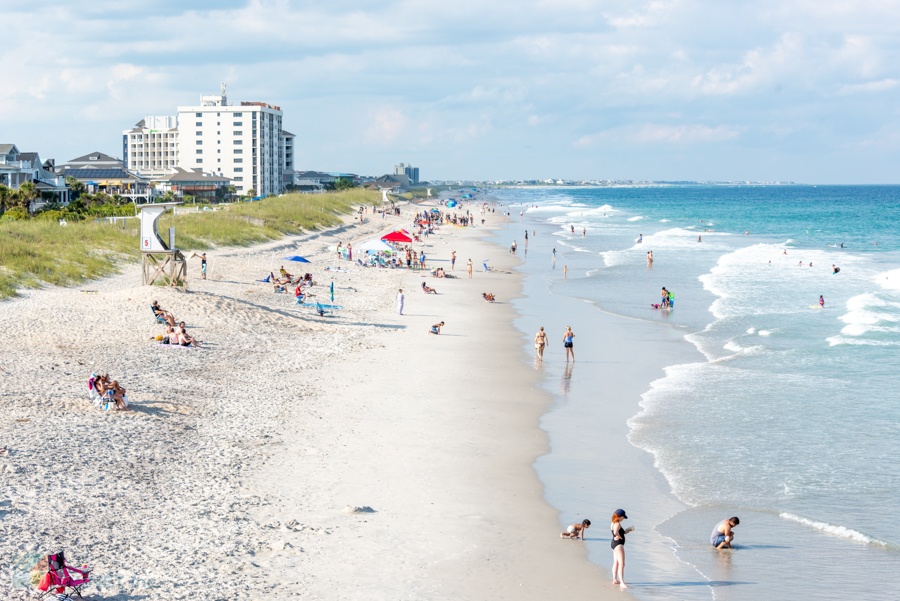
Wrightsville Beach is a small barrier-island town in New Hanover County, North Carolina, with a year-round population of roughly 2,500 that swells considerably during the warmer months. Laid-back and family-oriented, the community is best known for its wide, clean Atlantic beach strand, its lively surf scene, and its role as a popular seaside escape for visitors to the greater Wilmington area. The town sits about ten miles east of downtown Wilmington, a quick drive across the Intracoastal Waterway that makes it easy for guests to pair a beach holiday with the dining, historic district, and riverfront attractions of the larger city.
A defining feature of the island is the Wrightsville Beach Loop, a roughly 2.45-mile circuit of roadway, bike lanes, and sidewalks that loops around the heart of the town. Lined with beach cottages, palmettos, and small commercial blocks, the Loop is a magnet for runners, cyclists, and families out for an evening stroll, and it gives the town a distinct, walkable personality that sets it apart from more highway-driven coastal communities.
Stretching out into the surf, Johnnie Mercers Pier has anchored the town's oceanfront for generations as one of the longer-standing fishing piers on the North Carolina coast. Anglers cast for spot, mullet, and seasonal king mackerel right off the deck, while sightseers come for the straightforward pleasure of walking several hundred feet over the breaking waves and watching the surfers below.
Just a short drive west across the bridge, Airlie Gardens offers a quieter counterpoint to the beach days, with more than sixty acres of formal gardens, live oaks draped in Spanish moss, seasonal blooms, and a lakefront overlook. A bit farther south along the coast, Fort Fisher State Historic Site preserves the remains of a large Confederate earthwork that fell to Union forces late in the Civil War, closing the Confederacy's last major port at Wilmington; its museum and reconstructed gun battery sit a little under thirty minutes from the beach.
For short-term rental owners, Wrightsville Beach pairs a classic, recognizable Carolina beach identity with reliable draw from surfers, families, college visitors to nearby University of North Carolina Wilmington, and travelers using it as a base for exploring the Cape Fear coast. The combination of a walkable, amenity-rich island, easy access to Wilmington, and a string of well-loved natural and historic attractions nearby gives the town a year-round rhythm of demand that supports a diverse rental calendar.
Want to know if a property in Wrightsville Beach is a good investment?
Enter an address to get instant revenue potential and comps.