
Sparta, North Carolina
Want to see how Sparta compares to other top cities in North Carolina? Explore all city regulations in North Carolina. →
Sparta, NC
Generally Investor Friendly
STR Regulations for Sparta, North Carolina
Executive Overview: Are Short-Term Rentals Allowed in Sparta, NC?
Short-term rentals are allowed in Sparta, North Carolina, but they are not unregulated. Because Sparta’s town limits and its extraterritorial jurisdiction are excluded from Alleghany County’s Property Rights Protection Ordinance, STRs within the town itself are governed primarily by the Town of Sparta’s zoning and any town-level policies (if any). Outside the town (within the unincorporated areas of Alleghany County), the county’s open-district zoning system applies: an STR is not a prohibited or exempt use and does not appear to qualify as a use-by-right; therefore, an STR typically must obtain a Conditional Use Permit (CUP) from the Planning Board before operating. Regardless of jurisdiction, North Carolina law imposes statewide obligations including carbon monoxide detection, smoke detector and safety code compliance, and collection/remittance of applicable occupancy taxes. Practically, this means investors can operate in both town and county settings, but the path to compliance is different: town STRs must verify local zoning and any municipal rules, while county STRs must obtain a CUP and complete site plan and compliance processes.
References:
- County ordinance (jurisdictional exclusion for town of Sparta limits): www.alleghanycounty-nc.gov/ordinances/1-324.pdf
- County website (for CUP and permitting processes): alleghanycounty-nc.gov/
- County Board of Commissioners portal (for Planning Board actions and public processes): alleghanycounty-nc.gov/index.php/board-of-commissioners/
- State-level STR regulations summary: www.ncleg.gov/EnactedLegislation/Statutes/HTML/BySection/Chapter_160D/GS_160D-1201.html
- NC occupancy tax overview (AOC resource): www.nc.gov/services/taxes-permits/occupancy-tax/
What do Airbnb hosts actually earn in Sparta?
Sparta hosts earn a median $23,841/year with $167 ADR and 48% occupancy.
Top performers pull in $32,805+ per year.
See the full Sparta market breakdownMarket Snapshot (What STR Investors Should Expect in Sparta)
Sparta is a small, scenic town in the Blue Ridge Mountains, with tourism anchored in outdoor activities, fall foliage, and local culture. The STR market is competitive and seasonal, with strong performance in summer and October and quieter winters. Property types include rustic cabins, modern condos, and charming cottages—often emphasizing outdoor amenities and mountain views. Investors typically emphasize fire pits, BBQ grills, scenic vistas, and proximity to hiking, fishing, and the Blue Ridge Parkway to drive bookings and rates. Community expectations and zoning sensitivity matter in this rural/suburban setting; respectful operations and proactive neighborhood engagement help preserve goodwill.
References:
- Market overview, seasonality, and amenities (Summer/GoSummer): www.gosummer.com/vacation-rental-management/sparta-north-carolina
- STR performance snapshot and market composition (StaySTRA): staystra.com/location/north-carolina/sparta/
How to Start a Short-Term Rental Business in Sparta/Alleghany County
- Site Due Diligence
- Determine if the property lies within the Town of Sparta limits (or its extraterritorial jurisdiction) or within unincorporated Alleghany County. The jurisdictional boundary dictates which permitting regime applies.
- Review local zoning to ensure lodging is an allowed use and confirm setbacks, signage, parking, and any neighborhood compatibility standards. If you are within the county’s open district, assume a Conditional Use Permit will be required.
- Permitting Pathway (County—Unincorporated Areas)
- Engage the County Administrator/Planning Department early for a pre-application conference to confirm if a Conditional Use Permit is needed.
- Prepare a sketch plan showing building locations, distances to property lines, signage and outdoor lighting, parking, and utility connections.
- Submit the Conditional Use Permit application, pay the nonrefundable fee ($50), and prepare for the Community Compatibility Assessment and Land Development Plan review.
- Attend the Planning Board public hearing (noticed to adjoining property owners within 2,000 feet) and be prepared to address compatibility questions (noise, lighting, traffic, odor, water runoff, views, and impacts on nearby property values).
- After approval, submit and obtain approval of the Site Plan (with specific plan content and timeframes required).
- Obtain building permits from the Alleghany County Building Inspection Department within six months of site plan approval and complete all conditions within twelve months.
- Secure a Certificate of Compliance prior to occupancy; operating without one is illegal.
- Permitting Pathway (Town of Sparta)
- Contact the Town of Sparta for zoning verification and any local licensing or compliance requirements. Although the county ordinance excludes the town limits, investors should confirm whether Sparta has adopted any town-level STR-specific rules.
- If no town-specific STR ordinance exists, comply with general zoning for lodging and any building/safety requirements; verify whether a local business license/permit is needed and the local occupancy tax rate/collection process.
- Safety and Code Readiness
- Install carbon monoxide detectors where required by North Carolina law (especially if the property has fossil-fuel-burning appliances, an attached garage, or is in proximity to potential CO sources).
- Ensure functioning smoke detectors, fire extinguishers, and clear emergency egress. Confirm compliance with state minimum housing and fire safety codes for rentals.
- Provide guests with emergency contact information and a clear house manual covering check-in/out, waste disposal, noise, parking, and local rules.
- Taxes and Registration
- Register for, collect, and remit the North Carolina occupancy tax (generally 6% in many counties; confirm the applicable Alleghany County rate).
- Also collect and remit North Carolina sales tax on the lodging portion as required by state law.
- Maintain accurate records and file on the required cadence.
- Property Readiness and Guest Experience
- Optimize listings for seasonal demand, emphasizing outdoor amenities and mountain access.
- Provide local guides and respect quiet hours/curfews; manage lighting and noise to maintain good neighbor relations.
- Establish professional cleaning and maintenance routines given the rural location.
References:
- County CUP process and fees, site plan requirements, timelines (open-district ordinance): www.alleghanycounty-nc.gov/ordinances/1-324.pdf
- County government and Planning Board: alleghanycounty-nc.gov/ and alleghanycounty-nc.gov/index.php/board-of-commissioners/
- State STR regulatory overview: www.ncleg.gov/EnactedLegislation/Statutes/HTML/BySection/Chapter_160D/GS_160D-1201.html
- Occupancy tax guidance: www.nc.gov/services/taxes-permits/occupancy-tax/
Required Documents, Permits, Licenses, and Guidelines
County (Unincorporated Alleghany County—Open District)
- Conditional Use Permit (CUP) application and fee ($50).
- Sketch Plan: building footprints and distances to property lines, signage and outdoor lighting locations, parking layout, deed restrictions (if any).
- Community Compatibility Assessment responses (noise, lighting, traffic, odor, runoff, views, property value impacts).
- Land Development Plan consistency assessment.
- Site Plan: title block (developer name, assigned number, owner name/address, graphic scale, total acreage), site boundary with dimensions, building dimensions and setbacks, septic/well or public utilities, utility easements, outdoor lighting, signage, parking, entrances/right-of-ways, north arrow, vicinity map, municipal/county boundary lines, buffers/green space, and any other information required by the Administrator.
- Building Permits: apply within six months of site plan approval; complete all CUP conditions within twelve months.
- Certificate of Compliance: required before occupancy; operating without it is a violation.
- Taxes and Safety: occupancy tax registration/remittance, sales tax remittance, CO detectors, smoke detectors, fire extinguishers, egress safety, and compliance with state/local codes.
Town of Sparta (Within Town Limits/ETJ)
- Zoning confirmation that lodging is a permitted use in the subject zoning district.
- Any town-issued business license/registration (if applicable).
- Building permits and inspections as required by state law; verify town-level compliance pathways if any.
- Taxes: register for and collect/remit NC occupancy tax and sales tax.
- Safety: CO detectors, smoke detectors, and fire safety equipment as required statewide.
Statewide (North Carolina)
- Compliance with NC General Statutes governing STRs (e.g., local authorization, safety, and registration requirements per GS 160D-1201).
- Occupancy tax rules; obtain county-specific rate and filing cadence.
- Sales tax collection and remittance on lodging.
- Carbon monoxide detector installation as required by state law; maintain smoke detectors and fire safety equipment.
References:
- County process specifics, permit types, fees, and compliance certificates: www.gosummer.com/vacation-rental-management/sparta-north-carolina (for general permitting outline), www.alleghanycounty-nc.gov/ordinances/1-324.pdf (for legal framework)
- State regulations: www.ncleg.gov/EnactedLegislation/Statutes/HTML/BySection/Chapter_160D/GS_160D-1201.html
- State tax information: www.nc.gov/services/taxes-permits/occupancy-tax/
Specific Regulations: City, County, and State
City of Sparta (Town-Level Rules)
- Jurisdiction: Town limits and extraterritorial jurisdiction are excluded from Alleghany County’s Property Rights Protection Ordinance; therefore, STRs are governed by town zoning and any town-level policies.
- No city-specific STR ordinance is identified in the provided content. Investors should confirm with the Town of Sparta whether any municipal licensing, caps, safety inspections, or operating standards apply.
- Compliance with statewide safety (CO/smoke/fire equipment) and tax obligations remains mandatory.
Alleghany County (Unincorporated Areas—Open District)
- Legal framework: Property Rights Protection Ordinance—open district zoning with limited prohibited uses; many uses require a Conditional Use Permit after review.
- STR classification: STRs (transient lodging) are not listed as prohibited or exempt uses and do not clearly qualify as uses-by-right; therefore, STRs typically require a Conditional Use Permit.
- Process: pre-application conference, CUP application and $50 fee, Community Compatibility Assessment, Planning Board public hearing with notice to adjoining property owners within 2,000 feet, and approval standards tied to the Land Development Plan and compatibility criteria.
- Site plan: required within three months of CUP approval; detailed content specified by ordinance; Planning Board approval and timelines to cure deficiencies; building permits required within six months of site plan approval; all conditions to be completed within twelve months.
- Certificate of Compliance: required before occupancy; violations subject to penalties.
- Appeals and variances: decisions may be appealed to the Board of Commissioners; variances require four-fifths vote and strict findings.
- Penalties: violations may constitute a misdemeanor with fines up to $50 per violation and/or up to 30 days imprisonment.
North Carolina (Statewide STR Regulations)
- Local authorization and safety/registration: GS 160D-1201 requires compliance with local regulations and adherence to minimum safety standards for short-term rentals.
- Taxes: occupancy tax at the county rate must be collected and remitted; sales tax applies to the lodging portion and must be remitted.
- Carbon monoxide detectors: state law requires installation in rental properties where risk is present (e.g., fossil-fuel-burning appliances, attached garages, proximity to CO sources).
- Safety: smoke detectors, fire extinguishers, and emergency egress must be maintained consistent with state codes.
References:
- County ordinance and CUP procedures: www.alleghanycounty-nc.gov/ordinances/1-324.pdf
- County website and Planning Board: alleghanycounty-nc.gov/ and alleghanycounty-nc.gov/index.php/board-of-commissioners/
- State STR statute: www.ncleg.gov/EnactedLegislation/Statutes/HTML/BySection/Chapter_160D/GS_160D-1201.html
- Occupancy tax resource: www.nc.gov/services/taxes-permits/occupancy-tax/
- Safety compliance and management overview (Summer): www.gosummer.com/vacation-rental-management/sparta-north-carolina
Local Contacts (Authority in Charge of STRs and Zoning/Permitting)
Use the following primary points of contact for permitting, zoning verification, and compliance questions.
Alleghany County Government (County Administrator and Planning Board—Primary for County STRs)
- Website: alleghanycounty-nc.gov/
- Planning Board (Conditional Use Permits): alleghanycounty-nc.gov/index.php/board-of-commissioners/
- Purpose: zoning verification in unincorporated areas, CUP applications, site plan approvals, building permits, and certificate of compliance.
Town of Sparta (Within Town Limits/ETJ)
- Official municipal website: townofsparta.org/
- Purpose: confirm whether town-level STR rules apply, zoning confirmation for lodging uses within the town, and any municipal licensing or inspection requirements.
North Carolina Department of Revenue (State Taxes)
- Occupancy and sales tax registration and filings: www.nc.gov/services/taxes-permits/
- Purpose: register for tax accounts, determine applicable occupancy tax rate and filing cadence for Alleghany County, and ensure proper sales tax collection/remittance.
Notes:
- Contact the County Administrator/Planning Department for pre-application conferences, CUP guidance, and scheduling public hearings.
- Phone/email contacts are not listed in the provided content; obtain current staff contacts directly from the above websites.
Source Links (Do Not Attempt to Fetch)
- Alleghany County Property Rights Protection Ordinance (Open District Zoning): www.alleghanycounty-nc.gov/ordinances/1-324.pdf
- Alleghany County Government: alleghanycounty-nc.gov/
- Alleghany County Board of Commissioners/Planning Board: alleghanycounty-nc.gov/index.php/board-of-commissioners/
- Town of Sparta (Official Site): townofsparta.org/
- NC General Statutes—Short-Term Rental Regulations (GS 160D-1201): www.ncleg.gov/EnactedLegislation/Statutes/HTML/BySection/Chapter_160D/GS_160D-1201.html
- North Carolina Occupancy Tax (State Resource): www.nc.gov/services/taxes-permits/occupancy-tax/
- Vacation Rental Management Overview (Sparta): www.gosummer.com/vacation-rental-management/sparta-north-carolina
- StaySTRA Market Overview and Performance (Sparta): staystra.com/location/north-carolina/sparta/
- High Country Host Visitor Guide (Sparta): highcountryhost.com/Sparta-NC-Travel-Guide
Practical Steps and Compliance Checklist
- Confirm jurisdiction (Town of Sparta vs. Alleghany County).
- Engage county planning if in unincorporated areas; prepare for CUP and compatibility review.
- Complete site plan and obtain building permits; secure certificate of compliance before first guest.
- Register for and remit occupancy and sales taxes; maintain records.
- Install and maintain CO/smoke detectors and fire safety equipment; provide emergency information to guests.
- Optimize listings for seasonal demand and respect neighbor relations; manage noise, lighting, and parking.
This guide is investor-focused and designed to be actionable. If town-specific STR rules are enacted in Sparta, investors should verify any new licensing, caps, or operational standards with the Town of Sparta. In the meantime, county STRs should strictly follow the CUP and site plan regime, and all operators must adhere to North Carolina’s safety and tax requirements.
Next step
Found a property in Sparta?
Paste any address and get estimated revenue, cash-on-cash return, and comparable STR performance in under 5 minutes. 3 free analyses per day.
Free brief
Get the free Sparta STR Investment Brief
Revenue data, top neighborhoods, seasonal trends, and the key regulations for Sparta, North Carolina in one email.
Sparta
Market Saturation Score
Photos of Sparta

Overview of Sparta
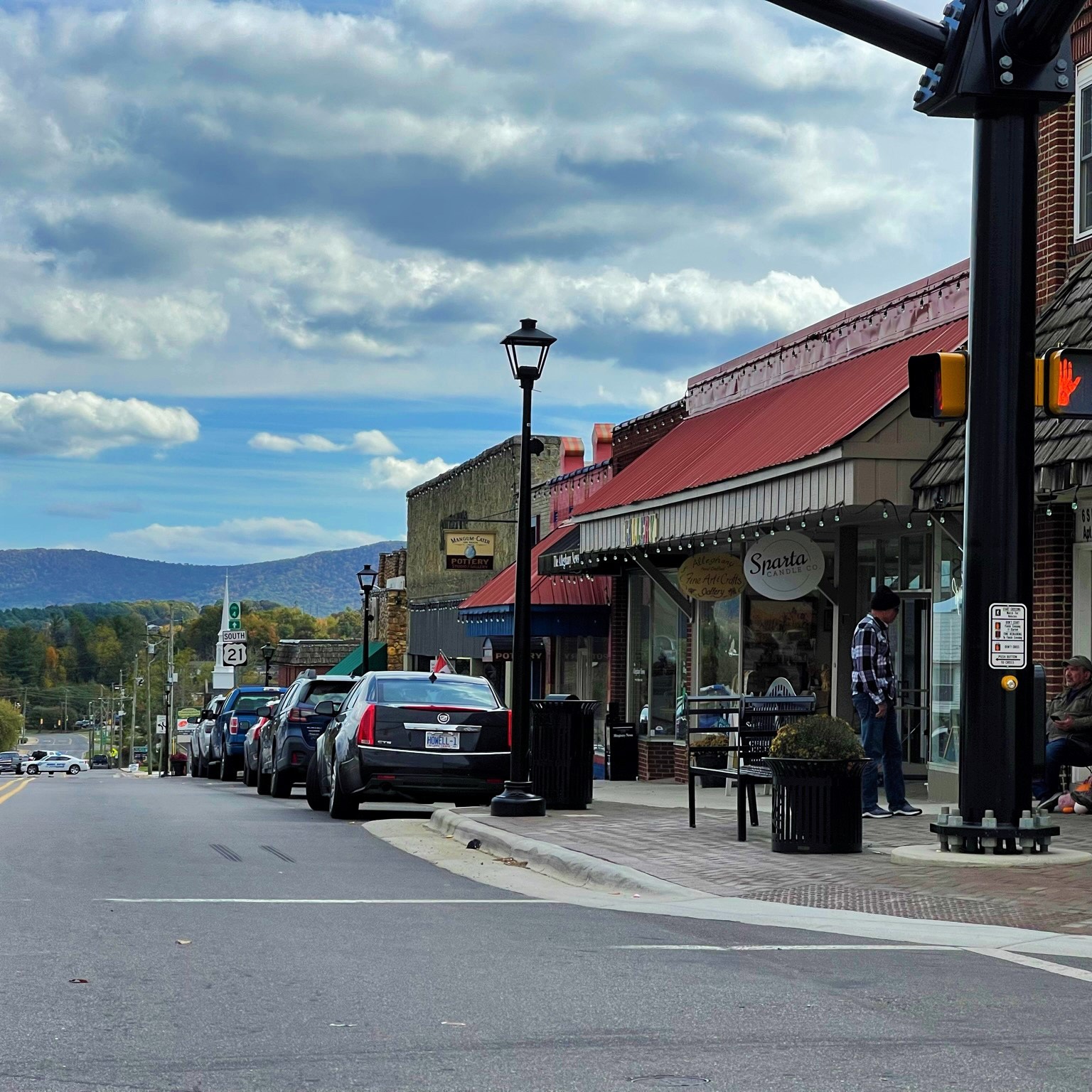
Sparta is a small mountain town that serves as the county seat of Alleghany County in northwestern North Carolina, tucked into the Blue Ridge Mountains just a few miles south of the Virginia state line. With a population of roughly 1,700 residents, Sparta has the unhurried, close-knit feel of a traditional High Country community, anchored by a historic courthouse square and a handful of locally owned shops and cafes. The town functions as a quiet gateway to some of the most scenic stretches of the southern Appalachians, drawing visitors who prefer winding back roads and forested hollows to busier tourist corridors. It sits about 80 miles northwest of Winston-Salem, the nearest sizable city, and roughly 100 miles northeast of Asheville, both reached by mountain drives that are themselves part of the appeal.
Just west of town, Stone Mountain State Park covers more than 14,000 acres of rugged Blue Ridge terrain and is one of the most striking natural landmarks in northwestern North Carolina. The park's centerpiece is a 600-foot granite dome that rises above the surrounding woodlands, with hiking trails leading to its summit, trout fishing along the widges of the nearby creek, and a restored 19th-century homestead that offers a glimpse of mountain life from earlier centuries. It is about a 25-minute drive from Sparta and consistently ranks among the state's most popular outdoor destinations.
To the south and east of town, the Blue Ridge Parkway threads through some of its most celebrated miles, including Doughton Park, one of the parkway's largest recreation areas. Visitors can pull off for scenic overlooks, picnic areas, and access to miles of hiking trails that wander through grassy balds and hardwood forest. The nearest parkway entrance is only a short drive from downtown Sparta, making it an easy day trip for travelers based in the area.
The [New River](en.wikipedia.org/wiki/New_River_(Kanawha_River_tributary) also passes through Alleghany County, recognized as one of the oldest rivers in the world and one of the few in North America that flows northward. Locals and visitors come for tubing, kayaking, and fly fishing, and the river's gentle stretches are accessible within a short drive of town. Smaller roadside outfitters and river-access points dot the surrounding countryside during the warmer months.
Sparta's combination of small-town mountain character, easy access to Stone Mountain State Park and the Blue Ridge Parkway, and proximity to the New River makes it an appealing base for travelers seeking the outdoors without the crowds of better-known High Country destinations like Boone or Blowing Rock. For short-term rental owners, the town's quiet setting, scenic location, and steady stream of seasonal visitors drawn to nearby parks and rivers offer a comfortable balance of rural charm and accessible year-round appeal.
Want to know if a property in Sparta is a good investment?
Enter an address to get instant revenue potential and comps.