
Newton, North Carolina
Want to see how Newton compares to other top cities in North Carolina? Explore all city regulations in North Carolina. →
Newton, NC
Generally Investor Friendly
STR Regulations for Newton, North Carolina
Note: None of the sources below contain Newton-specific short‑term rental (STR) ordinances or contacts. This guide therefore relies on state-level rules and Catawba County requirements that apply to STRs operated from properties located in Newton (Catawba County).
1) Overview: Are Short-Term Rentals Allowed in Newton, NC?
Explicit answer: Yes—short‑term rentals of residential property are allowed in Newton, NC, subject to zoning, building/housing, fire/life safety, taxation, and any HOA/condo rules. There is no Newton‑specific STR ordinance in the provided sources, so investors must comply with applicable North Carolina statutes and Catawba County rules. The general legal framework is as follows:
- Zoning: Local governments (city and county) may regulate where STRs may operate and may impose reasonable operational limits (e.g., parking, noise, occupancy caps) via zoning. Courts have affirmed that STRs are not per se a “residential” land use, and municipalities can regulate them as lodging uses within their zoning authority. Registration requirements tied to zoning permits are permissible; blanket “registration/enrollment” as a precondition to rent may be preempted by state law in some circumstances.
- Building/Housing/Fire: Properties used as lodging must meet minimum habitability, health, and safety standards (e.g., smoke/CO detectors, egress, fire protection). Periodic inspections are authorized; however, governments cannot require a building or housing code permit simply to rent residential property absent a history of violations.
- Taxes: Rentals of 90 days or fewer are subject to North Carolina sales and use tax and to any applicable local occupancy (room) tax. Platforms like Airbnb commonly collect and remit these taxes; hosts remain responsible for compliance and for ensuring that any local occupancy taxes for Catawba County are properly addressed.
Bottom line: You can operate an STR in Newton if your property is properly zoned, meets building/housing/fire safety standards, and all taxes are collected/remitted. If the local STR definition ties to 90 days or fewer (a common threshold), you will also be responsible for collecting/remitting state and local occupancy taxes.
What do Airbnb hosts actually earn in Newton?
Newton hosts earn a median $33,202/year with $152 ADR and 67% occupancy.
Top performers pull in $47,064+ per year.
See the full Newton market breakdown2) Starting a Short-Term Rental Business in Newton, NC
A practical, step-by-step pathway:
- Confirm your zoning entitlement
- Determine your zoning district and whether short‑term rental use is permitted as a lodging use (or by special use). Check with the Catawba County Planning & Development/Zoning office to confirm.
- If your property is in a homeowners’ association or condo, obtain written approval for transient rentals (house rules often prohibit STRs).
- Secure required approvals
- Building/Housing/Fire: Ensure the dwelling meets life‑safety, habitability, and fire code requirements. If you propose structural changes, obtain building permits from Catawba County Building Inspections.
- Zoning: If local ordinances require it (they often do), obtain a zoning permit for STR use and renew as prescribed. Post the permit number on all advertisements as required.
- Business License: If you conduct business within Newton’s corporate limits, a City of Conover business license may be required (Newton’s administrative functions are performed through the Conover Service Center). Confirm applicability with the City/County business licensing office.
- Tax setup
- Register with the NC Department of Revenue for sales/use tax (if you will collect/remit yourself instead of relying on a platform).
- Register with Catawba County for local occupancy (room) tax and implement monthly/quarterly remittance.
- If you rely on Airbnb/Vrbo for collection/remittance, confirm in your host dashboard that Catawba County occupancy tax is being collected and remitted; otherwise, collect and remit directly.
- Marketing and guest operations
- Publish your local tax IDs and (if applicable) zoning permit number in listings, guest agreement, and on‑premises documentation.
- Implement quiet hours, occupancy limits (commonly “two adults per bedroom”), parking plans, and waste/noise rules. Include these rules in the booking agreement and display them in‑unit.
- Maintain a guest log (names, dates, room count) for at least three years if local ordinances require it.
- Ongoing compliance
- Renew permits as required (often annually).
- Maintain current certificates for smoke/CO detectors and any fire/life‑safety equipment.
- Track nights rented and file sales tax and occupancy tax returns per the applicable cadence.
- Monitor HOA/condo rules; violations can jeopardize your STR operation even where zoning and taxes are in order.
3) Required Documents, Permits, Licenses, and Guidelines
Based on the sources and typical North Carolina practice:
- Zoning/STR permit (where required by county ordinance; obtain and renew annually; post permit number on ads and at the property).
- Building/Housing/Fire compliance verification (smoke/CO detectors, egress, habitability standards). Building permits are required for structural changes; routine rentals do not require a building/housing code permit absent a history of violations.
- Business license if conducting business within city limits (contact the City/County licensing office).
- Tax registrations:
- NC Department of Revenue sales/use tax account (if not collected by a platform).
- Catawba County occupancy (room) tax registration (confirm registration and filing cadence).
- Guest documentation:
- Guest registry (names, check‑in/out, number of guests/rooms) retained for at least three years if required locally.
- Posted house rules (quiet hours, occupancy, parking, waste removal) in the unit and in the rental agreement.
- Insurance: Reasonable liability coverage is commonly required or advisable.
Note: If you list on platforms, they generally collect and remit state sales tax and often the local occupancy tax for North Carolina jurisdictions. Confirm in your host dashboard that Catawba County occupancy tax is being collected and remitted; if not, you must register and remit directly.
4) Specific Regulations at City, County, and State Level
- City (Newton, NC)
- No Newton‑specific STR ordinance is provided in the sources. Newton contracts administrative services through the City of Conover Service Center; any required city licensing/permits are typically handled through that portal. Confirm whether a city business license applies and whether any Newton‑specific advertising or operational requirements apply through Conover Service Center/Zoning.
- County (Catawba County)
- Zoning: Use is subject to county zoning and land‑use regulations. Confirm whether STRs are permitted as a lodging use in your district or require a special use permit.
- Building/Housing/Fire: Minimum standards for habitability and life safety apply. Structural work requires permits; routine rentals do not trigger a building/housing code permit absent a violation history.
- Taxes: Catawba County assesses a local occupancy (room) tax on accommodations for less than 90 days; the standard rate in North Carolina counties is 3% (confirm locally). Rentals of 90 days or fewer also incur NC sales tax (see below).
- Administration: Zoning and building inspections are handled by county departments; tax collections for occupancy tax are administered by the County Tax Administrator/Finance Office (see Contacts).
- State (North Carolina)
- Zoning authority: Cities and counties may regulate the location and operation of STRs under zoning, including parking, occupancy caps, and operational limits. Courts have allowed reasonable restrictions and permitting, and have limited or invalidated registration schemes intertwined with prohibited “enrollment” requirements.
- Building/Housing/Fire: Periodic inspections are authorized. Governments may not require a building/housing code permit simply to rent residential property absent a history of violations.
- Taxes: For stays of 90 days or fewer, the rental is subject to:
- NC sales and use tax (statewide 4.75% plus any local sales tax rate applicable in Catawba County; total commonly 6.75%–7.0%). Confirm the current local sales tax rate with the NC Department of Revenue.
- Local occupancy (room) tax (commonly 3% in North Carolina counties, including Catawba County; confirm the current rate and any Transient Occupancy Tax rules directly with the county).
- Legislative context: Proposals such as Senate Bill 291 (2025 session) would have preempted certain local controls (e.g., bans on STRs, night‑count caps, owner‑present requirements) while authorizing limited permitting and operational rules (e.g., nominal permit fee not exceeding $25, occupancy limited to two adults per bedroom, 1 parking space per bedroom). As of the materials provided, SB 291 had been referred to committee; check current status on the NC General Assembly website.
5) Contact Information (Phone, Email, Website)
-
City of Newton – Administrative Services via Conover Service Center
- Phone: (828) 464‑1191
- Website: www.conover.nc.us (City of Conover website; Newton administrative services portal)
- Notes: Use for zoning/permitting questions when Newton directs applicants to Conover; confirm whether a city business license applies.
-
Catawba County – Tax Administrator/Finance (Occupancy/ Room Tax)
- Phone: (828) 465‑8420
- Notes: Confirm occupancy tax registration, rate, filing frequency, and platform remittance setup.
-
Catawba County – Planning & Development / Zoning
- Phone: (828) 465‑8420 (general); ask for Planning & Development or Zoning.
- Notes: Confirm whether STRs are a permitted lodging use in your district, whether a special use permit or zoning permit is required, and any operational conditions (parking, occupancy, signage).
-
Catawba County – Building Inspections
- Phone: (828) 465‑8420 (general); ask for Building Inspections.
- Notes: For life‑safety and habitability standards, smoke/CO compliance, and any necessary building permits for renovations.
-
North Carolina Department of Revenue (Sales/Use Tax)
- Phone: (877) 252‑4052
- Website: www.ncdor.gov
- Notes: Register for sales/use tax, confirm the local sales tax rate applicable to Catawba County, and obtain filing guidance.
6) Links to Source Pages
-
UNC School of Government, Land Use Regulation of Short‑Term Rental of Residential Property
-
NC General Assembly – Senate Bill 291 (2025–2026): Regulation of Short‑Term Rentals
-
NC General Assembly – Senate Bill 667 (2023–2024): Regulation of Short‑Term Rentals
-
Watauga Democrat news article on SB 291’s proposed limits on local control
-
Hostaway overview of North Carolina STR/tax framework (Airbnb collection/remittance)
-
City of Conover (Newton administrative services portal)
-
North Carolina Department of Revenue (Sales/Use Tax)
Practical cautions:
- County rates and procedures, especially for occupancy tax, can change; always verify the current rate and any new Catawba County STR regulations with the County Tax Administrator and Planning/Zoning offices.
- Many North Carolina counties, including Catawba, assess a 3% occupancy tax; the NC sales tax rate includes a 4.75% state portion plus local sales tax. The total sales tax applicable in Catawba County is commonly 6.75%–7.0%. Confirm the exact combined rate with the NC Department of Revenue.
Next step
Found a property in Newton?
Paste any address and get estimated revenue, cash-on-cash return, and comparable STR performance in under 5 minutes. 3 free analyses per day.
Free brief
Get the free Newton STR Investment Brief
Revenue data, top neighborhoods, seasonal trends, and the key regulations for Newton, North Carolina in one email.
Newton
Market Saturation Score
Photos of Newton


Overview of Newton
Newton is a small city in western North Carolina and the seat of Catawba County, set in the rolling foothills where the Piedmont begins to give way to the Blue Ridge. With a population of roughly 13,000, it carries the unhurried pace of a small Southern county seat while functioning as a practical base for visitors exploring the Catawba Valley. The city is best known as a quiet, affordable gateway to the region's outdoor recreation, craft-furniture heritage, and a string of nearby mountain and lake destinations. It sits about 45 miles northwest of Charlotte, the nearest major city, an easy drive of roughly 50 minutes down Interstate 40.
Just to the east of Newton lies Lake Norman, the largest man-made lake in North Carolina and one of the most popular recreational reservoirs in the state. About a 25- to 30-minute drive from town, the lake draws visitors for boating, fishing, paddleboarding, and waterfront dining, with several public access points and marinas scattered along its roughly 520 miles of shoreline. It gives short-term-rental guests a full lake experience without having to drive into the mountains.
A short drive west brings guests to the neighboring city of Hickory, about 15 minutes from Newton. Hickory's revitalized downtown offers locally owned restaurants, breweries, the Hickory Museum of Art, and the Catawba Science Center, and the broader metro area has a long-standing reputation as a center of furniture manufacturing that lends the region a distinctive design-forward character.
Further afield, about an hour west of Newton, Chimney Rock State Park rises above the broad waters of Lake Lure, the latter famously featured as a filming location for "Dirty Dancing." Visitors come for the panoramic views from the namesake Chimney Rock outcropping, the hiking trails of the broader park, and the small-town charm of Lake Lure's waterfront. The drive threads through scenic foothill country and offers a satisfying day trip for guests who want a taste of the North Carolina mountains without committing to a full Asheville excursion.
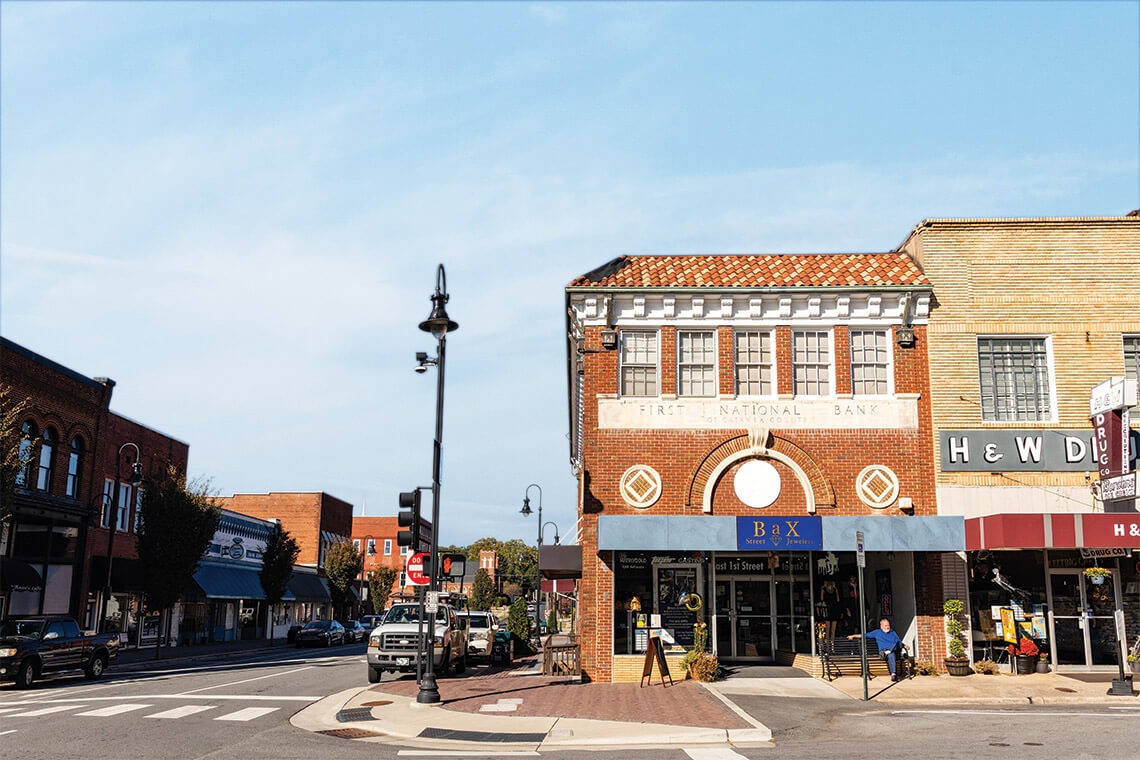
Newton itself has the appeal of a walkable historic downtown anchored by its 1924 courthouse square, along with a growing roster of local cafés, antique shops, and a handful of community events that give the city a genuine small-town rhythm.
For short-term-rental owners, Newton occupies a useful middle ground. It is far enough from Charlotte and the mountains to keep nightly rates approachable, yet close enough to Lake Norman, Hickory's urban amenities, and the Blue Ridge foothills to give guests a varied itinerary in any season. The combination of small-city character, four-season outdoor appeal, and easy access to both lake and mountain destinations makes it a quietly versatile base for travelers exploring western North Carolina.
Want to know if a property in Newton is a good investment?
Enter an address to get instant revenue potential and comps.