
Lexington, North Carolina
Want to see how Lexington compares to other top cities in North Carolina? Explore all city regulations in North Carolina. →
Lexington, NC
Generally Investor Friendly
STR Regulations for Lexington, North Carolina
Overview: Are STRs allowed in Lexington, NC?
- Yes. Short-term rentals (STRs) are permitted in North Carolina, including Lexington (Davidson County). North Carolina’s Vacation Rental Act recognizes rentals of fewer than 90 days for leisure/vacation as lawful vacation rentals and prohibits local governments from enacting outright bans. Local authorities can, however, regulate STRs via zoning and compliance standards (see State-Level Rules, below).
- If your property is within the City of Lexington limits, the municipal zoning and related standards apply; if it is in unincorporated Davidson County, county zoning and health/safety codes apply. Because city-specific STR rules for the City of Lexington were not provided in your sources, focus on North Carolina state law and Davidson County zoning/health-and-safety compliance.
How to start a short-term rental business in this market
- Confirm your property’s jurisdiction and zoning
- If inside City of Lexington corporate limits, verify that STRs are an allowed use in your zoning district (e.g., residential, mixed-use). If in unincorporated Davidson County, ensure your property’s zoning permits transient lodging or is compatible with an STR.
- If unsure, request a zoning determination from the Planning & GIS Department before investing.
- Register for tax compliance with North Carolina and Davidson County
- North Carolina Department of Revenue (NCDOR): Register to collect/remit State Sales Tax (4.75%) and applicable local sales taxes on gross receipts for lodging. You will receive a Sales and Use Tax Certificate of Registration.
- Davidson County tax: Register with the county Tax Collector’s office for any local lodging/occupancy taxes that may apply in your area (collection method and rate vary by jurisdiction; confirm with the county).
- Establish business licensing and insurance
- Business privilege license/tax certificate: Required for unincorporated county operations; some municipalities also require a business license. Check the Davidson County Register of Deeds/Tax Collector for business licensing.
- Insurance: Carry liability coverage (commonly at least $1,000,000) and ensure property and casualty policies allow short-term rentals. Note that HOA/condo bylaws may restrict or prohibit STRs independent of government law.
- Standardize safety, health, and compliance measures
- Compliance with building, fire, and housing codes is mandatory; meet electrical, smoke/CO alarm, fire extinguisher, egress, and habitability standards; if a septic system is used, ensure capacity and maintenance records are current. Cities may limit occupancy by building/septic standards; apply those to your layout.
- Establish operational controls
- Good neighbor practices: Quiet hours, occupancy and vehicle caps, trash collection schedule, parking plans, and guest screening. Prepare written house rules and include short-term rental references/acknowledgment in guest agreements.
- Local contact: Some jurisdictions require a responsible party within a specified radius when guests are present. Even if not required, name a local contact for emergencies and code issues.
- Marketing and tax handling
- If booking through platforms (Airbnb/Vrbo), they often collect and remit lodging taxes on your behalf. For direct bookings, you must collect and remit all applicable taxes and comply with the Vacation Rental Act’s written-agreement requirements.
Required documents, permits, licenses, and guidelines
- State and local tax registration
- NCDOR Sales and Use Tax Certificate of Registration (for lodging tax collection/remittance).
- Davidson County local lodging/occupancy tax registration (if applicable; confirm with county).
- Zoning and use approval
- Zoning use verification/conditional use approval (if required by zoning district).
- Building/fire/housing code compliance certificate or inspection approval (as applicable).
- Business licensing and identification
- Davidson County business privilege license/tax certificate (for unincorporated county operations).
- Short-term rental permit (if the City of Lexington or county requires one; if not required, keep a zoning use verification letter and code compliance on file).
- Display permit/license number on your listings if required.
- Insurance and safety documentation
- General liability policy (commonly $1,000,000).
- Property and casualty insurance endorsements allowing short-term rental use.
- Safety compliance documentation: smoke/CO alarms, fire extinguishers, egress plans, emergency contact signage, and (if applicable) septic records.
- Guest agreements and notices
- Written rental agreement compliant with the Vacation Rental Act (less than 90 days; guest maintains a permanent residence elsewhere).
- Guest acknowledgment of local ordinances governing noise, waste, parking (required by some local rules).
Specific regulations for STRs (city, county, state)
- State-level rules (North Carolina)
- Vacation Rental Act: Rentals under 90 days for leisure/vacation purposes are vacation rentals; written agreements are required; guests must have a permanent residence to which they intend to return.
- Local regulation framework: Municipalities can adopt STR regulations such as permits, occupancy limits, vehicle caps, zoning restrictions, building/housing code compliance, and neighborhood compatibility measures. North Carolina allows but does not mandate local registration; some local governments have adopted permitting and compliance systems.
- Taxes: STR operators must collect/remit State Sales Tax (4.75%) and applicable local sales/lodging taxes; marketplaces often collect taxes on your behalf, but for direct bookings you are responsible.
- County-level (Davidson County)
- STRs in unincorporated areas must comply with zoning and health/safety codes; a business privilege license/tax certificate may be required. Davidson County administers zoning through the Planning & GIS Department.
- City-level (City of Lexington)
- No city-specific STR regulations were provided in your sources. If your property lies inside the City of Lexington corporate limits, you must confirm whether the city requires a permit, occupancy limits, vehicle caps, or neighborhood compatibility standards.
- Practical guidance: Assume you will need a zoning use determination, business license, and proof of safety compliance; display any required permit numbers on listings; maintain records for inspections.
Contacts for the local authority in charge of STRs
- Davidson County Planning & GIS (primary zoning authority)
- Website: www.lex-co.com/departments/planning-gis
- Address: 212 South Lake Drive, Lexington, SC 29072
- Phone: 803-359-8000
- Note: This is the county contact provided in your sources. For Davidson County, NC, verify the correct planning/zoning department via the county website.
- North Carolina Department of Revenue (tax compliance)
- Website: www.ncdor.gov/
- Davidson County Register of Deeds/Tax Collector (business licensing, local taxes)
- Use the online services portal referenced in the county site if licensing or tax registration is required: www.lex-co.com/services/rods-online-services
- Note: The above service links to a local portal; adapt to Davidson County, NC’s official websites.
Links to source pages (IMPORTANT)
- County STR announcement: www.lex-co.sc.gov/news/2024-11/new-short-term-rental-permitting-requirements
- County zoning/land development: www.lex-co.com/departments/community-development/land-development
- Code of Ordinances (reference): library.municode.com/sc/lexington_county/codes/code_of_ordinances?nodeId=COORLECOSOCA
- North Carolina Department of Revenue: www.ncdor.gov/
- North Carolina Vacation Rental Act: www.ncleg.gov/Laws/GeneralStatuteSections/Chapter42A
Practical takeaway for investors
- STRs are allowed in Lexington, NC under North Carolina law. Treat zoning and safety compliance as your first gate; get a zoning determination and line up licensing/tax registrations. For properties inside the City of Lexington limits, check for any municipal STR permit and display requirements. For unincorporated Davidson County, ensure your business privilege license/tax certificate and code compliance are in place, and confirm local lodging tax administration. Keep written agreements, safety documentation, and insurance on file, and design your operation around clear neighbor-friendly policies.
What do Airbnb hosts actually earn in Lexington?
Lexington hosts earn a median $29,249/year with $195 ADR and 55% occupancy.
Top performers pull in $43,725+ per year.
See the full Lexington market breakdownNext step
Found a property in Lexington?
Paste any address and get estimated revenue, cash-on-cash return, and comparable STR performance in under 5 minutes. 3 free analyses per day.
Free brief
Get the free Lexington STR Investment Brief
Revenue data, top neighborhoods, seasonal trends, and the key regulations for Lexington, North Carolina in one email.
Lexington
Market Saturation Score
Photos of Lexington

Overview of Lexington
Lexington is a small city in Davidson County in the Piedmont region of North Carolina, with a population of approximately 19,000. The city has a distinctly Southern character and is widely known as the "Barbecue Capital of the World," a reputation built on a long tradition of pork shoulder barbecue that draws food lovers from across the Southeast. Located roughly 30 miles south of Winston-Salem and about 70 miles northeast of Charlotte, Lexington serves as a friendly small-city base for travelers exploring the central Piedmont.
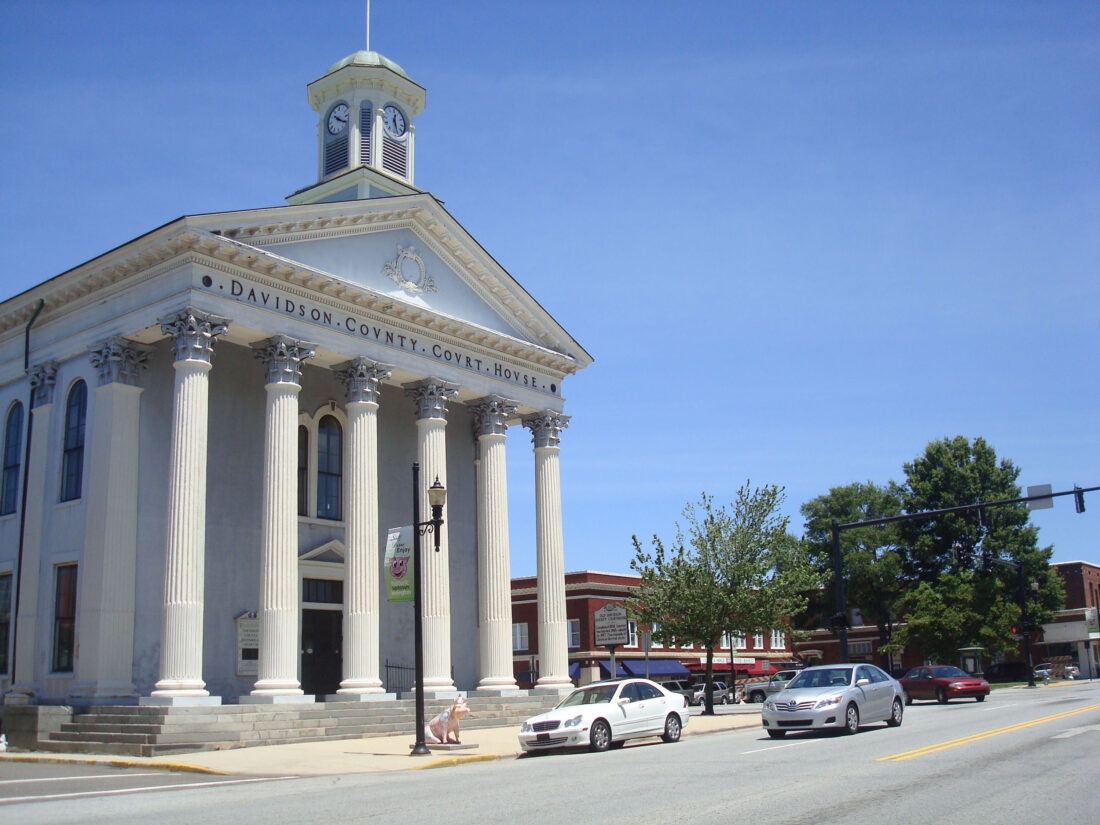
Each October, downtown Lexington hosts the Lexington Barbecue Festival, a one-day street festival that consistently ranks among the largest food festivals in the American South, attracting well over 100,000 visitors to the city's historic uptown square. The event centers on Lexington-style barbecue but also features live music, craft vendors, and a parade. For the rest of the year, the uptown district around the square offers boutique shopping, locally owned restaurants, and the restored Davidson County Courthouse, giving visitors a low-key glimpse of small-town Piedmont life.
A short drive north of the city sits Childress Vineyards, a winery founded by NASCAR team owner Richard Childress on a former horse farm just off Interstate 85. The property includes a tasting room, restaurant, and event spaces, and has become one of the most-visited wineries in the region, offering tours and tastings year-round. It sits roughly 10 minutes from uptown Lexington.
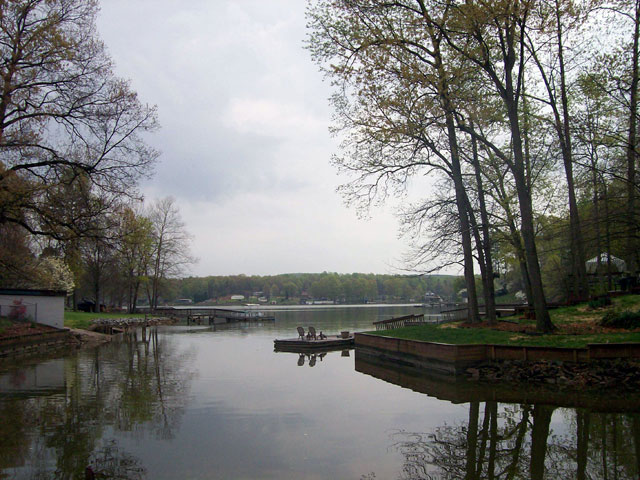
About 20 minutes east, the city of Salisbury and the surrounding Rowan County area provide additional day-trip opportunities, including the North Carolina Transportation Museum, housed in a former Southern Railway steam locomotive repair shop. The museum preserves a sizable collection of locomotives and rail cars and runs seasonal train excursions that draw rail enthusiasts and families. Just south of Lexington, High Rock Lake, the second-largest lake in North Carolina, offers boating, fishing, and lakeside recreation across roughly 15,000 surface acres spread across Davidson and surrounding counties.
With its central Piedmont location, its signature food culture, and easy access to lakes, vineyards, and a celebrated transportation museum within roughly half an hour, Lexington offers short-term-rental owners a varied draw: the once-a-year surge of Barbecue Festival visitors, year-round regional tourism tied to NASCAR heritage and the Yadkin River wine country, and a quieter, walkable uptown that rewards slow-paced stays.
Want to know if a property in Lexington is a good investment?
Enter an address to get instant revenue potential and comps.