
High Point, North Carolina
Want to see how High Point compares to other top cities in North Carolina? Explore all city regulations in North Carolina. →
High Point, NC
Challenging To Investors
STR Regulations for High Point, North Carolina
Note on sourcing and currency: This guide synthesizes the provided web content and publicly referenced materials. BuildYourBNB indicates “no specific mention of STRs” in High Point’s ordinances as of 2021 and classifies STRs as “not regulated” locally (as of that date). You should verify current status with local authorities before operating.
Are Short-Term Rentals Allowed in High Point, NC?
High Point does not currently have city-specific STR regulations (per BuildYourBNB’s 2021 review). There is no dedicated city STR ordinance, business license condition, or permitting requirement referenced for short-term rentals. That said, standard city code (zoning, safety, noise, parking, etc.) applies and can be enforced via general ordinances. Always confirm with the Planning & Development Department that your property’s zoning permits transient rentals and with the Fire Marshal that safety equipment and occupancy standards are met.
What do Airbnb hosts actually earn in High Point?
High Point hosts earn a median $27,165/year with $174 ADR and 58% occupancy.
Top performers pull in $38,281+ per year.
See the full High Point market breakdownHow to Start a Short-Term Rental Business in This Market
-
Confirm zoning eligibility. Contact the City of High Point Planning & Development Department to ensure the subject property can be used as a short-term rental. Be prepared to provide the parcel address and zoning district.
-
Consider a local business license. Even without a dedicated STR ordinance, municipalities sometimes require a general business license for rental operations. Confirm if one is needed for your property and how to obtain/renew it.
-
State tax registration. Register with the North Carolina Department of Revenue (NC DOR) to collect/remit sales and use tax on bookings under 90 days. This is a state-level requirement; see details in the next section.
-
Local occupancy and other taxes. If High Point or Guilford County imposes a local occupancy tax, you must register and remit. Check with the City Finance Department/Tax Collector and Guilford County Tax Administration for current rates and requirements.
-
Safety and code compliance. High Point follows standard fire/life-safety and building code requirements (e.g., smoke and carbon monoxide detectors, egress, posted address, emergency information). Obtain any required inspections before listing. The Fire Marshal can advise on occupancy limits and safety equipment.
-
Insurance. Obtain short-term rental or landlord insurance with liability coverage appropriate for transient guests.
-
Set operations and house rules. Publish guest rules for occupancy, parking, quiet hours, trash/recycling, and emergency contacts. Build a digital and physical house manual; consider smart locks to simplify check-in.
-
Prepare the property. Ensure the unit is professionally cleaned between stays, well-maintained, and outfitted with essential amenities and safety gear.
-
Launch and market. Choose a booking model (direct or third-party platforms). If using platforms, expect them to collect/remit certain taxes automatically; verify your specific obligations and confirm they’re correctly configured for your property.
Required Documents, Permits, Licenses, and Guidelines
- NC Department of Revenue registration for sales/use tax collection/remittance on stays under 90 days (state level).
- If applicable: local business license (verify with City of High Point).
- If applicable: local occupancy tax registration with the City or County.
- Safety equipment compliance: working smoke alarms in every sleeping room and common area; carbon monoxide alarms as required by NC statute; clearly posted address; emergency contact information; and adherence to fire code egress requirements.
- Insurance: short-term rental/landlord policy with general liability appropriate for transient lodging.
- Guest agreement/rental agreement: required by North Carolina state law; include house rules, occupancy limits, quiet hours, and liability/indemnity terms as appropriate.
- House manual and signage: instructions for check-in (including any smart lock codes), Wi-Fi, appliances, trash/recycling schedules, and emergency procedures.
- Platform tax setup: if listing on Airbnb/VRBO, ensure platform-level tax collection is configured and verify that state/local taxes are properly collected and remitted.
Specific Regulations: City (High Point), County (Guilford), and State (North Carolina)
-
City of High Point
- No dedicated STR ordinance (as of 2021). High Point’s Code of Ordinances is the governing municipal code; consult the Municode library for current titles and sections. Enforcement occurs via general ordinances (e.g., noise, zoning, parking, public health/safety).
- Contact planning staff to verify zoning allowances for short-term rentals in the subject district and any conditional use or permit requirements.
-
Guilford County
- County-level sales and use tax applies in addition to the state rate. For 2024–2025, the combined state + local sales tax rate in Guilford County is 7.00% (4.75% state + 2.25% local). Confirm the current rate annually with the NC DOR and/or county tax administration.
- Local occupancy taxes are set by local jurisdictions and can vary. Verify whether Guilford County or any applicable municipality within the county (e.g., High Point) levies an occupancy tax and confirm registration and remittance procedures.
-
State of North Carolina
- North Carolina Vacation Rental Act: a short-term rental is a residential property rented for vacation, leisure, or recreation for a term of less than 90 days to individuals who have a permanent residence to which they intend to return.
- Taxes: state sales/use tax at 4.75% applies to stays under 90 days. Local sales tax (2.00%–2.75% depending on county) applies on top of state sales tax. Gross receipts are taxable; this generally includes room charges and often cleaning and other guest fees unless separately stated and reasonable under the tax code. Hosts must register with the NC Department of Revenue and file returns.
- Local occupancy taxes: localities may impose occupancy taxes at varying rates; hosts may be required to register and remit. Some platforms collect and remit certain occupancy taxes on behalf of hosts, but hosts must verify coverage and compliance.
- Guest agreements: North Carolina law requires a written vacation rental agreement.
- Insurance: short-term rentals should be covered by appropriate liability insurance. Consider a policy tailored to transient lodging exposures.
- Safety: comply with state smoke/CO alarm laws and fire code requirements; occupancy limits and safety signage must be maintained.
Contact Information (Phone, Email, Website)
-
City of High Point – General
- Phone: 336-883-3111
- Address: 211 South Hamilton St., P.O. Box 230, High Point, NC 27261
- Website: www.highpointnc.gov/
-
City of High Point – Planning & Development (zoning, permits)
- Website: www.highpointnc.gov/1108/Guidelines-for-Rental-Leased-Properties (verify correct planning department page; this link is the official “Guidelines for Rental & Leased Properties” page)
- Phone (general city): 336-883-3111
-
City of High Point – Fire Marshal/Inspection (fire code and safety)
- Phone (general city): 336-883-3111
- Website: www.highpointnc.gov/
-
City of High Point – Code of Ordinances
- Municode Library: library.municode.com/index.aspx?clientId=10918
- Note: As of 2021, no STR-specific chapter was identified; always verify current code.
-
North Carolina Department of Revenue (taxes)
- Website: www.ncdor.gov/
- Guidance: See “Sales and Use Tax for Lodging” resources for short-term rental tax obligations.
-
Guilford County Tax Administration
- Phone: 336-641-3363
- Website: www.guilfordcountync.gov/
Links to Source Pages
- City of High Point – Guidelines for Rental & Leased Properties: www.highpointnc.gov/1108/Guidelines-for-Rental-Leased-Properties
- City of High Point – Code of Ordinances (Municode): library.municode.com/index.aspx?clientId=10918
- BuildYourBNB – High Point Airbnb / STR Regulations (2021 overview): www.buildyourbnb.com/us-airbnb-and-short-term-rental-regulations/high-point
- RedAwning – High Point Market Overview: www.redawning.com/pm/market-overview/high-point-north-carolina
- PMI Piedmont – 7 Tasks for STR Management in High Point, NC: www.greensboroncvacationmanagementinc.com/blog/7-tasks-you-need-to-do-in-short-term-rental-management-in-high-point-nc
- Steadily – NC STR Laws and Regulations (state overview): www.steadily.com/blog/airbnb-short-term-rental-laws-and-regulations-in-north-carolina
- City of High Point – General (for departments/contacts): www.highpointnc.gov/
- NC Department of Revenue: www.ncdor.gov/
- Guilford County Tax Administration: www.guilfordcountync.gov/
Practical next steps
- Call Planning at 336-883-3111 to confirm zoning and any local business license needs.
- Register with the NC Department of Revenue for sales/use tax collection if you will accept direct bookings and for compliance on stays under 90 days.
- Verify occupancy tax status and any local registration with Guilford County and the City of High Point Finance/Tax Collector.
- Coordinate with the Fire Marshal for safety requirements and occupancy limits.
- Implement a compliant guest agreement and house rules, secure appropriate insurance, and set up your property for a safe and successful STR operation.
Next step
Found a property in High Point?
Paste any address and get estimated revenue, cash-on-cash return, and comparable STR performance in under 5 minutes. 3 free analyses per day.
Free brief
Get the free High Point STR Investment Brief
Revenue data, top neighborhoods, seasonal trends, and the key regulations for High Point, North Carolina in one email.
High Point
Market Saturation Score
Photos of High Point


Overview of High Point
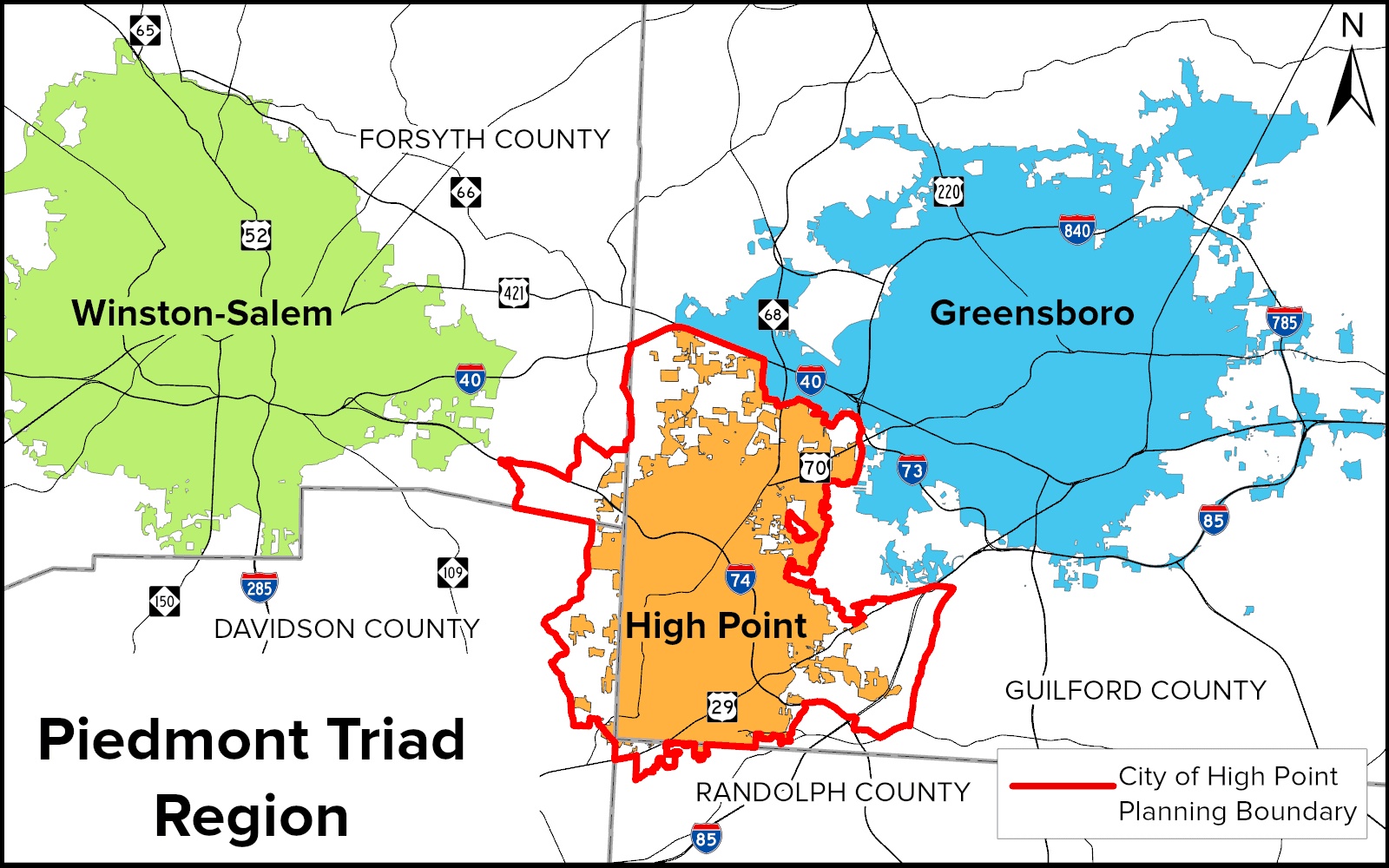
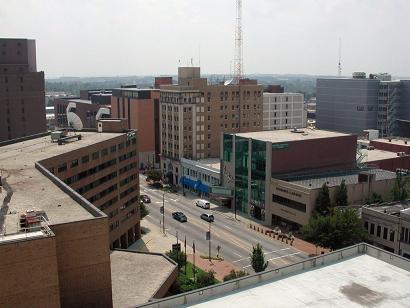
High Point is a mid-sized city in the Piedmont region of North Carolina, primarily in Guilford County with small portions extending into Randolph, Davidson, and Forsyth counties. Home to roughly 115,000 residents, it forms one point of the Piedmont Triad alongside Greensboro and Winston-Salem, a metropolitan area of more than 1.6 million people. The city is internationally recognized as the "Home Furnishings Capital of the World" thanks to the semiannual High Point Market, the largest home furnishings trade show on the globe, which fills downtown showrooms twice a year with designers, buyers, and journalists from around the world. High Point sits roughly 80 miles northeast of Charlotte, about an hour and a half by car via I-85, and is well positioned for day trips across central North Carolina and toward the Blue Ridge foothills.
High Point University anchors the city's southern edge with a campus that has become a destination in its own right. Built and expanded at a remarkable pace over the past two decades, the school is known for its striking blend of modern and traditional architecture, including a soaring green-domed library, stained-glass windows salvaged from historic buildings, and an oak grove of transplanted century-old trees. Self-guided tours of the public spaces are popular, and the campus regularly hosts concerts, lectures, and Division I athletic events that draw visitors from across the region.
A few miles west of downtown, the High Point Museum traces the city's evolution from a colonial crossroads to a furniture-industry powerhouse. The complex includes a reconstructed 1780s log house and offers rotating exhibits on local industry, civil rights history, and the surrounding natural environment, making it a comfortable stop for an hour or two and a useful orientation to the broader region before visitors set out to explore.
About 45 minutes south in Asheboro, the North Carolina Zoo sprawls across more than 2,000 wooded acres and ranks among the largest natural-habitat zoos in the United States. Visitors walk through African savanna and North American woodland habitats, with separate parking and tram routes for each continent, making it a natural full-day outing and a strong anchor for short-term rental stays that pair city conveniences with a memorable day trip.
For travelers who want to mix in time outdoors, state parks such as Hanging Rock and Pilot Mountain sit to the northwest and the Uwharrie National Forest to the south, all within roughly an hour of the city. Combined with the dining, sports, and entertainment scenes of neighboring Greensboro and Winston-Salem, each about 20 to 30 minutes away, High Point functions less as a single attraction and more as a comfortable, well-located base from which to explore a wide swath of central North Carolina.
High Point offers short-term rental owners a distinctive mix of year-round demand drivers. The biannual furniture market reliably fills rooms with design professionals from around the world, while High Point University brings a steady flow of campus visitors, prospective students, and event attendees. Its central position in the Triad places guests within a short drive of the region's largest employers, universities, and cultural venues, and within an hour of major outdoor destinations like the North Carolina Zoo and Hanging Rock State Park. That combination of recurring business travel, university traffic, and family leisure demand makes High Point a quietly steady market in a fast-growing part of North Carolina.
Want to know if a property in High Point is a good investment?
Enter an address to get instant revenue potential and comps.