
Hayesville, North Carolina
Want to see how Hayesville compares to other top cities in North Carolina? Explore all city regulations in North Carolina. →
Hayesville, NC
Very Investor Friendly
STR Regulations for Hayesville, North Carolina
Overview: Are Short‑Term Rentals Allowed in Hayesville?
Yes. Short‑term rentals (STRs) are allowed in Hayesville, North Carolina. There is no statewide prohibition against STRs, and, as of the latest available information, Hayesville has not enacted a local ordinance that bans or otherwise regulates STRs. The town did discuss an STR ordinance in 2023—setting a public hearing in August and tabling the proposal in September—but no adoption or final regulations have been reported. In the absence of city‑level rules, operators must comply with applicable state‑level statutes and general laws (zoning, building and housing codes, taxation, and any homeowners association restrictions).
State‑level requirements apply. In North Carolina, an STR is defined by the Vacation Rental Act as the rental of a residential property for fewer than 90 days for recreational, leisure, or vacation purposes where the tenant maintains another permanent residence. North Carolina does not require state registration or a state‑issued STR license, but operators must collect and remit state sales tax and any applicable local occupancy/lodging taxes, and they must comply with zoning, building, and health/safety standards that generally apply to residential uses.
Regulatory outlook. State legislators introduced Senate Bill 667 in 2023 to create a uniform framework for STRs. The bill would have prohibited cities from banning STRs in residential areas, limited certain local restrictions, and allowed a low‑cost local permit (up to $25) plus reasonable occupancy and parking limits. As of the most recent source available, SB 667 had not passed and remains stalled. If enacted in the future, SB 667 could preempt or reshape local ordinances in Hayesville and across North Carolina.
Bottom line for investors: Hayesville is open for STRs today under state rules and general local compliance obligations. Monitor the town for any ordinance development, and be ready to adapt if state law changes.
What do Airbnb hosts actually earn in Hayesville?
Hayesville hosts earn a median $23,263/year with $164 ADR and 50% occupancy.
Top performers pull in $32,229+ per year.
See the full Hayesville market breakdownHow to Start a Short‑Term Rental Business in Hayesville
- Confirm zoning and use eligibility.
- Treat your property as a residential use unless the town has specifically zoned or conditioned STRs as a different use.
- Verify that short‑term lodging is compatible with your subdivision, HOA, or community covenants. HOAs can restrict rentals through their governing documents; if your HOA permits rentals, the STR still must follow all applicable laws.
- Meet health, safety, and housing standards.
- Maintain safe, code‑compliant structures, electrical systems, gas connections, smoke and carbon monoxide detectors, and adequate sanitation.
- Occupancy limits and parking constraints may be set by local or state standards (for instance, building code occupancy and vehicle counts). Confirm the number of permissible occupants and on‑site parking to avoid violations.
- Register for and collect taxes.
- Register with the North Carolina Department of Revenue (NCDOR) to obtain a Sales and Use Tax Certificate of Registration if you will be the merchant of record and your sales are not exclusively facilitated by a marketplace that collects and remits taxes for you.
- Collect North Carolina state sales tax and any applicable local sales taxes on gross receipts.
- Collect and remit any local occupancy/lodging taxes where your property is located. If you transact only through a marketplace that facilitates lodging taxes, you generally do not need to register and file lodging tax returns; otherwise, you must remit lodging taxes yourself.
- Build a compliant operating framework.
- Post or provide guests with local ordinances covering noise, waste removal, and parking; include these rules in your rental agreement.
- Identify a responsible person (owner or authorized agent) who can respond to guest issues and be available as required by any local or state standards that may apply in the future (for example, being within a 50‑mile radius while guests are in residence).
- Obtain required permits if applicable.
- If your city, county, or HOA imposes zoning, business, or property maintenance requirements, secure those approvals.
- If the town adopts a future STR ordinance, expect a simple permit with modest fees (historically discussed at $25) and conditions tied to health and safety violations, occupancy, and parking.
- Operate and maintain compliance.
- Track and remit sales and lodging taxes on schedule.
- Monitor enforcement, respond promptly to violations, and document corrective actions.
- Keep apprised of local council activity for any new STR ordinance.
Required Documents, Permits, Licenses, and Guidelines
- Sales and Use Tax Certificate of Registration (NCDOR).
- Issued by the North Carolina Department of Revenue when you register as a tax‑collecting retailer. Required when you are the merchant of record and not exclusively selling through a marketplace that collects tax for you.
- State and local sales tax compliance.
- Collect state sales tax and any local sales taxes on gross receipts; file returns per NCDOR requirements.
- Local occupancy/lodging tax registration and remittance (if applicable).
- Register with the local jurisdiction that administers lodging taxes; file and remit according to local schedules.
- Rental agreement and guest rules.
- Contracts must incorporate applicable local ordinances related to noise, waste, and parking. Provide written summaries when required.
- Zoning/use verification.
- Confirm that STR use is allowed under local zoning and HOA rules; obtain any conditional use approvals if applicable.
- Building, housing, and safety compliance.
- Adhere to all applicable building, housing, fire, and health codes. Expect occupancy limits and parking constraints to be applied in accordance with state and local standards.
- Future local STR permit (if adopted).
- The town discussed a permitting system, with a one‑time fee of $25 and revocation grounds tied to multiple health and safety violations within a rolling 12‑month period.
Specific Regulations: City, County, and State
City of Hayesville (Clay County)
- No adopted STR ordinance has been identified. The town held a public hearing in August 2023 and tabled an STR ordinance proposal in September 2023; no final rules are in force as of the latest reporting.
- In the absence of city‑specific rules, general laws apply: zoning consistency, building and housing codes, public health and safety standards, parking norms, and community standards via HOAs.
Clay County
- No county‑specific STR ban or separate registration requirement was identified in the provided sources. County ordinances may exist for broader topics (e.g., health, safety, noise), but these were not included in the provided materials.
State of North Carolina
- North Carolina Vacation Rental Act.
- Defines a short‑term rental as a rental of a residential property for less than 90 days for recreational, leisure, or vacation purposes, where the tenant maintains another permanent residence. The act frames the landlord‑tenant relationship and requirements for vacation rentals in the state.
- No statewide STR ban.
- STRs are not prohibited statewide; however, local governments may regulate STRs within bounds established by state law.
- Tax obligations.
- STRs are subject to state sales tax, local sales tax, and local lodging/occupancy taxes. Registration with NCDOR is required when you are the merchant of record; if you operate exclusively through a marketplace that facilitates lodging taxes, you generally do not need to register and file lodging returns yourself.
- SB 667 (2023 legislative session—stalled).
- The bill would have prohibited cities from banning STRs in residential areas and from classifying STRs as a commercial use; limited cities’ ability to cap the number of nights rented or require owner on‑site occupancy; and preempted several restrictive local rules.
- It would have allowed cities to require a low‑cost permit (up to $25), to limit occupancy based on building and septic standards, and to restrict parking (e.g., one vehicle per bedroom).
- It would have required STR contracts to include or summarize local ordinances on noise, waste, and parking, and required an operator or agent to be within a 50‑mile radius during guest stays.
- Because SB 667 did not pass, these provisions are not current law. Investors should monitor for future bills or adopted city ordinances.
City‑level examples elsewhere in NC (context only)
- Raleigh, Asheville, and Pinehurst have adopted various restrictions; these are illustrative of how some North Carolina cities regulate STRs but do not apply to Hayesville unless Hayesville adopts similar rules.
Contact Information (Phone, Email, Website)
North Carolina Department of Revenue (NCDOR)
- Phone: Not provided in the sources; visit NCDOR online for current contact information.
- Website: www.ncdor.gov/
- Notes: Register for Sales and Use Tax; review sales and lodging tax guidance for short‑term rentals.
Town of Hayesville (Town Hall/Clerk)
- Address: Moore’s Plaza, US Hwy. Bus. 64 Suite 4, Hayesville, NC 28904
- Phone: 828‑389‑8431
- Website: Not provided in the sources; contact the Clay County Progress for Town information.
- Notes: Monitor for any adopted STR ordinance and permitting requirements.
Clay County Tax Administrator (for occupancy/lodging tax administration)
- Phone: Not provided in the sources.
- Address: Moore’s Plaza, US Hwy. Bus. 64 Suite 4, Hayesville, NC 28904
- Notes: Confirm whether a local lodging/occupancy tax applies and how to register.
Links to Source Pages
- NC Short‑Term Rentals Regulation: A Breakdown of the Changes — Cedar Management Group
- Hayesville Town Council tables short‑term rental ordinance — Clay County Progress
- Hayesville Town Council sets hearing on short‑term rentals — Clay County Progress
- North Carolina Department of Revenue
- North Carolina Vacation Rental Act (Chapter 42A)
- Senate Bill 667 (2023) — Regulation of Short‑Term Rentals
- RedAwning — North Carolina market overview and general STR insights (non‑regulatory)
Action checklist for Hayesville investors:
- Confirm zoning and HOA permission for STR use.
- Secure a Sales and Use Tax Certificate of Registration with NCDOR if you are the merchant of record.
- Register for, collect, and remit state sales tax and any applicable local lodging/occupancy taxes.
- Verify building/housing code compliance; establish occupancy and parking limits accordingly.
- Include local noise, waste, and parking rules in your guest agreement.
- Monitor Hayesville Town Council and Clay County for any adopted STR rules and permit requirements.
Next step
Found a property in Hayesville?
Paste any address and get estimated revenue, cash-on-cash return, and comparable STR performance in under 5 minutes. 3 free analyses per day.
Free brief
Get the free Hayesville STR Investment Brief
Revenue data, top neighborhoods, seasonal trends, and the key regulations for Hayesville, North Carolina in one email.
Hayesville
Market Saturation Score
Photos of Hayesville


Overview of Hayesville
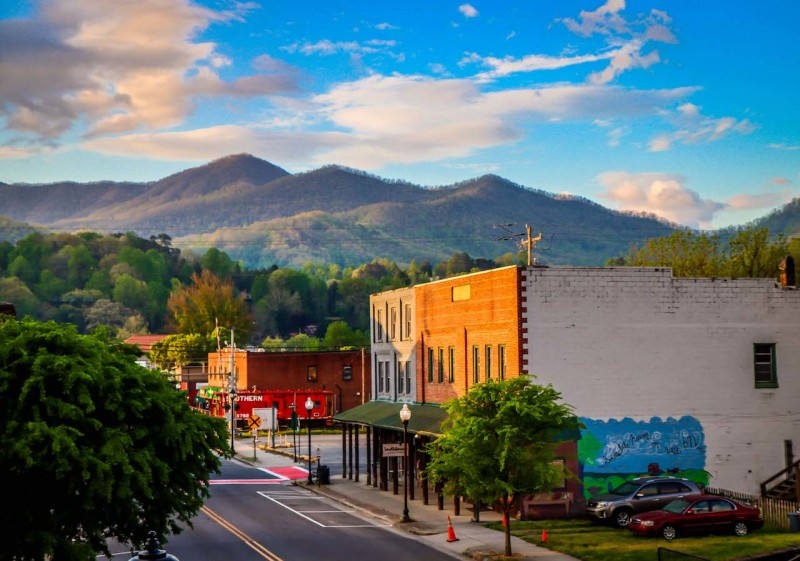
Hayesville is a small town nestled in the Blue Ridge Mountains of western North Carolina, serving as the county seat of Clay County. With a town population of only a few hundred residents and a county population of roughly 11,000, Hayesville carries the unhurried character of a Southern Appalachian mountain community. The town is best known as a gateway to Lake Chatuge and the surrounding Nantahala National Forest, drawing visitors who come for the cool mountain air, forested ridges, and the kind of small-town main street that still operates at a slower pace. It sits in the far southwestern corner of the state, about 95 miles southwest of Asheville and roughly 110 miles northeast of Atlanta, making it a remote-feeling destination that is still within reach of two major metropolitan areas.
Just a few minutes from the center of town, Lake Chatuge spreads across the North Carolina–Georgia border, its 7,500 acres of water backed up behind a Tennessee Valley Authority dam completed in the 1940s. The lake is a focal point for visitors year-round, supporting boating, fishing, swimming, and lakeside picnicking, and several public recreation areas and marinas line its shores within a 10- to 15-minute drive of downtown Hayesville. Its scenic, ridge-ringed shoreline is one of the defining visual features of the area.
To the north and east of town, the Nantahala National Forest — the largest of North Carolina's four national forests — offers more than half a million acres of protected mountains, rivers, and woodlands. Visitors can reach popular trailheads, waterfalls, and sections of the Appalachian Trail within roughly 30 to 60 minutes of Hayesville, and the forest's trout streams and whitewater tributaries attract paddlers and anglers throughout the warmer months. Fall foliage season brings a steady stream of leaf-peepers, while the mild summers make the area a refuge from the heat of the Deep South.
A short drive east of Hayesville in the community of Brasstown, the John C. Campbell Folk School has been teaching traditional Appalachian crafts, music, and woodworking since 1925. About 10 minutes from the town square, the campus welcomes students for weeklong residencies and day-long classes in blacksmithing, pottery, weaving, and storytelling, and it hosts seasonal events and a craft store that draw curious visitors passing through the region.
For short-term rental owners, Hayesville offers a quiet but well-positioned base in a region that consistently attracts outdoor enthusiasts, lake-goers, and travelers seeking an authentic mountain experience without the crowds of busier Western North Carolina destinations. Its proximity to both Atlanta and Asheville gives it a broad potential guest pool, while the combination of Lake Chatuge, national forest access, and the area's cultural institutions like the Folk School provides a layered appeal that supports stays in every season.
Want to know if a property in Hayesville is a good investment?
Enter an address to get instant revenue potential and comps.