
Goldsboro, North Carolina
Want to see how Goldsboro compares to other top cities in North Carolina? Explore all city regulations in North Carolina. →
Goldsboro, NC
Generally Investor Friendly
STR Regulations for Goldsboro, North Carolina
Overview: Are short‑term rentals allowed in Goldsboro, NC?
Yes. Short‑term rentals are allowed in Goldsboro. The City’s Unified Development Ordinance (UDO) permits lodging uses—including “Bed and Breakfast (Includes short‑term rental such as Airbnb, VRBO, HomeAway, etc.)”—as a listed use under “Business and Personal Services” in the Off‑Street Parking Requirements table (Table 6‑1). There is no city‑wide prohibition on STRs in the materials provided, nor is there a separate STR ordinance referenced. As with any use, full compliance with zoning, parking, lighting, and site‑design standards remains mandatory.
How to start an STR business in Goldsboro (high‑level steps)
- Select a compliant property. Confirm the zoning district allows lodging uses (listed as “Bed and Breakfast,” etc.). If unsure, seek a zoning determination from the City.
- Design your STR for compliance. Use the UDO’s design standards for parking, lighting, and landscaping (see “Goldsboro Regulations” below).
- Building and life‑safety. If changing use or renting rooms, verify compliance with the North Carolina State Building Code (especially for egress, fire protection, and occupancy). If interior alterations are planned, a building permit may be required.
- Business licensing. Goldsboro requires a city business license (Business Privilege License). This is obtained through the City’s Finance Department; revenue/tax matters may require a separate process. If you collect state sales and transient accommodations taxes, you will need to register with the North Carolina Department of Revenue.
- Ongoing compliance. Maintain off‑street parking, lighting controls, and landscaping as required; manage guest parking; avoid nuisances (noise, glare); keep shared‑parking and access easements current if applicable.
Required documents, permits, licenses, and guidelines
- City business license (Business Privilege License) — Goldsboro Finance Department; application details should be confirmed directly with the City.
- Building permit (as applicable) — for interior changes affecting egress, structural modifications, or changes of use.
- Certificate of occupancy (if required) — following completion and inspection.
- Zoning compliance — confirmation that lodging use is permitted under the property’s zoning. If not clearly permitted, request a written determination.
- North Carolina state tax registrations — if applicable, register with the N.C. Department of Revenue to collect/remit sales tax and transient accommodations (lodging) tax.
- Plans — prepare site plans, parking/loading layouts, lighting photometric plan (where applicable), and landscaping plans consistent with UDO Article 6 standards.
Goldsboro regulations (city‑level): STR use, parking, lighting, landscaping
- STR as lodging. “Bed and Breakfast (Includes short‑term rental such as Airbnb, VRBO, HomeAway, etc.)” is specifically listed in the parking requirements table, indicating lodging uses are permissible and recognized for compliance purposes.
- Off‑street parking (Table 6‑1). Bed and Breakfast/STR parking is required at 1 space per room, plus 1 space per employee. Maximum is 2 spaces per room plus 1 per employee. The “room” for STRs typically means each rentable sleeping unit. If the STR is a whole‑house rental (entire dwelling), treat the entire dwelling as the “unit” and compute parking accordingly (consult the Administrator for guidance if occupancy models suggest higher parking demand).
- Where and how to provide parking (Section 6.1.3). Required spaces must be on the same parcel as the principal structure unless shared parking is used (see below). Spaces cannot be in the public right‑of‑way. They must be permanent and maintained in sound condition. Paving, drainage, striping, and overhang protection standards apply.
- Shared/off‑site parking (Section 6.1.6). Off‑site parking is allowed up to 300 feet from the STR in non‑residential zoning districts, subject to a recorded, five‑year agreement approved by the City Attorney and Administrator. Mixed‑use/shared‑parking reductions are available per Table 6‑2 (weekday/weekend/time‑of‑day allowances).
- Loading (Section 6.1.7–6.1.8). Loading spaces are required for commercial uses with regular deliveries; if needed, minimum dimensions are 15 ft x 30 ft with 15 ft clear height. Seek a modification if applicable.
- Lighting standards (Section 6.2). Commercial lighting must meet IESNA recommendations with minimum maintained foot‑candle levels (e.g., parking lots: 0.5 min for low activity, 0.9 min for medium activity, 1.1 min for high activity; uniformity ratio 4:1). Full cutoff fixtures are generally required for >2,000‑lumens outdoor area/parking lighting. Maximum trespass is 0.4 FC at property lines unless a higher level is approved. Building‑mounted lighting must be full cutoff outside service/loading areas.
- Landscaping, screening, buffering (Section 6.3). Vehicular Surface Area (VSA) landscaping requires 50% of plantings within VSA interior islands/medians, 50% evergreen, and all spaces within 60 ft of a parking lot tree unless the impervious surface ratio (ISR) is <0.20. Tree preservation rules (CRZ protection, fencing, and credit rules) apply. Buffer yard standards (Types A–D) apply between different land‑use classes (Tables 6‑8 and 6‑9). Protected street yards and street‑tree requirements apply to all frontages.
Note on exemptions and adjustments (Section 6.3.2). Single‑family and two‑family dwellings are exempt from landscaping standards. Modifications of up to 20% of landscaping requirements may be granted by the Planning Director upon written request.
Wayne County regulations (county‑level)
The materials provided do not include county‑specific STR regulations. Confirm with the Wayne County Planning/Zoning or Board of Commissioners for any county‑level permits or rules.
North Carolina state‑level regulations
- Building/life‑safety. The North Carolina State Building Code governs egress, fire protection, occupancy, and accessibility. Interior alterations to add guest rooms, alter exits, or convert a dwelling to lodging trigger code compliance and potential permits/inspections.
- Taxes. North Carolina requires collection/remittance of sales tax and transient accommodations tax by lodging operators, including STRs. Register with the N.C. Department of Revenue; consult current rates and filing schedules.
Key contacts (phone, email, website where available)
- City of Goldsboro – Planning & Development (Administrator, UDO/Zoning): 919‑580‑4323; website: www.goldsboronc.gov
- City of Goldsboro – Building Inspections: 919‑580‑4323; website: www.goldsboronc.gov
- City of Goldsboro – Finance Department (Business License): 919‑580‑4323; website: www.goldsboronc.gov
- North Carolina Department of Revenue (State tax registration): 877‑308‑9092; website: www.ncdor.gov
- Wayne County Planning/Zoning: 919‑731‑1435; website: www.waynegov.com
Note: Phone numbers listed above are from the City’s main contact lines referenced on the City website; verify current extensions and staff assignments with the Department.
Source links (for reference and detailed codes)
- UDO Article 6 – Supplemental Regulations (Parking, Loading, Lighting, Landscaping): www.goldsboronc.gov/wp-content/uploads/UDO160D-Article-6.pdf
- City of Goldsboro – Official Website: www.goldsboronc.gov
Practical takeaway for investors: Goldsboro explicitly recognizes STRs as lodging within its parking and zoning framework. Success hinges on getting the parking right (1 space per rentable room + 1 per employee; consider shared parking), meeting commercial lighting standards, and incorporating landscaping and buffering as applicable. Secure the city business license and confirm state tax registrations early; work closely with City Planning for any zoning questions and with Building Inspections for life‑safety/code compliance.
What do Airbnb hosts actually earn in Goldsboro?
Goldsboro hosts earn a median $23,196/year with $118 ADR and 64% occupancy.
Top performers pull in $30,295+ per year.
See the full Goldsboro market breakdownNext step
Found a property in Goldsboro?
Paste any address and get estimated revenue, cash-on-cash return, and comparable STR performance in under 5 minutes. 3 free analyses per day.
Free brief
Get the free Goldsboro STR Investment Brief
Revenue data, top neighborhoods, seasonal trends, and the key regulations for Goldsboro, North Carolina in one email.
Goldsboro
Market Saturation Score
Photos of Goldsboro


Overview of Goldsboro
Goldsboro is a small city in eastern North Carolina, serving as the county seat of Wayne County. With a population of approximately 33,000 residents, it carries the easygoing pace of a mid-sized Southern town, anchored by a historic downtown, a strong military presence, and a setting along the Neuse River. The city is best known as the home of Seymour Johnson Air Force Base, one of the region's largest employers and a major installation in the U.S. Air Force, which gives the area a steady flow of visitors on temporary duty, family travel, and permanent change-of-station moves. Goldsboro sits about 60 miles southeast of Raleigh, roughly an hour's drive along US-70, placing it within easy reach of the Triangle's larger urban amenities while retaining a quieter, more affordable character of its own.
Just southeast of town, Cliffs of the Neuse State Park is a natural anchor for outdoor-focused stays. The park wraps around a striking stretch of bluffs overlooking the Neuse River and offers miles of hiking trails, a swimming lake in warmer months, picnic areas, and a campground. It is roughly a 20- to 25-minute drive from downtown Goldsboro, making it a convenient day-trip option for guests who want a quick escape into nature without committing to a long drive.
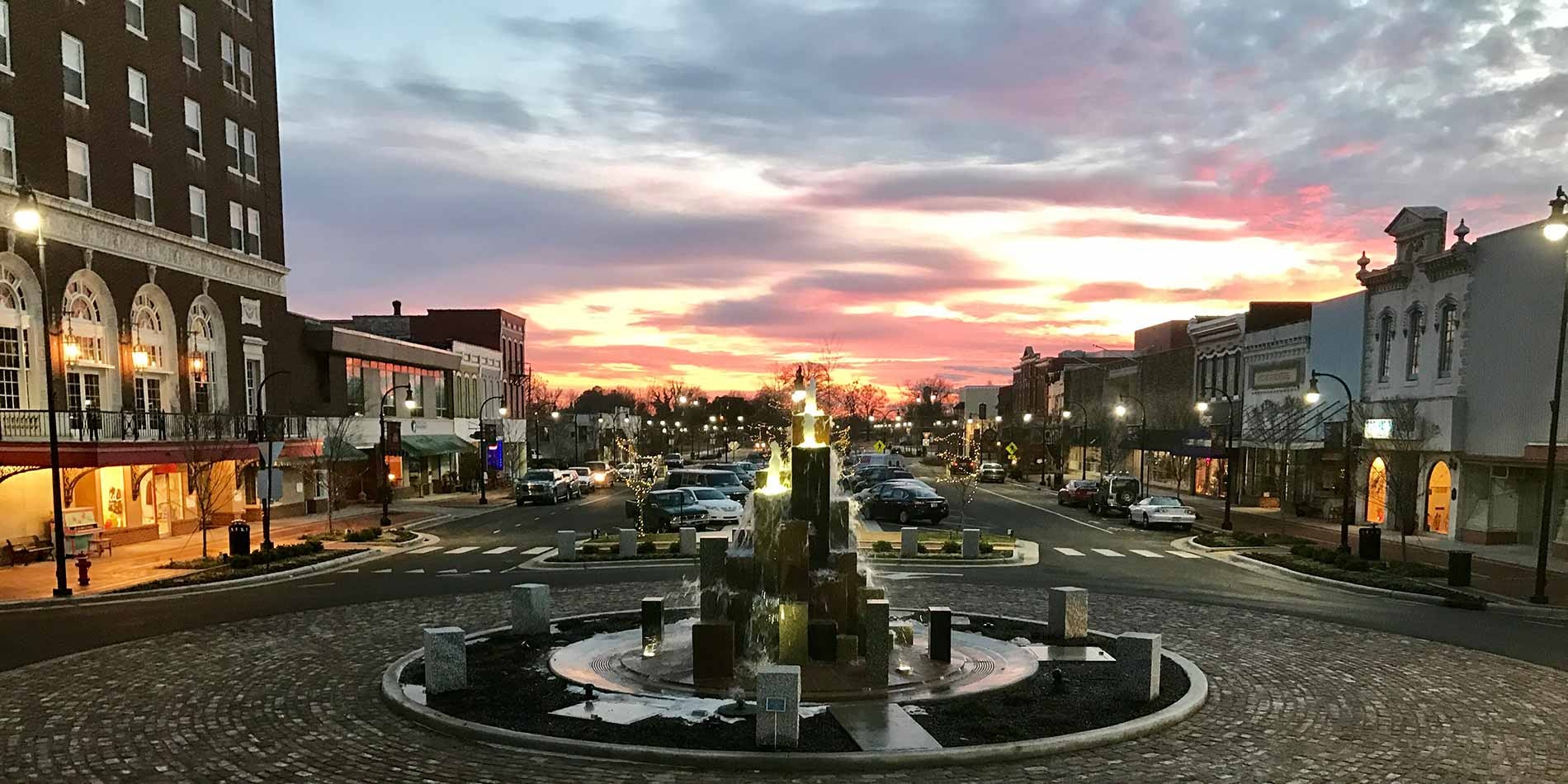
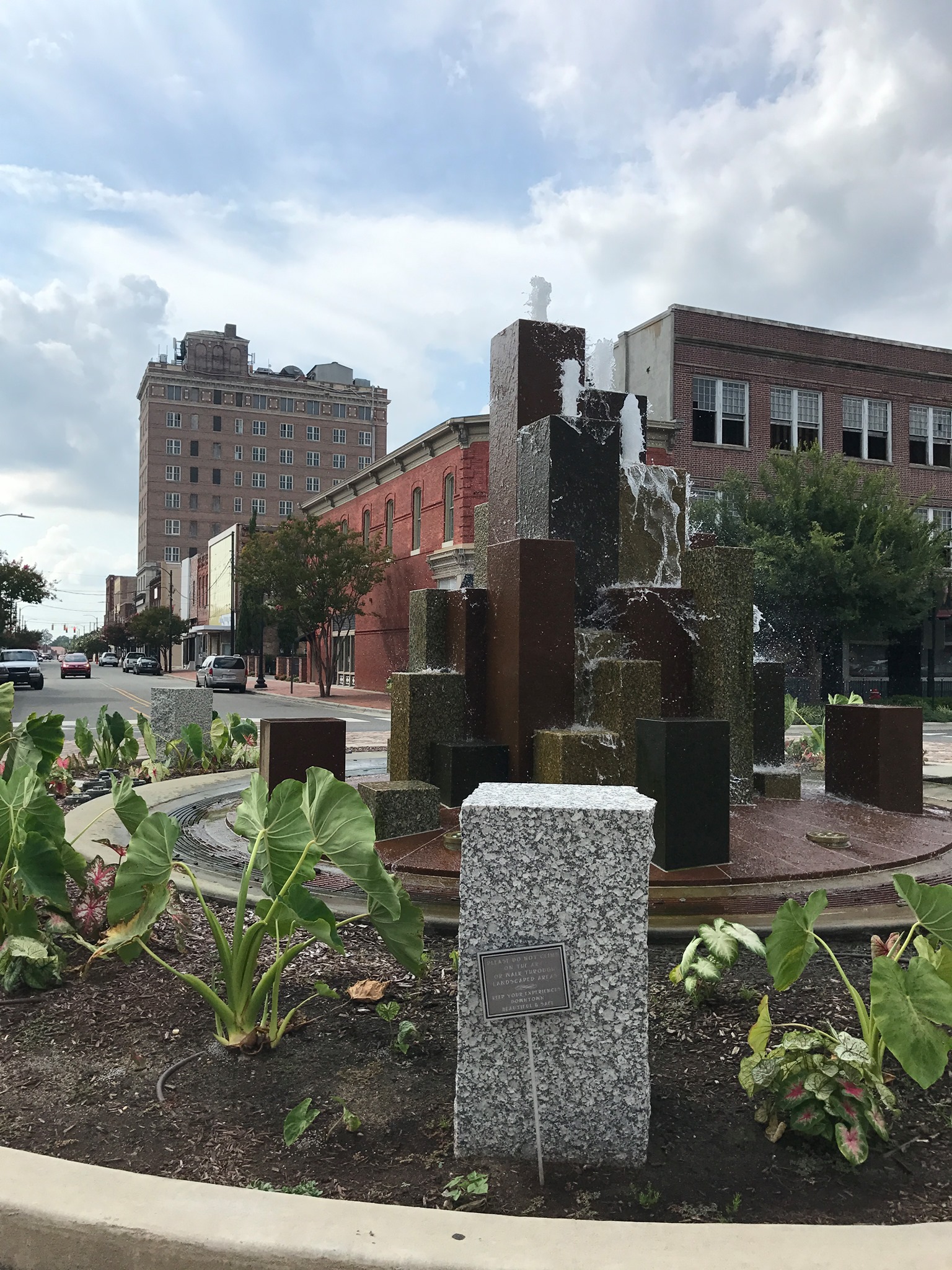
Downtown Goldsboro itself has been quietly revitalized in recent years, with a walkable stretch of locally owned restaurants, coffee shops, breweries, and small performance venues that give the city center a low-key but genuine sense of place. The area hosts regular community events, outdoor markets, and live music, and it sits close to the revived Center Street corridor that has become a focal point for visitors looking to spend an evening out without venturing to a larger city.
A short drive east of Goldsboro, the surrounding Wayne County countryside offers agricultural landscapes, tobacco heritage sites, and small rural communities that reflect the area's longstanding farming traditions. The Neuse River, which winds through the region, supports fishing, paddling, and riverside recreation, and it ties the city to a wider network of river towns stretching toward the coast. Roughly two hours to the southeast, the Crystal Coast and communities like New Bern open up additional possibilities for beach and waterfront day trips.
For short-term rental investors, Goldsboro offers a combination of stable, year-round demand from military families and base visitors, a comparatively low entry cost relative to North Carolina's coastal and Triangle markets, and a diverse set of nearby draws ranging from state park hiking to coastal excursions. Its central position in eastern North Carolina makes it a practical base for travelers who want to experience both the region's small-town character and the wider attractions of the Tar Heel State.
Want to know if a property in Goldsboro is a good investment?
Enter an address to get instant revenue potential and comps.