
Enfield, North Carolina
Want to see how Enfield compares to other top cities in North Carolina? Explore all city regulations in North Carolina. →
Enfield, NC
Generally Investor Friendly
STR Regulations for Enfield, North Carolina
Overview: Are Short-Term Rentals Allowed in Enfield, NC?
- Are STRs allowed? Yes, provided the property is located in a zoning district that permits lodging use and the unit complies with all applicable building, life-safety, and local rental regulations.
- Enfield’s municipal code does not contain a separate short‑term rental ordinance or a standalone STR licensing program. Instead, STRs are treated as standard “residential rental property” and must meet the North Carolina State Building Code, smoke/CO detector requirements, and local rental-property registration rules (the latter applies to landlords whose properties generate excessive code violations or crime; see § 150.50–§ 150.52).
- State level: North Carolina does not prohibit short‑term rentals. STRs are permitted where local zoning allows lodging use, subject to state building codes, fire/life-safety rules, and, in some jurisdictions, local registration or taxation.
Bottom line: STRs are allowed in Enfield as a matter of state law and local practice if your zoning permits lodging and you meet building and safety standards.
What do Airbnb hosts actually earn in Enfield?
Enfield hosts earn a median $21,691/year with $127 ADR and 56% occupancy.
Top performers pull in $27,316+ per year.
See the full Enfield market breakdownHow to Start a Short‑Term Rental Business in Enfield (Step-by-Step)
-
Confirm land use and zoning
- Verify the parcel’s zoning and whether “lodging,” “hotel/motel,” or “vacation rental” is an allowed use in Chapter 153 (Zoning). Use Halifax County’s GIS (tax data/assessor maps) or contact the Town to confirm the zoning district at the subject address.
- If the zoning does not allow lodging use, you will need a variance or a zoning map/text amendment (a discretionary process with no guarantee of approval).
-
Choose the property type and safety approach
- Entire home or a room in an owner-occupied house? Both are permissible if allowed by zoning and life-safety standards.
- Ensure the dwelling meets the N.C. State Building Code and the smoke/CO detector requirements in § 150.15–§ 150.20 (see Required Documents/Permits/Licenses below).
-
Obtain permits and inspections, as applicable
- Building/inspection permits are required for construction, installation, repair, removal, or remodeling within the Town’s jurisdiction (§ 150.02).
- No building/structure subject to a building permit may be occupied until a Certificate of Occupancy or Temporary Certificate is issued (§ 150.06).
- Enfield adopts the N.C. State Building Code statewide; permits and inspections follow the state code procedures (§ 150.01; § 150.04).
-
Register as a residential rental property, if applicable
- Enfield requires owners of certain “residential rental property” to register only when the property: (a) has more than four verified violations in a rolling 12-month period, (b) has two or more verified violations in a rolling 30‑day period, or (c) is identified within the top 10% of properties with crime/disorder problems (§ 150.51–§ 150.52).
- If your STR falls into one of those categories, register with the Town Administrator or designee using the required information (property address, owner details, number of units, current tenant(s)). Update within five business days of any change (§ 150.52).
-
Comply with life-safety and property standards
- Smoke detectors: Location, type, and maintenance per § 150.16–§ 150.18. For units built/renovated after 4/1/1993, 115‑volt, permanently connected smoke detectors are required. Owners must provide written certification annually to tenants that detectors are present, inspected, and functional.
- Carbon monoxide detectors: Required as “smoke and carbon monoxide detectors” and must be located and maintained per N.C. State Building Code requirements (§ 150.16).
- Vacant property: If the home will be unoccupied, follow Enfield’s vacant property registration, maintenance, and security rules (§ 150.40–§ 150.44).
- Street numbers: Display clearly per Halifax County’s assigned address; minimum sizes/contrasting colors apply; violation penalty $100 (§ 150.30; § 150.99).
-
Taxes and other obligations
- State income and business taxes: Report STR income on your federal and state tax returns. North Carolina generally does not have a unique “STR tax” at the state level.
- Local lodging taxes/registration: The provided Enfield materials do not specify a local occupancy or lodging tax or a local STR registration scheme separate from the zoning and life-safety requirements summarized here. Confirm with the Town whether Enfield or Halifax County imposes a lodging tax or requires any lodging-specific registration or collection.
- Insurance: Carry appropriate property and liability coverage, and verify policy terms for short‑term occupancy.
-
Operations and enforcement
- Maintain compliance with building/safety codes, local ordinances, and any HOA/Condo rules. Violations can trigger stop‑work orders, enforcement actions, or the residential rental property registration requirements if repeated violations or crime are documented.
Required Documents, Permits, Licenses, and Guidelines
- Building and inspection permits
- Apply to the Code Enforcement Officer before beginning construction, installation, repair, removal, or remodeling activities.
- Fees established annually by the Board of Commissioners; permit validity per G.S. § 160D‑1111; renewals possible for 90 days at no charge; emergency work allowed with post‑event application (§ 150.02).
- Certificate of Occupancy
- Required before occupying any building/structure or use of land subject to a building permit (§ 150.06).
- N.C. State Building Code
- Adopted and enforced townwide; the Code Enforcement Officer administers enforcement (§ 150.01; § 150.04; § 150.03).
- Smoke detectors and carbon monoxide detectors
- Location and maintenance per § 150.16; specifications per § 150.17; responsibilities per § 150.18.
- Built/renovated after 4/1/1993: 115‑volt, permanently connected detectors; detectors powered by AC require a permit but no fee (§ 150.17).
- Residential Rental Property Registration (conditional)
- Triggered only when a property meets the enforcement thresholds for violations or crime/disorder (§ 150.51–§ 150.52).
- Submission to Town Administrator or designee; update within five business days of changes.
- Vacant Property Registration, Maintenance, and Security (if unoccupied)
- Registration within 30 days of vacancy or notice; maintenance to eliminate “evidence of vacancy”; security to prevent unauthorized access (§ 150.40–§ 150.44).
- Subdivision Compliance (if creating new lots)
- Any subdivision of land must follow Chapter 151 procedures and minimum design/utility/street standards; no plat may be recorded without Town approval.
Specific Regulations (City, County, State)
City of Enfield
- Building regulations and inspections: N.C. State Building Code adopted; permits required for construction/renovation; inspections authorized; stop‑work orders possible; CO/Temporary Certificates required prior to occupancy (§ 150.01–§ 150.06).
- Smoke/CO detectors: Mandatory installation, location, and maintenance; 115‑volt permanent detectors required in newer construction; annual written certification to tenants; owner responsibility to repair within five days of written notice (§ 150.16–§ 150.18).
- Residential rental property registration: Applies only to properties with multiple verified code violations or significant crime/disorder activity; no routine rental registration requirement for STRs unless triggered (§ 150.50–§ 150.52).
- Vacant property: Registration, maintenance, and security requirements when property exhibits evidence of vacancy or has been unoccupied for 30+ days (§ 150.40–§ 150.44).
- Street numbers: Assigned by Halifax County; must be displayed per size and contrast rules; violation penalty $100 (§ 150.30; § 150.99).
Halifax County (as relevant)
- Street addressing is assigned by Halifax County; property numbering and street naming for purposes of compliance are administered by the County (§ 150.30).
State of North Carolina
- STRs are permitted under state law where local zoning allows lodging use.
- Building codes and life-safety: N.C. State Building Code applies statewide and governs minimum construction, life-safety, and inspection standards for dwellings used for rent.
- Development approvals and local enforcement: Governed by G.S. Chapter 160D as referenced in the Enfield code (§ 150.02, § 150.03, § 150.04, § 150.05, § 150.06).
- Note on local lodging taxes/occupancy taxes: Not covered in the provided Enfield materials; contact the Town to confirm whether Enfield or Halifax County imposes a lodging/occupancy tax, registration, or reporting requirement for short‑term rentals.
Contact Information (Local Authority in Charge of STRs/Building/Zoning)
- Town of Enfield (General)
- Website: enfieldnc.org
- Town Hall physical address and mailing address: Not provided in the source materials.
- Email and phone: Not provided in the source materials.
- Use the Town website to obtain current contact details for:
- Code Enforcement Officer (for building permits, inspections, Certificate of Occupancy)
- Town Administrator (for residential rental property registration if triggered)
- Planning/Zoning (for zoning confirmation and any future STR-specific ordinances)
- For county-level addressing: Halifax County (street numbering and mapping).
Links to Source Pages
- Title XV. Land Usage — Town of Enfield (includes building, subdivisions, housing code, zoning, flood damage prevention; see § 150.01–§ 150.06 for building/permits; § 150.15–§ 150.20 for smoke/CO; § 150.30 for street numbers; § 150.40–§ 150.44 for vacant property; § 150.50–§ 150.52 for conditional rental property registration; § 151.00 et seq. for subdivisions):
Practical Investor Notes
- Zoning is the gating factor. Confirm the zoning district and whether lodging uses are allowed before acquisition.
- Treat STRs like any rental dwelling under the N.C. State Building Code; install/maintain smoke and carbon monoxide detectors per § 150.15–§ 150.20 and obtain appropriate permits/inspections.
- Enfield does not publish a standalone STR permit; however, plan on standard building and life-safety compliance, and be prepared to register under § 150.50–§ 150.52 if repeated violations or disorder are documented.
- Local lodging/occupancy taxes are not addressed in the provided documents; verify any tax or registration requirements with the Town.
If you have a specific parcel address or potential property, start with zoning confirmation at the Town, then proceed with building/safety due diligence, and build a compliance checklist that includes permitting, detectors, addressing, and (if triggered) residential rental property registration.
Next step
Found a property in Enfield?
Paste any address and get estimated revenue, cash-on-cash return, and comparable STR performance in under 5 minutes. 3 free analyses per day.
Free brief
Get the free Enfield STR Investment Brief
Revenue data, top neighborhoods, seasonal trends, and the key regulations for Enfield, North Carolina in one email.
Enfield
Market Saturation Score
Photos of Enfield

Overview of Enfield
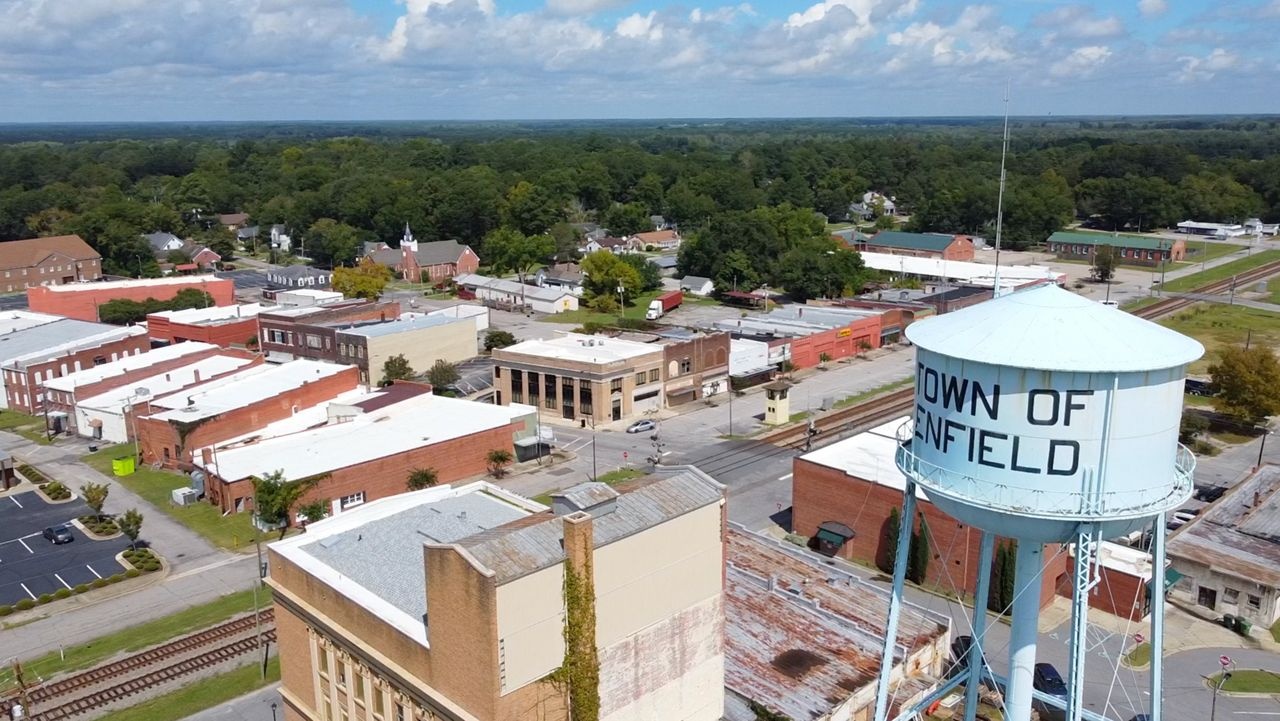
Enfield is a small, historically rooted town in Halifax County in northeastern North Carolina, with a population of roughly 2,300 residents. The town sits in a quiet stretch of the coastal plain, where pine forests, farmland, and slow-moving rivers shape the rhythm of daily life. It carries a classic small-town Southern feel, with an older main street, a scattering of historic homes, and a close-knit community. Enfield serves as a convenient base for visitors exploring the broader region, including the Revolutionary-era sites around Halifax and the natural areas along the Roanoke River. It lies approximately 30 miles east of Rocky Mount and roughly 80 miles northeast of Raleigh, the nearest major cities.
A short drive west of Enfield brings visitors to Historic Halifax, a preserved colonial-era site where the Halifax Resolves were adopted in 1776, an early formal call for colonial independence that preceded the Declaration of Independence by a few months. The site features restored buildings, a visitors center, and interpretive programs, and it sits about 15 miles west of Enfield, roughly a 20-minute drive. The Historic Halifax State Historic Site is widely regarded as one of the most meaningful Revolutionary War-era locations in the American South.
For outdoor recreation, the nearby Roanoke River National Wildlife Refuge protects a long corridor of bottomland hardwood forest and swamp along one of the Southeast's most important migratory bird flyways. Visitors come for hiking, paddling, and wildlife watching, with several public access points within a half-hour drive of Enfield. The refuge is a particular draw in spring and fall, when warblers and other songbirds move through the area in impressive numbers.
Closer to home, Enfield itself rewards a slow look around, with a few 19th-century buildings and a quiet, walkable core that reflects its origins as a small trading town. The surrounding Halifax County countryside adds to the appeal, offering rural roads, fishing spots, and the unhurried character of small-town North Carolina that stands in clear contrast to busier destinations along the coast and the Piedmont.
Enfield makes a compelling base for a short-term rental because of its central position within a region rich in both Revolutionary history and natural beauty. Guests can spend a morning exploring colonial Halifax, an afternoon on a wildlife refuge trail, and an evening strolling through a peaceful small town that has changed little in generations. Its location within easy driving distance of both Rocky Mount and Raleigh makes it a practical stop for travelers moving through eastern North Carolina, while its calm, authentic atmosphere offers the kind of restful retreat that has become increasingly rare.
Want to know if a property in Enfield is a good investment?
Enter an address to get instant revenue potential and comps.