
Hot Springs, Montana
Want to see how Hot Springs compares to other top cities in Montana? Explore all city regulations in Montana. →
Hot Springs, MT
Very Investor Friendly
STR Regulations for Hot Springs, Montana
This guide synthesizes the available evidence to give short‑term rental (STR) investors a practical view of what is permitted, what is required, and who to contact before operating in Hot Springs, Montana. Because the city of Hot Springs does not have published, city‑specific STR ordinances in the sources reviewed, investors should rely on state‑level Montana requirements and monitor local channels for any future changes.
Are short‑term rentals allowed in Hot Springs, MT?
Yes—short‑term rentals are allowed in Hot Springs under Montana’s statewide framework. A University of Montana study cited in Montana sources notes that smaller towns and counties often feel no compelling need to regulate STRs, and we found no Hot Springs‑specific rules in the content reviewed. As a result, the market is characterized by a low regulatory burden (AirROI’s 2025 report for Hot Springs labels STR regulation level as “Low,” and there were no licensed listings among the properties analyzed, which strongly suggests that hosts are operating under the state’s Public Accommodation regime rather than a local licensing layer). Investors should verify current local ordinances and permit requirements directly with the city before opening, and should watch for any bills at the state level that could affect future local authority to regulate STRs (e.g., SB 336, which seeks to classify STRs as residential use while preserving local zoning options and bed tax obligations).
How to start a short‑term rental business in Hot Springs
Operationalizing an STR in Hot Springs follows Montana’s statewide lodging model and should be approached as a phased compliance build, coupled with market‑aligned planning. Start by selecting a property that meets habitability and safety standards, then complete the required Public Accommodation License with the Montana Department of Public Health and Human Services (DPHHS). Set up guest registration and record retention, address water and wastewater compliance, confirm hygienic amenities and cleaning protocols, and prepare for annual inspections. Ensure lodging taxes are collected and remitted properly, and—because there is no evidence of city‑specific licensing—monitor the city’s and Sanders County’s official channels for any future updates. Finally, calibrate the business plan to Hot Springs’ market realities: modest seasonality, a low regulatory environment, and a market dominated by one‑ and two‑-bedroom entire‑home listings.
Required documents, permits, licenses, and guidelines
Montana’s Public Accommodation License is the primary statewide requirement for STRs. The license application must be submitted annually to DPHHS. The rules for public accommodations are prescriptive about potable water, wastewater disposal, hygiene and cleaning standards, and amenities. Hosts must maintain a guest register with names and contact information and retain the records for at least one year. The property is inspected as part of the approval process and thereafter on an annual schedule to ensure continued compliance. Montana’s lodging taxes apply at the state level: the Lodging Facility Use Tax (4%) and the Lodging Sales Tax (4%), both calculated on the full listing price including cleaning and guest fees for reservations of 29 days or shorter. Airbnb remits these taxes to the Montana Department of Revenue on behalf of hosts. Unless the city or county later imposes a local layer of regulation, there is no evidence of additional local permits or licenses specific to Hot Springs in the reviewed sources, and the AirROI analysis did not identify any licensed listings among the 26 properties reviewed.
Specific regulations: city, county, and state
State of Montana. Public Accommodation License rules govern lodging facilities, including STRs, with standards for potable water, adequate wastewater disposal, hygiene and cleanliness, and amenities; inspections occur as part of the initial approval and annually thereafter. Hosts must keep a guest register (names and contact information) for at least one year. Two lodging taxes—Lodging Facility Use Tax (4%) and Lodging Sales Tax (4%)—apply to the full listing price, including cleaning and guest fees, for reservations of 29 days or fewer; Airbnb collects and remits them to the Department of Revenue. No statewide zoning limitations apply to STRs, but a bill (SB 336) under consideration would define STRs as a residential use, protect STR activity in portions of a primary residence (including separate buildings on the same or adjoining property), and preserve local governments’ ability to regulate STRs in certain zoning districts while grandfathering existing STRs.
City of Hot Springs. We found no published Hot Springs‑specific STR regulations in the sources provided. Given the lack of city ordinance references, it is reasonable to conclude that Hot Springs currently allows STRs under the statewide framework without additional local licensing or zoning restrictions in the reviewed materials.
Sanders County. The county is the local health jurisdiction in the public health network; it performs inspections in partnership with DPHHS for public accommodations. We found no evidence in the sources of Sanders County‑imposed STR regulations beyond the statewide rules.
Contact information for the local authority in charge of STRs
Montana Department of Public Health and Human Services (DPHHS) – Public Accommodations Licensing. Address and submission procedures are provided on DPHHS’s Public Accommodation License application page. Phone and email addresses are not listed in the source content provided.
Montana Department of Revenue – Lodging Taxes. No phone or email contact details were provided in the source content. Airbnb remits the Lodging Facility Use Tax and the Lodging Sales Tax on behalf of hosts; you can consult the Montana Department of Revenue lodging tax information for policy and reporting specifics.
City of Hot Springs. We did not find direct STR licensing contacts in the provided content. For any local permit questions or updates on potential city regulations, call the city directly or consult the city’s website. Since STRs are subject to local zoning oversight if later enacted, confirm current status with the city before commencing operations.
Links to source pages
Airbnb Rules in Montana | Laws, Regulations, and Taxes (Hostaway). www.hostaway.com/blog/airbnb-rules-in-montana/
DPHHS Public Accommodation License Application. dphhs.mt.gov/assets/publichealth/FCS/SanitarianResourcePage/FCSForms/PublicAccommodations/PALicenseAppPage1.pdf
DPHHS Rules for Public Accommodations. dphhs.mt.gov/assets/publichealth/FCS/PublicAccomodations/PAWEBRULE.pdf
Montana Department of Revenue – Lodging Taxes (ServiceNow). montana.servicenowservices.com/citizen/kb?id=kb_article_view&sysparm_article=KB0013531
NBC Montana – Senate Bill 336 coverage. nbcmontana.com/news/local/montana-senate-bill-seeks-to-revise-laws-related-to-short-term-rentals
AirROI Market Report – Hot Springs, Montana (2025). www.airroi.com/report/world/united-states/montana/hot-springs
This guide is intended to be informative and not legal advice. Because local rules can change and enforcement practices may vary, investors should confirm current requirements with DPHHS and the city of Hot Springs before operating.
What do Airbnb hosts actually earn in Hot Springs?
Hot Springs hosts earn a median $13,837/year with $139 ADR and 45% occupancy.
Top performers pull in $29,818+ per year.
See the full Hot Springs market breakdownNext step
Found a property in Hot Springs?
Paste any address and get estimated revenue, cash-on-cash return, and comparable STR performance in under 5 minutes. 3 free analyses per day.
Free brief
Get the free Hot Springs STR Investment Brief
Revenue data, top neighborhoods, seasonal trends, and the key regulations for Hot Springs, Montana in one email.
Hot Springs
Market Saturation Score
Photos of Hot Springs

Overview of Hot Springs
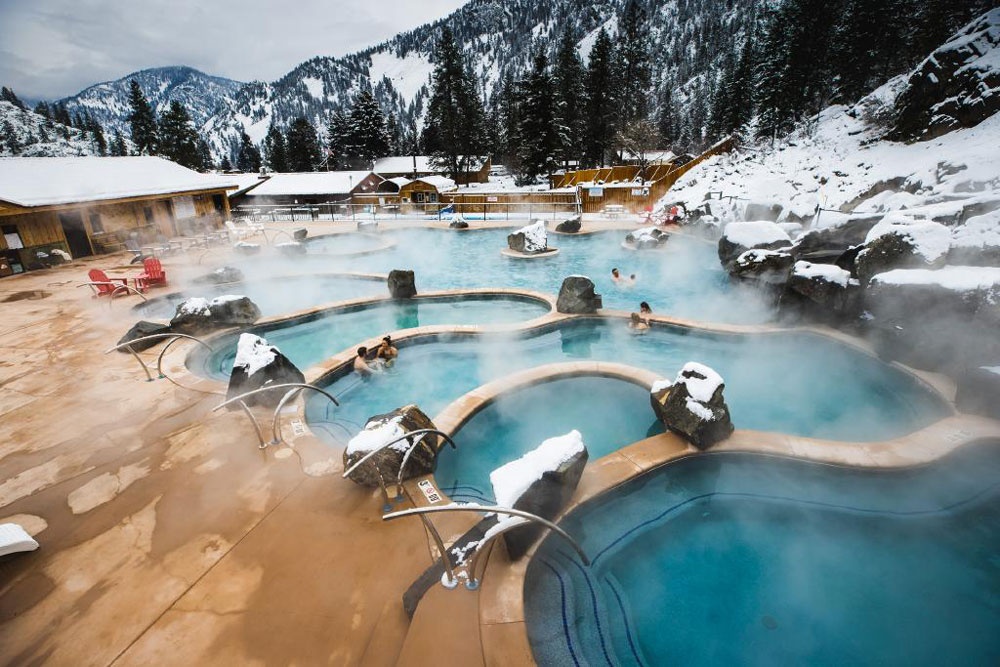
Hot Springs is a small town in Sanders County in the western part of Montana, with a population of approximately 500 residents. The town has a quiet, rustic character and is best known for its natural geothermal hot mineral springs, which have attracted visitors for well over a century. It serves as a relaxing base for exploring the broader Flathead region of western Montana, and sits roughly 75 miles northwest of Missoula, the nearest sizable city.
The hot springs themselves remain the central attraction, and a handful of bathhouses and inns channel the mineral-rich water into soaking pools that have long been associated with relaxation and therapeutic use. Symes Hot Springs Hotel is among the historic establishments in town that have welcomed soak-seekers for generations.
Flathead Lake is one of the largest natural freshwater lakes in the western United States and lies about 25 miles west of Hot Springs. The lake offers boating, fishing, and scenic shoreline drives, with the surrounding area dotted by small communities, cherry orchards, and state parks.
The National Bison Range, a wildlife refuge managed by the U.S. Fish and Wildlife Service, is located roughly 30 miles west of Hot Springs near the community of Moiese. The refuge is home to herds of bison as well as elk, deer, bighorn sheep, and pronghorn, and offers a scenic drive through open grassland and rolling hills.
Glacier National Park lies to the north of Hot Springs, across a drive of roughly two and a half to three hours. The park is renowned for its dramatic mountain scenery, remnant glaciers, alpine meadows, and the famous Going-to-the-Sun Road, making it a popular day trip or overnight excursion for visitors staying in the area.
Hot Springs' appeal as a short-term rental destination lies in its blend of small-town character and access to a wide range of natural attractions. Visitors come primarily for the hot springs, but the town's location within driving distance of Flathead Lake, the National Bison Range, and Glacier National Park makes it a practical and peaceful base for exploring one of the most scenic corners of the northern Rockies.
Want to know if a property in Hot Springs is a good investment?
Enter an address to get instant revenue potential and comps.