
Provincetown, Massachusetts
Want to see how Provincetown compares to other top cities in Massachusetts? Explore all city regulations in Massachusetts. →
Provincetown, MA
Challenging To Investors
STR Regulations for Provincetown, Massachusetts
Overview: Short-Term Rental Status in Provincetown, MA
Short-term rentals ARE ALLOWED in Provincetown, MA, but they are extensively regulated. The town has implemented a comprehensive regulatory framework that includes ownership limits, certificate requirements, and strict enforcement mechanisms designed to prevent the corporatization of the STR market while maintaining housing availability for year-round residents.
As of 2024, Provincetown has just over 900 short-term rental certificates issued for approximately 1,000 active STR units. The town's approach reflects its unique status as a seasonal tourist destination with competing demands on housing stock from year-round residents, vacation homes, and summer workforce housing needs.
What do Airbnb hosts actually earn in Provincetown?
Provincetown hosts earn a median $43,720/year with $426 ADR and 56% occupancy.
Top performers pull in $62,294+ per year.
See the full Provincetown market breakdownHow to Start a Short-Term Rental Business in Provincetown
Step 1: Understand Eligibility Requirements
Before proceeding with any application, investors must confirm they meet the following criteria:
- Individual Ownership: You must be an individual, not a corporation. Corporations are prohibited from obtaining STR certificates.
- LLC Exception: Limited Liability Companies (LLCs) can operate STRs if owned by a person (not a corporation).
- Quantity Limits: No person may hold more than two short-term rental certificates.
- Property Type Restrictions: Timeshares, affordable housing units, and accessory dwelling units (ADUs) are not permitted as short-term rentals.
Step 2: Secure Property and Verify Compliance
- Ensure your property is residential and suitable for short-term rental use
- Confirm no affordable housing restrictions apply
- Verify the property is not classified as an ADU
- Check that acquiring this property won't exceed your two-certificate limit if you already own STRs
Step 3: Apply for Required Documentation
- Submit a Rental Certificate application through the town's online permitting system
- Pay the annual certification fee of $750
- Complete any required inspections or compliance reviews
Step 4: Ongoing Compliance and Operations
- Maintain active certification annually
- Adhere to all Board of Health regulations
- Keep current with any regulatory updates
- Maintain proper insurance and safety standards
Required Documents, Permits, Licenses, and Guidelines
Primary Requirements
1. Rental Certificate
- Issuing Authority: Provincetown Board of Health
- Application Process: Online through Viewpoint Cloud permitting platform
- Annual Fee: $750 (as of January 2023)
- Validity: Annual renewal required
- Associated Regulation: Board of Health Regulation "Habitations for Rent"
2. State Tax Registration
- Short-term rental operators must register with the Massachusetts Department of Revenue for tax purposes
- This includes potential room occupancy tax and sales tax obligations
3. Business Registration (if applicable)
- Local business registration may be required depending on your business structure
- Note that corporations cannot obtain STR certificates, but individual owners operating through LLCs may be permitted
Supporting Documentation
- Proof of property ownership or legal rental agreement
- Property insurance documentation
- Safety and compliance certificates as required by local health regulations
- Contact information for local property manager or owner (if not residing locally)
Board of Health Compliance
All STRs must comply with the Board of Health Regulation "Habitations for Rent", which establishes public health and safety standards for all rental dwelling units, including:
- Health and safety inspections
- Occupancy limits
- Safety equipment requirements
- Sanitation standards
- Maintenance requirements
Specific Regulations for Short-Term Rentals
City/Town-Level Regulations (Provincetown)
Ownership Limitations:
- Maximum of two short-term rental certificates per individual
- Corporations are prohibited from obtaining STR certificates
- LLCs are permitted if owned by an individual person, not a corporation
- Existing grandfathering: Owners with more than two properties as of April 22, 2024, may retain them but cannot acquire additional STR properties
Property Type Restrictions:
- Timeshares: Not permitted as short-term rentals
- Affordable housing units: Not permitted as short-term rentals
- Accessory Dwelling Units (ADUs): Not permitted as short-term rentals
- Existing long-term rentals: Must maintain any tenant protections as required by state law
Financial Requirements:
- Annual certification fee: $750 per property
- Payment deadline: Annual renewal required
- Late fees: May apply for late renewal (specific penalties not detailed in sources)
County-Level Regulations
The sources do not provide specific county-level regulations for Barnstable County (where Provincetown is located) that would apply differently than town regulations.
State-Level Regulations (Massachusetts)
State Law Preemption:
- Provincetown's regulations were certified by the Massachusetts Attorney General's office as not conflicting with state law
- Local municipalities retain authority to regulate short-term rentals within their jurisdictions
Massachusetts Room Occupancy Tax:
- STR operators may be subject to Massachusetts room occupancy tax
- Registration with the Massachusetts Department of Revenue is typically required
Condominium Conversion Act of 1983:
- If converting rental properties to condominiums for STR use, landlords must consider tenant protections
- Low-income or elderly tenants (over 62) may be entitled to continued tenancy or relocation assistance
- Tenants must prove "intent to convert" in housing court to trigger protections
Health and Safety Standards:
- Massachusetts Office of Attorney General provides guidance on health at home standards
- Landlords must maintain safe and healthy housing conditions
Enforcement and Penalties
Primary Enforcement Authority:
- Provincetown Board of Health is responsible for enforcement
Civil Penalties:
- Maximum penalty: $5,000 per violation
- Scope: Applies to properties operating without proper certification or in violation of regulations
- Compliance requirements: All existing STRs must obtain certification regardless of previous operating status
Contact Information for Local Authority
Primary Contact: Provincetown Board of Health/Community Development
Physical Address:
Town of Provincetown
260 Commercial Street
Provincetown, MA 02657
Phone:
- Main: 508-487-7000
- Community Development: 508-487-7020 (for rental certificate information)
- Fax: 508-487-9560
Email:
- General Compliance: compliance@provincetown-ma.gov
- Rental Certificate Questions: Community Development Department
Online Resources:
- Town Website: www.provincetown-ma.gov/
- Online Permitting Platform: provincetownma.viewpointcloud.com/
- Rental Certificate Information: www.provincetown-ma.gov/1170/Rental-Certificate-Information
- Board of Health Regulations: www.provincetown-ma.gov/DocumentCenter/View/940
Additional Municipal Contacts
Town Manager's Office:
- Phone: 508-487-7000
- For policy questions regarding STR regulations
Housing Office:
- Phone: Contact through main town number
- For housing-related concerns and tenant resources
State-Level Resources
Massachusetts Attorney General's Office:
- Eviction Help: www.mass.gov/forms/eviction-help-request
- Health at Home Guidance: www.mass.gov/guides/health-at-home
Massachusetts Department of Revenue:
- For tax registration and compliance questions
Legal Aid Resources:
- Mass Legal Help: masslegalhelp.org/
- South Coastal Counties Legal Services: sccls.org/
Important Regulatory Notes and Market Context
Market Dynamics
Provincetown's STR market is characterized by:
- High seasonal demand: Tourist destination with significant seasonal variation
- Limited corporate presence: Only 35% of hotels are corporation-owned (pre-regulation)
- Individual ownership predominance: About 90% of STRs belong to owners with one or two properties
- Limited market concentration: Just over 10% of units belong to owners with three or more properties
Regulatory Evolution
The current regulatory framework emerged from:
- 2023 Town Meeting: Voter approval of Articles 11 and 12
- April 2024: State Attorney General certification of new bylaws
- Ongoing enforcement: Board of Health implementation and compliance monitoring
Investment Considerations
Advantages:
- Established regulatory framework provides certainty
- Existing STRs are protected under grandfathering provisions
- Strong tourist demand supports rental income potential
- Limited competition from large corporate operators
Challenges:
- Strict ownership limits may restrict portfolio scaling
- Annual certification costs and compliance requirements
- Seasonal market volatility typical of resort communities
- Competition with long-term housing needs and workforce housing initiatives
Compliance Best Practices:
- Maintain detailed records of all certifications and renewals
- Establish relationships with local property managers if you don't reside locally
- Monitor regulatory updates and compliance requirements
- Consider the impact of STR operations on local housing availability and community relations
Links to Source Pages
- Provincetown Renter Information: www.provincetown-ma.gov/158/Renter-Information
- Provincetown Rental Certificate Information: www.provincetown-ma.gov/1170/Rental-Certificate-Information
- Provincetown Online Permitting Platform: provincetownma.viewpointcloud.com/
- Board of Health Regulation "Habitations for Rent": www.provincetown-ma.gov/DocumentCenter/View/940
- UMass Donahue Institute STR Study: donahue.umass.edu/our-publications/a-review-of-short-term-rental-regulations-and-implications-for-provincetown
- Provincetown Independent STR Analysis: provincetownindependent.org/featured/2024/09/18/short-term-rentals-an-industry-of-ones-and-twos/
- Cape News STR Discussion: www.capenews.net/falmouth/news/provincetown-official-offers-insight-into-towns-short-term-rental-regs/article_47c1ed49-66d8-417e-afcd-52e38db1ba34.html
- Massachusetts Attorney General Health at Home: www.mass.gov/guides/health-at-home
- Massachusetts Attorney General Eviction Help: www.mass.gov/forms/eviction-help-request
- Mass Legal Help Housing Resources: masslegalhelp.org/housing-homelessness
- South Coastal Counties Legal Services: sccls.org/
This guide is based on information available as of 2024 and reflects Provincetown's specific regulatory environment. Investors should verify current requirements and consult with local authorities before making investment decisions.
Next step
Found a property in Provincetown?
Paste any address and get estimated revenue, cash-on-cash return, and comparable STR performance in under 5 minutes. 3 free analyses per day.
Free brief
Get the free Provincetown STR Investment Brief
Revenue data, top neighborhoods, seasonal trends, and the key regulations for Provincetown, Massachusetts in one email.
Provincetown
Market Saturation Score
Photos of Provincetown


Overview of Provincetown
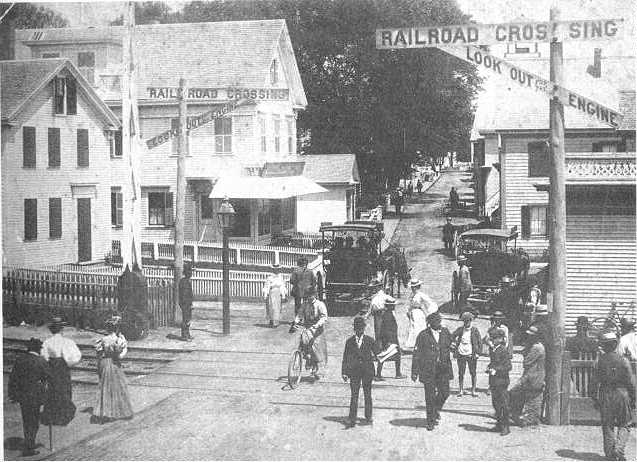
Provincetown is a small coastal town perched at the very tip of Cape Cod in Barnstable County, Massachusetts, with a year-round population of roughly 3,000 residents that swells dramatically each summer. It has a long-standing reputation as an art colony, a beach destination, and one of the most prominent LGBTQ-friendly towns in the United States, while also carrying deep significance as the spot where the Mayflower first landed in 1620. The town serves as a natural gateway to the northern reaches of the Cape Cod National Seashore and is located approximately 120 miles southeast of Boston, typically reached by car in around two and a half to three hours, or by ferry from Boston in roughly ninety minutes.
Rising prominently above the town, the Pilgrim Monument and Provincetown Museum commemorates the signing of the Mayflower Compact and offers sweeping views of the harbor and outer beach from its 252-foot granite tower. The site sits just steps from the center of town, making it an easy starting point for visitors exploring Provincetown's history and waterfront.
Just beyond the town center, the Cape Cod National Seashore protects more than forty miles of Atlantic shoreline and the surrounding dunes, pine barrens, and ponds. Within a ten- to fifteen-minute drive from downtown, Race Point Beach and Herring Cove Beach draw visitors for swimming, sunbathing, whale-watching, and dramatic sunsets, while the Province Lands' network of trails and bike paths weaves through some of the most striking dune scenery on the East Coast.
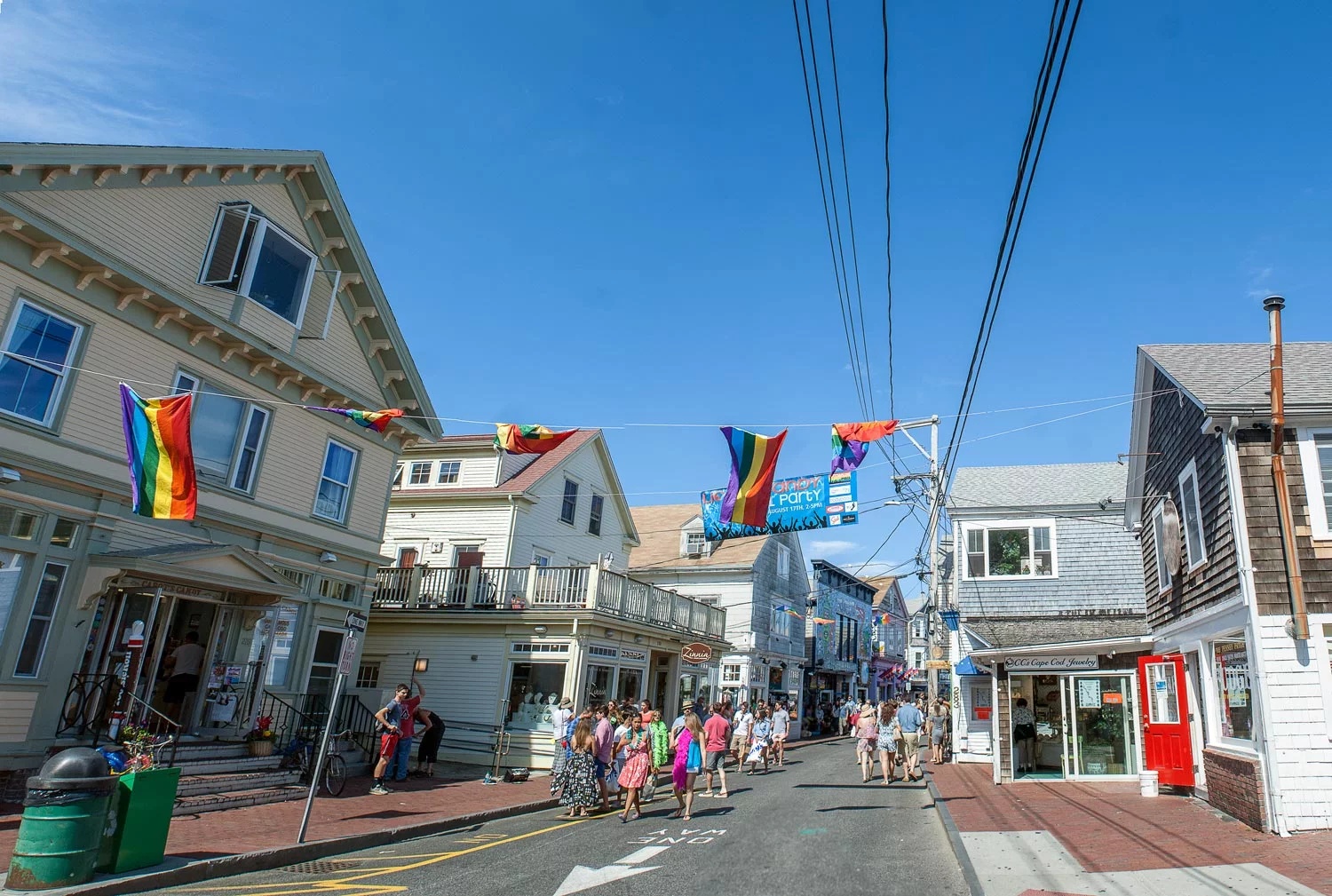
Lining the harbor for nearly two miles, Commercial Street forms the lively spine of Provincetown, packed with independent art galleries, seafood restaurants, ice cream shops, and boutiques housed in former fishermen's cottages. The street is also the departure point for the town's whale-watch excursions, deep-sea fishing trips, and ferries to Boston and the Boston Harbor Islands, and it remains the social heart of the town from morning until well past midnight during the busy season.
A short drive or bike ride from Commercial Street, the Province Lands Visitor Center offers interpretive exhibits about the surrounding ecosystem and serves as a hub for exploring the area's dunes, ponds, and bird-rich marshes. Cycling is a popular way to travel between the beaches and trails, with rentals widely available in town.
Provincetown's combination of historic landmarks, protected natural scenery, a walkable harborfront, and an unmistakable creative and inclusive culture makes it a particularly compelling base for short-term rentals. Visitors tend to come for the beaches and the arts scene but stay for the town's singular atmosphere, and the compact layout means that nearly every lodging option sits within easy reach of the dunes, the galleries, and the bay.
Want to know if a property in Provincetown is a good investment?
Enter an address to get instant revenue potential and comps.