
Palatine, Illinois
Want to see how Palatine compares to other top cities in Illinois? Explore all city regulations in Illinois. →
Palatine, IL
Unfriendly To Investors
STR Regulations for Palatine, Illinois
Executive Overview: STR Status in Palatine
Short-term rentals (STRs) are explicitly prohibited within the Village of Palatine. Article V of Chapter 10 of the Palatine Code of Ordinances (adopted by Ordinance O‑74‑22 on July 11, 2022) bans the operation, use, offering, and advertising of any property as an STR, defined as a dwelling unit rented for 30 consecutive days or less. Hotels, bed‑and‑breakfast establishments, and boarding facilities are excluded from this STR definition but remain subject to other codes and approvals. The Village classifies violations of the STR ban as a public nuisance, enabling abatement, injunctive relief, and recovery of attorney fees. There is a narrow statutory exception for post-closing sale-leasebacks between buyer and seller, which does not create a general STR allowance.
Given this prohibition, investors should view Palatine as a long‑term rental (LTR) market only. Any STR strategy must pivot to LTR operations (30+ days), or pursue permitted non-STR uses such as hotels or bed‑and‑breakfasts subject to zoning and licensing outside Article V.
What do Airbnb hosts actually earn in Palatine?
Palatine hosts earn a median $34,361/year with $257 ADR and 62% occupancy.
Top performers pull in $53,607+ per year.
See the full Palatine market breakdownWhat You Can Legally Operate in Palatine
- Long‑Term Rentals (LTRs): 30 consecutive days or more. These are subject to the Rental Dwelling Licensing Program (annual operating licenses, inspections, fees, and compliance with the International Property Maintenance Code as amended locally).
- Hotels/Motels and Bed‑and‑Breakfasts: These are not classified as STRs under the ordinance and can be considered if the underlying zoning and applicable state/local licensing allow them (see “Other Uses Outside STR Rules” below).
- Owner-Occupied Home‑Sharing: The ordinance’s STR prohibition does not include an explicit home‑sharing or “occasional rental” exemption for owner‑occupied units. In practice, renting any part of a dwelling for 30 days or less would likely be treated as a violation. Treat any nightly or weekly rentals as non‑compliant unless you secure an allowed use under zoning (e.g., bed‑and‑breakfast) and meet all non‑STR licensing requirements.
- Sale‑Leaseback Exception: When a seller, after closing, leases the property back from the buyer under a written agreement for a period of time, that arrangement is not considered an STR. This is a narrow, transaction‑specific carve‑out.
How to Start a Long‑Term Rental Business (Palatine LTR Pathway)
-
Confirm Zoning and Deed/Condo/HOA Rules
- Verify that the intended use is permitted for the zoning district (single‑family, townhome, condominium, multi‑family, etc.).
- For condominiums or townhomes, confirm that leasing is permitted by the association documents and any HOA rules. The Palatine code requires associations to provide annual lists of non‑owner‑occupied unit owners and tenants to the Village.
-
Obtain a Rental Dwelling Operating License
- Submit a completed application and pay applicable fees.
- The license is annual and tied to the specific property; it is not transferable. New owners must obtain a new license.
- Conditional approvals may be granted for up to six months in special circumstances (e.g., weather, material availability), counted toward the one‑year license term. Failure to complete full licensure by the end of the conditional term results in forfeiture of fees and unlicensed status.
- Display the license conspicuously in the common area (for multi‑family buildings).
- Owners must designate an agent for service of notices when absent from the Village for 30+ days; nonresidents must designate an agent in writing. Provide written notice to the code official within 24 hours of transferring control of a licensed property.
-
Complete Crime Free Multi‑Housing (CFMH) Training
- Owners of rental properties must attend and complete the Village’s CFMH seminar before obtaining a new license.
- Property managers acting as the owner’s agent may attend; a new manager replacing a prior manager has 90 days from proof of change to complete the seminar.
- Initial attendance is required once, with a refresher every three years, and compliance is tied to license eligibility.
- CFMH mandates lease addenda for criminal nuisance abatement and guest registration (see “Required Lease Addenda” below).
-
Pass Rental Inspections and Meet IPMC Standards
- Multiple dwellings: Annual inspections of common areas and a percentage of units determined by the average violations per unit.
- ≤3 avg violations: 25% of units inspected annually.
- 4–5 avg violations: 50% of units inspected annually.
- ≥6 avg violations: 100% of units inspected annually; the Village may require 100% within 60 days of the current inspection.
- Single‑family rentals (attached, detached, condos): Inspection at least every other year if violations ≤3; if ≥4 violations, the property must be re‑inspected within the next 12 months.
- After any sale, the new owner must obtain inspection and licensing before renting.
- Multiple dwellings: Annual inspections of common areas and a percentage of units determined by the average violations per unit.
-
Maintain Records and Comply with Ongoing Requirements
- Keep accurate records of all repairs, alterations, equipment changes, and corrections made as a result of inspections; make them available upon request.
- Provide copies of license addenda and guest registration data to the Police Department upon request.
- Condominium/townhome associations and management companies must provide annual lists of non‑owner‑occupied unit owners and, where available, their tenants.
-
Optional: Use the Citizen Self Service Portal
- The Village’s CSS portal supports permitting and licensing processes. For current capabilities, refer to the portal: Citizen Self Service (CSS) Portal.
Required Documents, Permits, Licenses, and Mandatory Training
- Rental Dwelling Operating License (annual; tied to property; non‑transferable)
- Completed application form (includes agent designation for nonresidents and for owners absent 30+ days)
- Payment of license fee, cancellation/absentee fees, re‑inspection fees, and late fees
- Proof of Crime Free Multi‑Housing training attendance and completion
- Lease addenda (crime‑free addendum; guest registration clause; notice of Palatine ordinances)
- Inspection reports and compliance records
- Written agent designation for service of notices
- Association records: Names and mailing addresses of non‑owner‑occupied unit owners and, where available, tenants
- Proof of purchase (for post‑closing inspection and licensing) if the property changed ownership
Specific Regulations and Standards
-
Chapter 10 – Existing Structures’ Maintenance and Occupancy
- Adopts the 2015 International Property Maintenance Code (IPMC) with local amendments covering exterior property sanitation, pest elimination, heat supply (Sept 15 to May 1), insect screens (Apr 15 to Oct 15), multiple occupancy responsibilities, and identification of unit numbers in multi‑family buildings.
-
Licensing (Article IV)
- Operating license required for all rental dwellings, including single‑family homes, townhomes, condos, and multi‑family buildings.
- Annual license term; conditional approvals up to six months may reduce the remaining term.
- Inspections per violation profile; compliance required for license issuance or renewal.
- Display license in common areas; notify the Village within 24 hours of transfer of control.
-
Crime Free Multi‑Housing (Article IV)
- Mandatory training; required lease addenda and guest registration for all rentals.
- Nuisance property standards; administrative hearings; fines ($200–$1,000 per violation, each day a separate violation), potential license suspension/revocation, and closure orders for nuisance properties.
- Exclusions apply for certain domestic violence, disability‑related, or emergency contacts as defined.
-
Short‑Term Rentals (Article V)
- STRs (≤30 days) are prohibited; operation, use, offering, and advertising are unlawful.
- Violations constitute a public nuisance; Village may seek injunctive relief and recover attorney fees.
- Sale‑leaseback exception allows temporary post‑closing leases between buyer and seller under written agreement.
-
Penalties (Article VII)
- Violations of Chapter 10 carry fines from $50 to $750 per offense; each day a violation occurs or continues constitutes a separate offense.
- Additional fees apply for re‑inspections, cancellations/absenteeism, and late licensing.
-
Occupancy and Related Standards (as adopted in Article III)
- IPMC standards govern equipment, sanitation, safety, pest control, heat and ventilation, and exterior property conditions.
- No separate Palatine‑specific occupancy cap beyond the IPMC and any applicable zoning occupancy limits is detailed in the provided materials.
Enforcement and Remedies (STRs and Nuisance Activity)
-
STR Violations
- Deemed a public nuisance; subject to abatement via injunctive relief and all available legal remedies.
- Village entitled to reimbursement of reasonable attorney fees and costs incurred to abate the nuisance.
-
Nuisance Property Procedures
- Police Chief reviews reports and may notify the person in charge when nuisance activity emerges.
- Administrative hearings determine nuisance designation and impose fines, abatement orders, license suspension/revocation, and closure orders.
- Each day a violation continues constitutes a separate offense; repeat citations within 18 months from the same unit can lead to indefinite suspension or revocation by the Village Manager.
Contact Information (Local Authority)
-
Village of Palatine
- Address: 200 E. Wood Street, Palatine, IL 60067
- Phone: 847‑358‑7500
- Website: Palatine, IL – Official Village Website
- CSS Portal: Citizen Self Service (CSS) Portal (for licensing and permitting workflows)
-
Notes
- Department or staff emails for rental licensing are not specified in the provided materials.
- Crime Free Multi‑Housing training is coordinated through the Police Department; the coordinator’s contact is not provided in the cited content.
Other Uses Outside STR Rules
- Hotels/Motels and Bed‑and‑Breakfasts are excluded from the STR definition and may be permissible if the property is zoned for such uses and the operator secures applicable state and local permits (e.g., business licenses and health/fire approvals). Investors pursuing hospitality uses must confirm zoning and obtain all required approvals independently.
Links to Source Pages
- Rental Program Overview: Village of Palatine – Rental Program Overview
- Chapter 10 – Existing Structures’ Maintenance and Occupancy (PDF): Palatine Code of Ordinances – Chapter 10 (Municode PDF)
- GC Realty Blog Context (rentals in Palatine): What You Must Know About Renting Your Property in Palatine
- Citizen Self Service (CSS) Portal: Palatine CSS Portal
- Village Online Payments (related to licensing fees): Palatine Online Payments
- Village Code of Ordinances Library: Village of Palatine – Municode Code Library
Investor Implications and Strategy
- STR Ban: Nightly or weekly rentals in Palatine are prohibited. Any STR marketing, reservations, or operations should be halted or converted to LTR tenancy of 30+ days.
- LTR Pathway: Follow the licensing and inspection program, complete CFMH training, incorporate required lease addenda, and maintain inspection records.
- Compliance Costs: Budget for annual licensing, potential re‑inspection fees, cancellation/absentee fees, and late charges if license renewal lapses.
- Risk Management: Promptly address nuisance activity to avoid administrative hearings, fines, and potential license suspension/revocation.
- Zoning Due Diligence: Validate that intended uses (LTR, hotel, bed‑and‑breakfast) are permitted in the subject zoning district; confirm HOA/condo association leasing policies.
This guide reflects Palatine’s code as provided in the cited sources and does not cover Cook County or Illinois state statutes beyond the City’s codified references. For statewide Illinois considerations, consult the Illinois General Assembly or local legal counsel.
Next step
Found a property in Palatine?
Paste any address and get estimated revenue, cash-on-cash return, and comparable STR performance in under 5 minutes. 3 free analyses per day.
Free brief
Get the free Palatine STR Investment Brief
Revenue data, top neighborhoods, seasonal trends, and the key regulations for Palatine, Illinois in one email.
Palatine
Market Saturation Score
Photos of Palatine


Overview of Palatine
Palatine is a suburban village in Cook County, Illinois, situated in the northwestern reaches of the Chicago metropolitan area. With a population of roughly 69,000 residents, it carries the feel of an established, family-friendly commuter community: a mix of mid-century neighborhoods, mature tree-lined streets, and a walkable downtown that hums with restaurants, cafés, and small shops. Palatine sits about 30 miles northwest of downtown Chicago and is well known as a comfortable base from which residents commute into the city while enjoying a quieter suburban pace. It is also recognized for its strong public school system and its role as one of the larger villages along the Metra Union Pacific Northwest Line, which connects the community directly to Chicago's Loop in roughly 45 minutes by train.
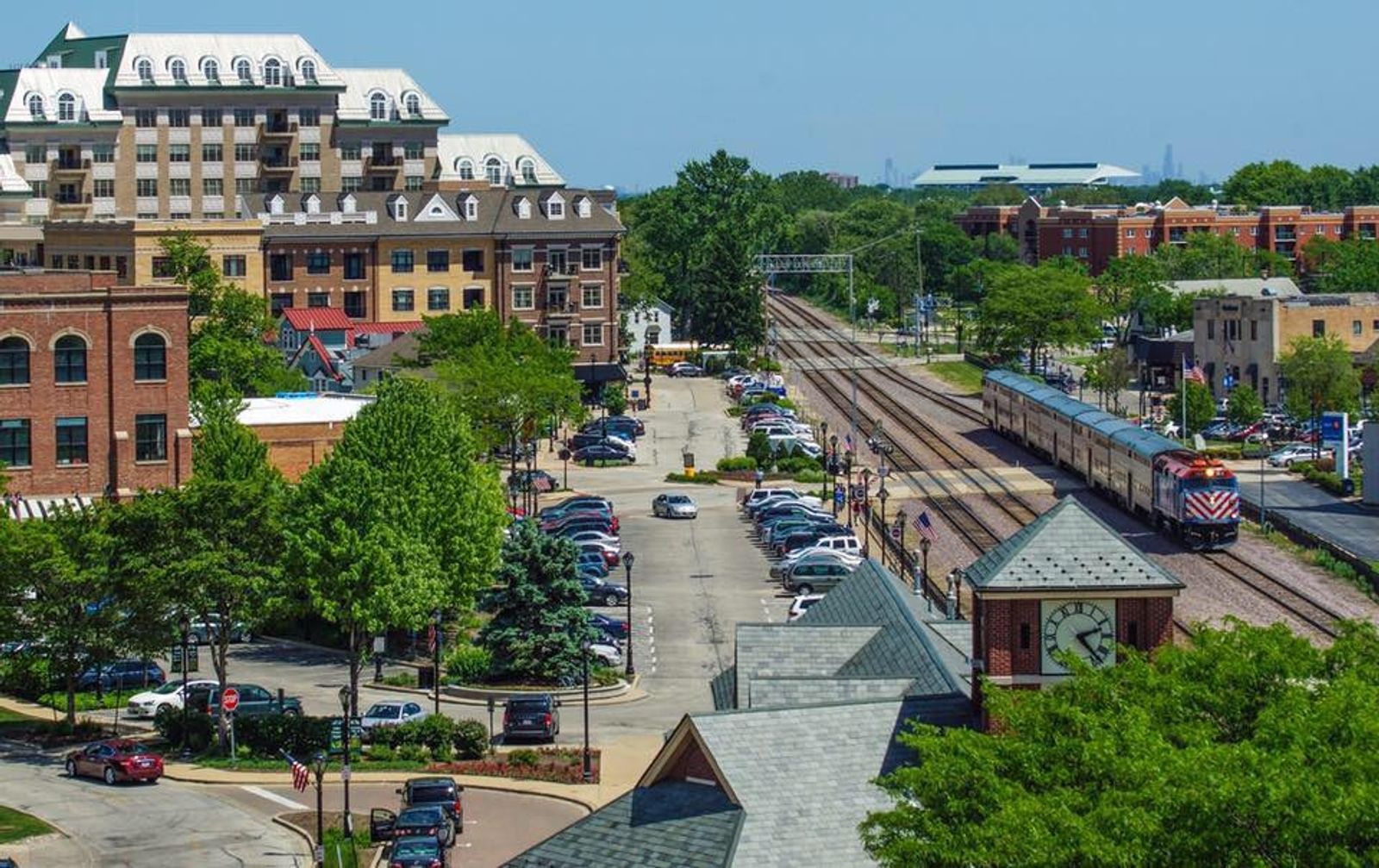
At the heart of the village is the historic downtown Palatine district, centered around the intersection of Railroad Street and Brockway. The area features a restored early-20th-century streetscape with locally owned restaurants, ice cream shops, and the iconic Palatine Clock Tower, and it hosts community events throughout the warmer months. The Metra station anchors the district, making it easy for visitors to step off the train and be within walking distance of most local amenities. More information about the village can be found on its Wikipedia page.
A short drive southeast of town, the Ned Brown Forest Preserve, often called Busse Woods, offers an expansive natural escape within Cook County. The preserve surrounds Busse Lake and includes miles of paved and unpaved trails for hiking, biking, and cross-country skiing, along with fishing piers, picnic groves, and boat rentals during the summer. The main entrance is roughly 15 minutes from central Palatine, and the preserve feels worlds away from suburban traffic despite being close to major highways.
About 15 minutes north of Palatine, the historic village of Long Grove has built its identity around a late-1800s streetscape anchored by a covered bridge over Buffalo Creek. The downtown is filled with independent boutiques, specialty food shops, and bakeries, and it draws weekend visitors who come for the old-fashioned atmosphere and seasonal festivals. Long Grove is also a popular stop during the holidays, when the village decorates extensively and hosts traditional German-style Christmas markets.
Palatine makes a compelling base for short-term rentals because it offers the calm of an upscale suburb with effortless access to one of America's largest cities. Guests can spend the day hiking forest preserve trails or browsing the historic downtowns of nearby villages, then catch a Metra train into Chicago for an evening of world-class dining, museums, and lakefront sightseeing before retreating to a quieter, more residential setting for the night. This combination of suburban comfort, transit convenience, and proximity to both nature and urban amenities gives Palatine broad appeal for a range of travelers.
Want to know if a property in Palatine is a good investment?
Enter an address to get instant revenue potential and comps.