
Macomb, Illinois
Want to see how Macomb compares to other top cities in Illinois? Explore all city regulations in Illinois. →
Macomb, IL
Generally Investor Friendly
STR Regulations for Macomb, Illinois
Overview: Are short‑term rentals allowed in Macomb, IL?
- Explicit conclusion: From the provided materials, there is no evidence of a city‑specific short‑term rental ordinance in Macomb. That means there is no explicit city license or dedicated STR law identified for Macomb in the content provided. Under Illinois law (House Bill 2919, HB2919), cities cannot prohibit short‑term rentals outright; they may enact rules focused on health and safety and apply transient lodging taxes at the same rates used for hotels. Consequently, investors should assume STRs are legally possible in Macomb at the state‑level, with municipal controls (if any) focused on general zoning, building, life safety, and rental inspection programs rather than a standalone STR permit.
- Practically: A compliant operation in Macomb typically means (1) ensuring the property is in a zoning district where transient rental use is allowed or can be approved (e.g., as a permitted, provisional, or special use), (2) meeting life‑safety requirements (smoke/CO detectors, fire extinguishers, safe egress), and (3) staying current on Illinois state‑level taxation of STRs. There is no evidence in the provided materials of a Macomb‑specific transient occupancy tax; however, state rules still apply.
Important note for investors: The absence of a city‑specific STR license in the provided content does not mean one does not exist; verify with the City of Macomb before listing.
How to start an STR business in this market
- Confirm zoning viability
- Contact the City of Macomb Community Development office to confirm whether short‑term rentals are a permitted, provisional, or special use in the subject property’s zoning district. For “special uses,” expect a public hearing and formal review; the process follows the City’s Planning Commission and City Council workflow (see Special Use Permits and Rezoning below).
- Align with general land‑use and permitting frameworks
- Site/Building Plan Review: For any new construction or significant alterations to accommodate STR operations, a formal site plan is required for multi‑family, commercial, industrial, institutional, or office developments. Use the City’s minor subdivision and subdivision procedures if land splits or plats are involved.
- Prepare for compliance
- Life‑safety measures: Install/maintain smoke alarms, carbon monoxide detectors, and fire extinguishers as applicable (best practice; some jurisdictions require specific placement and inspection intervals).
- Parking and neighborhood compatibility: Ensure guest parking and operations do not create nuisances; verify against zoning standards.
- Guest capacity and sanitation: Maintain safe occupancy and sanitation standards between guests; document cleaning protocols and provide clean linens, towels, and necessary amenities.
- Register for and collect state‑level taxes
- Register with the Illinois Department of Revenue (IDOR) for the Hotel Operators’ Occupation Tax applicable to short‑term rentals (see Tax section below).
- Set up a system to collect and remit state‑level taxes monthly/quarterly, depending on your liability cadence.
- Final compliance checklist
- Finalize zoning clearance or approvals.
- Confirm life‑safety measures are installed and functional.
- File tax registrations and set up tax remittance workflows.
- Draft house rules and operating manual for cleanliness and safety.
Required documents, permits, licenses, and guidelines
- Zoning determination letter or written confirmation from Community Development that transient rental use is allowed in the subject district (or can be approved via special use).
- If applicable, a Special Use Permit (see Special Use Permits section).
- If applicable, building/site plan review approvals for alterations or new construction.
- Rental Inspection program compliance (City of Macomb runs a rental inspections program; confirm whether STRs are treated as rental housing subject to these inspections).
- Business registration and tax setup:
- Register with the Illinois Department of Revenue for state transient lodging taxes (Hotel Operators’ Occupation Tax).
- Keep current with any local forms/requirements (City of Macomb “Forms, Permits & Licenses” and “City Payments” pages for any online workflows).
- Insurance: Homeowner’s fire/hazard and general liability coverage (minimum $1 million commercial general liability where required; consult your insurer for an STR‑specific policy).
- Property documentation: Proof of ownership; names and contact info of owner and local contact person; safety device installation records.
City zoning pathways (per City of Macomb materials)
- Permitted uses: Allowed “by‑right” with a building permit and sometimes a site plan (for new construction).
- Provisional uses: Allowed with restrictions on location/operation per the Zoning Ordinance.
- Special uses: Potentially appropriate for the district, but may have major impacts; require site plan review, individual regulation, public hearing, and notification to surrounding property owners. Approval follows Planning Commission review and City Council process.
- Rezoning: A “Rezoning Map Amendment” proceeds through the Planning Commission and three readings at City Council/Committee of the Whole, with applicants addressing the LaSalle Criteria (state standards for rezoning).
- Variances: Relief from specific Zoning Ordinance standards (e.g., setbacks, parking) that do not change the principal activity. Variances are decided by the Zoning Board of Appeals with staff recommendation.
Specific regulations for STRs in Macomb (city), McDonough County (county), and Illinois (state)
- City of Macomb: No Macomb‑specific STR license or dedicated STR rules appear in the provided materials. Existing City programs that likely govern STRs:
- Zoning Ordinance (zoning districts, permitted/provisional/special uses).
- Rental Inspections program (determine applicability to transient occupancy).
- Municipal Code (via Municode) and the City’s forms/permits/licensing pages (for any required registrations or inspections).
- If a property requires special approvals, expect Planning Commission and City Council involvement with neighbor notification and public hearings.
- McDonough County: No county‑specific STR ordinances or tax provisions are identified in the provided materials.
- State of Illinois:
- Short‑Term Rental definition (HB2919): Any residential unit rented for fewer than 30 consecutive days. Applies to single‑family homes and dwelling units in multi‑unit structures (condos, co‑ops, timeshares, joint ownership). Excludes non‑residential units, bed and breakfasts, and transient accommodations not classified as residential for property tax purposes.
- Local authority limits (HB2919): Illinois municipalities may not prohibit short‑term rentals. They may enact ordinances aimed at protecting public health and safety and may levy sales and occupancy taxes at the same rates applied to hotels.
- Taxation (SB2564 Short Term Rental Occupation Tax Act): Two taxes combine to equal the Hotel Operators’ Occupation Tax:
- 5% of 94% of gross rental receipts.
- 1% of 94% of gross rental receipts.
- Platforms (e.g., Airbnb, Vrbo) must apply, calculate, collect, and remit these taxes.
- Filing: Hotel Operators’ Occupation Tax Return (Form RHM‑1) filed monthly, quarterly, or annually based on liability; electronic payment required at $20,000+ annual liability.
- Safety and occupancy best practices: Smoke and CO detectors, fire extinguishers, safe occupancy limits, sanitation protocols, and amenity standards.
State‑level tax obligations (STRs in Illinois)
- Hotel Operators’ Occupation Tax: Combined tax equals 6% of 94% of gross rental receipts for STRs.
- Filing cadence: Monthly, quarterly, or annual based on average monthly liability; e‑payment required at ≥ $20,000 annual liability.
- Municipal/local transient taxes: Under state law, cities may apply sales or lodging taxes at rates equal to those for commercial transient lodgings like hotels; verify with local authorities if a local tax applies in Macomb (no local STR tax is documented in the provided materials).
- Platforms: Home‑sharing platforms must collect and remit state taxes for STR transactions.
Contact information and official resources
- City of Macomb (General)
- Address: 232 East Jackson Street, Macomb, IL 61455
- Phone: (309) 833‑2575
- Website: cityofmacomb.com/
- Community Development (zoning, special uses, plan review)
- Phone: (309) 833‑4944 (Community Development Coordinator)
- Key pages: Land Developments; Municipal Code; Permits; Forms, Permits & Licenses; Rental Inspections
- Planning and Boards (public hearings for special uses and variances)
- Zoning Board of Appeals (Variances)
- Planning Commission (Special Uses, Rezoning)
- Agendas, minutes, and schedules: portal.laserfiche.com/Portal/browse.aspx?id=21&repo=r-850674dd&preview=4o5vSQh
- Illinois Department of Revenue (state tax registration and filings)
- Register for Hotel Operators’ Occupation Tax and File Form RHM‑1
- Website: tax.illinois.gov/
Links to source pages (as provided)
- City of Macomb official website, Community Development and Land Developments pages: cityofmacomb.com/land-developments/
- Municipal Code of Macomb (Municode): library.municode.com/il/macomb/codes/code_of_ordinances
- City of Macomb permits and forms: cityofmacomb.com/permits/ and cityofmacomb.com/city-forms/
- City of Macomb rental inspections: cityofmacomb.com/rental-inspections/
- City contact: cityofmacomb.com/contact-us/
- AirDNA market overview for Macomb (data context; not a regulatory source): www.airdna.co/vacation-rental-data/app/us/illinois/macomb/overview
- Illinois Short‑Term Rental Laws overview (state definitions and tax framework): www.gosummer.com/post/illinois-short-term-rental-law
What to do next
- Email or call the City of Macomb Community Development office (309) 833‑4944 to confirm:
- Whether short‑term rentals are a permitted, provisional, or special use in the subject property’s zoning district.
- Whether the City’s rental inspection program applies to STR units.
- Any additional forms, fees, or inspection requirements before listing.
- If the property is in a district where STRs require special approval, prepare materials for the Planning Commission (site plan, narrative of compatibility, life‑safety plan, parking plan, neighborhood notice responses).
- Register with IDOR for state taxes and set up your remittance cadence.
- Document and retain proof of life‑safety compliance (installation records for smoke/CO detectors, fire extinguishers, recent inspections).
- If operating through platforms (Airbnb/Vrbo), ensure your listings include any required license number if the City later issues a local STR ordinance, and verify that platform tax collection aligns with your IDOR obligations.
Notes and caveats
- The City has not been shown in these materials to have enacted a standalone STR ordinance or local transient tax specific to STRs. However, Illinois law allows local governments to regulate for health and safety and to apply local taxes at hotel rates. Investors must verify the latest City ordinances and any local tax requirements directly with the City before listing.
- Treat AirDNA statistics as market context only; they do not constitute legal advice or compliance guidance. Always rely on City and State sources for legal requirements.
What do Airbnb hosts actually earn in Macomb?
Macomb hosts earn a median $21,012/year with $122 ADR and 69% occupancy.
Top performers pull in $27,854+ per year.
See the full Macomb market breakdownNext step
Found a property in Macomb?
Paste any address and get estimated revenue, cash-on-cash return, and comparable STR performance in under 5 minutes. 3 free analyses per day.
Free brief
Get the free Macomb STR Investment Brief
Revenue data, top neighborhoods, seasonal trends, and the key regulations for Macomb, Illinois in one email.
Macomb
Market Saturation Score
Photos of Macomb


Overview of Macomb
Macomb is a small college town set in the rolling farmland of western Illinois, serving as the seat of McDonough County. With a population of roughly 15,000 to 18,000 residents — swelled considerably by students during the academic year — the city has the welcoming, walkable feel of a classic Midwestern university town. It is best known as the home of Western Illinois University, whose presence shapes much of the local dining, events, and energy. Macomb sits about 75 miles southwest of Peoria and roughly 200 miles from Chicago, putting it within easy reach of larger Illinois and Iowa destinations while retaining a quiet, small-city character of its own.
A short drive north of town, Argyle Lake State Park offers a peaceful retreat with a 93-acre lake surrounded by woodlands. The park is popular for fishing, kayaking, picnicking, and camping, and it lies only about 8 miles from the Macomb city limits, making it a convenient option for visitors looking to spend a day outdoors. Its quiet trails and modest campground make it especially appealing during fall foliage season.
For those interested in history, the historic city of Nauvoo lies about 50 miles to the west along the Mississippi River. Once the home base of the early Latter-day Saint movement and now a popular heritage destination, Nauvoo features preserved 19th-century buildings, historic homes, a temple, the Rheinberger House, and the Nauvoo Pageant during the summer months. The drive from Macomb takes a little over an hour, and the route passes through scenic river-bluff country. Further south, the state capital of Springfield is roughly 80 miles away and offers a full day of Abraham Lincoln–related sites, including the Lincoln Home, the Lincoln Presidential Library and Museum, and the Lincoln Tomb.
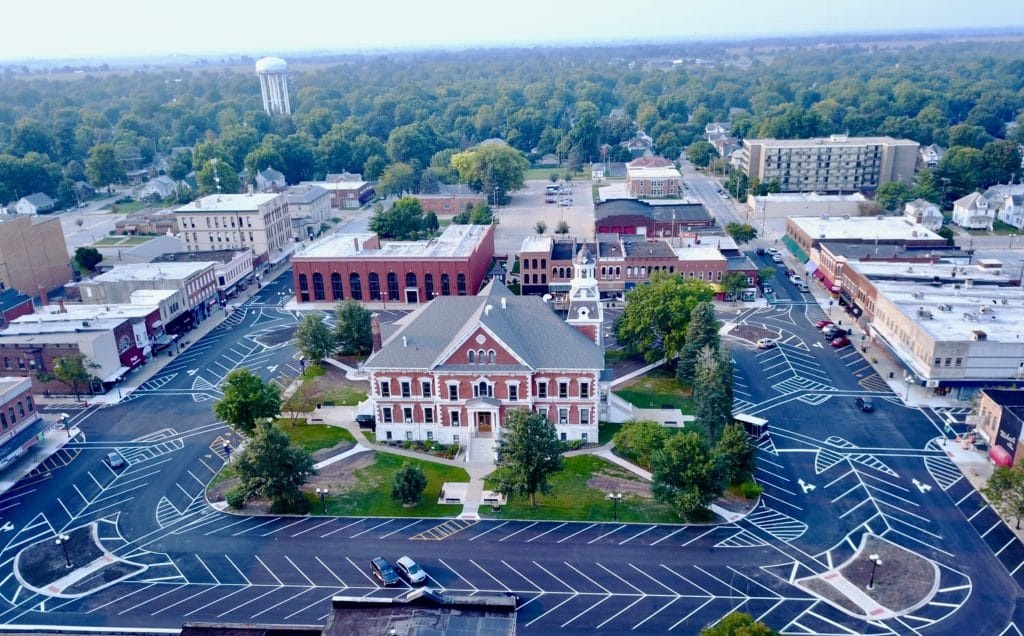
Closer to home, Macomb's downtown square anchors the community around the McDonough County Courthouse, a stately limestone building dating to the late 1800s. The square is lined with locally owned shops, coffee houses, and restaurants, and it hosts farmers' markets, festivals, and WIU homecoming events throughout the year. A few blocks from campus, Spring Lake Park provides walking paths, sports facilities, and an outdoor pool, serving as an everyday gathering place for residents and students alike.
Together, these features make Macomb a comfortable and affordable base for travelers exploring western Illinois. Short-term rental owners benefit from a steady mix of university visitors, family members in town for campus events, hunters and outdoor travelers using the region as a launching point, and road-trippers passing through on their way to the Mississippi River, Nauvoo, or Springfield. The combination of small-town charm, four-season outdoor recreation, and proximity to several well-known regional destinations gives the market a quiet but reliable rhythm throughout the year.
Want to know if a property in Macomb is a good investment?
Enter an address to get instant revenue potential and comps.