
Clear Lake, Iowa
Want to see how Clear Lake compares to other top cities in Iowa? Explore all city regulations in Iowa. →
Clear Lake, IA
Challenging To Investors
STR Regulations for Clear Lake, Iowa
Short-Term Rental Regulations in Clear Lake, Iowa
(A Guide for Investors and Operators)
I. Overview: Are Short-Term Rentals (STRs) Allowed in Clear Lake, IA?
Short-term rentals are legal in Clear Lake, Iowa. However, Clear Lake does not have a dedicated city ordinance specifically governing STRs. This means investors and hosts must comply with general zoning regulations and state-level requirements. Hosts operating in Clear Lake should assume they are operating within the bounds of broader municipal and state laws.
- Key Distinction: Clear Lake lacks the specificity of cities like Des Moines or Davenport, which have explicit STR definitions, licensing, and insurance requirements. Compliance relies on zoning, tax obligations, and general business/rental rules.
II. Starting an STR Business in Clear Lake, IA: Core Steps
- Verify Zoning Eligibility: Confirm with the City of Clear Lake Planning & Zoning Department that your property is located in a zoning district allowing short-term rental use (e.g., Commercial, Residential with specific allowances).
- Register for State Taxes: Before collecting rent, register with the Iowa Department of Revenue to collect and remit:
- Iowa State Sales Tax (5%): Applies to the total rental amount (base rent + cleaning fees + service fees).
- Iowa Hotel/Motel Tax (5%): Applies to the same taxable amount as sales tax. Hosts are responsible for collecting and remitting both taxes.
- Obtain Business License/Permit (If Required): The content is unclear on whether Clear Lake requires a specific business license/permit for STRs beyond zoning compliance. You must verify with the city if a rental permit, business license, or registration is mandatory.
- Secure Adequate Insurance: While not explicitly stated in the Clear Lake content, hosts in Iowa (e.g., Des Moines) are required to carry liability insurance. Verify specific insurance requirements with the city, but securing robust liability coverage (e.g., $500k+) is strongly recommended as a best practice.
- Understand Length-of-Stay Rules: The content indicates many Iowa cities define STRs as rentals under 30 consecutive days. Ensure your rental agreements and operations comply with any applicable length-of-stay limits imposed by zoning or other regulations.
III. Required Documents, Permits, Licenses, and Guidelines
- State-Level Requirements:
- Iowa Sales Tax Permit/Account: Mandatory for collecting/remitting sales and hotel/motel taxes. Register via the Iowa Department of Revenue.
- Compliance with State Tax Rules: Understanding monthly or semi-annual remittance schedules.
- Clear Lake City Requirements (Verification Needed):
- Zoning Compliance Confirmation: Proof/conversation confirming STR use is permitted at your specific address.
- Potential Business License/Rental Permit: Critical to confirm if required. May be tied to frequency/duration of rentals.
- Potential STR Registration: May be required.
- Potential Safety/Standards Requirements: Similar to Des Moines (e.g., maintained walkways, handrails, free of weeds/pests). Verify with the city.
- STR-Specific Guidelines:
- Guest Rules & Agreements: Clearly define occupancy limits, quiet hours, parking, smoking, etc.
- House Rules: Displayed prominently inside the property.
- Safety Protocols: Smoke detectors, CO detectors, fire extinguishers, first aid kit, clear escape routes.
- Local Contact Information: For guests to reach you or a designated local contact.
IV. Specific Regulations (City, County, State)
- Clear Lake City Level: No specific STR ordinances found in the provided content. Compliance relies on:
- Zoning Laws: STRs must be located in an appropriate zoning district.
- General Property Maintenance/Health & Safety Standards: Likely subject to standard city codes (weeds, debris, safety hazards, etc.).
- Potential Licensing/Permitting: Requires city confirmation.
- Cerro Gordo County (Clear Lake's County): No specific STR regulations found in the provided content. County-level rules are typically focused on broader land use, not typically STR-specific.
- State of Iowa Level:
- Tax Collection (Mandatory): 5% Sales Tax and 5% Hotel/Motel Tax on the gross rental amount (including fees). Remittance to Iowa Dept of Revenue required (frequency varies, often monthly).
- State Sales Tax Permit: Mandatory registration before collecting rent.
- Length-of-Stay: Many cities define STRs as <30 days; verify locally.
- Insurance: While not statewide, Iowa cities (e.g., Des Moines) mandate minimum liability coverage (e.g., $500k). Strongly recommended for Clear Lake hosts.
V. Contact Information for Local Authority
- City of Clear Lake (Planning & Zoning):
- Primary Contact: City Hall: (641) 357-2111
- Website: City of Clear Lake Official Website (Look for Planning & Zoning, Building, or Finance Departments)
- Email: Contact information varies by department. Use the city website's contact form or directory.
- Cerro Gordo County (General):
- Phone: (641) 423-5309
- Website: Cerro Gordo County Official Website (For zoning or general questions)
- Iowa Department of Revenue (Tax Registration/Compliance):
- Phone: (515) 281-3114 or (800) 367-3388
- Website: Iowa Department of Revenue
- Email: Use online contact forms on their website.
VI. Source Links
- State-Level Iowa STR Information: Lodge Compliance - Short-Term Rentals Laws in Iowa (Note: Contains links to local jurisdictions, including Clear Lake)
- Clear Lake STR Overview & Guidance: GoSummer - Vacation Rental Management in Clear Lake, Iowa
Important Disclaimer: This guide is based solely on the provided content and publicly available information. Regulations change frequently. You must independently verify all requirements with the City of Clear Lake Planning & Zoning Department and the Iowa Department of Revenue before operating. Contact the city directly to confirm zoning compliance, licensing/permitting needs, and any specific safety or operational requirements. Failure to comply with all applicable laws can result in fines or legal action.
What do Airbnb hosts actually earn in Clear Lake?
Clear Lake hosts earn a median $25,516/year with $233 ADR and 43% occupancy.
Top performers pull in $35,432+ per year.
See the full Clear Lake market breakdownNext step
Found a property in Clear Lake?
Paste any address and get estimated revenue, cash-on-cash return, and comparable STR performance in under 5 minutes. 3 free analyses per day.
Free brief
Get the free Clear Lake STR Investment Brief
Revenue data, top neighborhoods, seasonal trends, and the key regulations for Clear Lake, Iowa in one email.
Clear Lake
Market Saturation Score
Photos of Clear Lake


Overview of Clear Lake
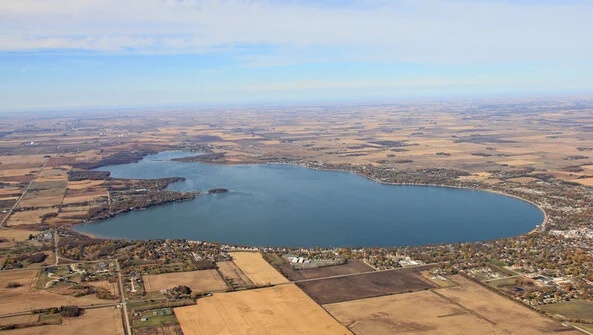
Clear Lake is a small, lakeside city in north-central Iowa, sitting in Cerro Gordo County just a few miles west of Mason City. With a population of roughly 7,700, it has the relaxed, midwestern-resort feel of a town that comes alive in summer and quiets down in winter. Clear Lake is best known for the body of water it takes its name from — a roughly 3,600-acre natural lake that draws boaters, anglers, and beachgoers — and for the decades of music history attached to its most famous building. The nearest major metropolitan area is the Minneapolis–Saint Paul twin cities, about 130 miles to the north, while Des Moines lies roughly 120 miles to the south.
The most iconic landmark in town is the Surf Ballroom, a restored 1930s Art Deco dance hall on the lake's north shore that has hosted big-band and rock-and-roll acts for nearly a century. It is best known as the site of the final concert by Buddy Holly, Ritchie Valens, and The Big Bopper on February 2, 1959, a day before their fatal plane crash outside town, and it was designated a National Historic Landmark for that association. Today it functions as a museum and live-music venue, and visitors can tour the stage and the small memorabilia room year-round. It is within walking distance of the downtown and the lakefront.
Just east of town, McIntosh Woods State Park wraps around the lake's east shore and offers the most accessible stretch of public beach, picnic areas, and a small network of wooded trails. It is the most popular spot in the area for swimming, sunbathing, and launching a kayak or paddleboard, and it draws a steady crowd on warm summer weekends. The park is roughly a ten-minute drive from the center of Clear Lake.
A short drive south brings visitors to neighboring Mason City, the county seat and a small city with an outsized cultural footprint. It is the hometown of composer Meredith Willson, and Music Man Square preserves the original riverboat set from the 1962 film adaptation of The Music Man. The city is also known for its concentration of Prairie School architecture, including a Frank Lloyd Wright-designed house and the Rock Crest–Rock Glen historic district of homes designed in the early twentieth century by a circle of Wright's contemporaries. Mason City sits about ten miles south of Clear Lake.
Clear Lake's mix of genuine water-front appeal, a nationally recognized music-history landmark, and easy access to the architectural and cultural sites of Mason City gives it a year-round draw that goes well beyond a single summer season. For short-term-rental owners, that combination — a recognizable destination with multiple anchor attractions clustered within a short drive — supports demand across beach trips in July, music-history tours in the off-season, and the steady flow of visitors passing through on the corridor between the Twin Cities and central Iowa.
Want to know if a property in Clear Lake is a good investment?
Enter an address to get instant revenue potential and comps.