
Kapolei, Hawaii
Want to see how Kapolei compares to other top cities in Hawaii? Explore all city regulations in Hawaii. →
Kapolei, HI
Challenging To Investors
STR Regulations for Kapolei, Hawaii
Overview: Are Short-Term Rentals Allowed in Kapolei?
Yes, short-term rentals are allowed in Kapolei, Hawaii, but only in very specific circumstances. Short-term rentals (STRs) are strictly limited to resort-zoned areas and select apartment-zoned districts within Kapolei. The vast majority of properties in Kapolei are NOT eligible for short-term rental operations due to strict zoning restrictions designed to preserve housing for long-term residents.
Short-term rentals in Kapolei are defined as lodgings that provide guest accommodation for fewer than 30 consecutive days. These regulations are enforced by the Honolulu Department of Planning and Permitting under Ordinances 22-7 and 24-14, which represent some of the most restrictive STR regulations in the United States.
What do Airbnb hosts actually earn in Kapolei?
Kapolei hosts earn a median $126,559/year with $703 ADR and 79% occupancy.
Top performers pull in $176,798+ per year.
See the full Kapolei market breakdownHow to Start a Short-Term Rental Business in Kapolei
Step 1: Verify Property Eligibility (Critical First Step)
Before proceeding with any investment, you must confirm your property is located in a permitted zone using the City's STR Eligibility Map. This is absolutely essential, as most properties in Kapolei fall outside the permitted zones. Properties outside designated resort areas cannot legally operate as short-term rentals.
Step 2: Obtain Required Tax Licenses
State-Level Tax Registration:
- General Excise Tax (GET) License: Apply through Hawaii Department of Taxation ($15 fee)
- Transient Accommodations Tax (TAT) License: Apply through Hawaii Department of Taxation ($5 for 1-5 units, $15 for 6+ units)
These licenses are mandatory prerequisites for STR operations and must be obtained before applying for STR registration.
Step 3: Secure Adequate Insurance Coverage
Obtain commercial general liability insurance or homeowner's insurance with business liability coverage providing at least $1,000,000 per occurrence. This coverage is required for both bed and breakfast homes and transient vacation units.
Step 4: Prepare Required Documentation
Compile all necessary documentation including ownership proof, property plans, and compliance certificates (detailed requirements listed below).
Step 5: Submit STR Registration Application
Submit your application through the Honolulu Department of Planning and Permitting using the HNL Build portal, providing all required information and paying applicable fees.
Required Documents, Permits, Licenses, and Guidelines
State-Level Requirements
Hawaii Department of Taxation Licenses:
- Hawaii GET License (General Excise Tax)
- Hawaii TAT License (Transient Accommodations Tax)
- Federal EIN or SSN/ITIN
City and County of Honolulu Requirements
STR Registration Requirements:
- Title report showing proof of ownership
- Property site plan with boundaries, dimensions, setbacks, structures, and parking spaces
- Floor plan identifying transient occupant bedrooms, maximum occupancy per room, and fire exits
- Real property tax home exemption (for B&Bs only)
- Evidence that STR is permitted by applicable homeowner's association
- Informational binder including house rules, emergency contacts, trash disposal instructions
- Statement of compliance with applicable regulations
- Proof of liability insurance ($1,000,000 minimum coverage)
Application Fees
- Initial STR Registration: $1,000
- Annual Renewal: $500
Nonconforming Use Certificates (NUCs)
For "grandfathered" STRs operating since before October 22, 1986:
- NUC renewals occur between September 1 and October 15 annually
- Failure to renew by October 15 results in automatic loss of NUC
- New NUCs are not being issued
Specific Regulations for Short-Term Rentals in Kapolei
Zoning Restrictions (Primary Limitation)
Critical Restriction: STRs are ONLY permitted in resort-zoned areas and specific apartment-zoned areas. Properties outside these zones cannot legally operate as short-term rentals, with the exception of grandfathered NUC properties.
Kapolei Reality: Most properties in Kapolei are located in residential zones that prohibit short-term rentals. The primary eligible areas in the Kapolei region are concentrated around the Ko Olina Resort complex.
Types of Permitted STRs
Bed and Breakfast Homes (B&Bs)
- Owner/resident presence required: Homeowner or permanent resident must be present during guest stays
- Room limitation: Maximum of 2 rooms for rent
- Occupancy limits: Maximum of 2 adult occupants per room
- Additional requirement: Must have real property tax home exemption
Transient Vacation Units (TVUs)
- Whole home or unhosted rentals: Owner not required to be present
- Occupancy limits: Maximum of 2 adult occupants per room
Operational Requirements
Rental Duration: Maximum rental period of 29 consecutive days
Registration Validity:
- STR registrations valid for one year
- Must be renewed annually
- Registrations are non-transferable
Compliance Requirements:
- Properties must comply with all building, fire, and safety codes
- Must maintain 24/7 emergency contact information
- Must display STR registration number and tax ID on all online listings
Tax Obligations
Hawaii State Taxes:
- Transient Accommodations Tax (TAT): 10.25% of gross rental income
- General Excise Tax (GET): 4% of gross rental income
Oahu-Specific Taxes:
- Oahu GET Surcharge: 0.5% of gross rental income
- Oahu Transient Accommodations Tax (OTAT): 3% of gross rental income
Additional Tax Requirements:
- Federal and state income taxes on rental income
- Property taxes at applicable rates
Enforcement and Penalties
Severe Financial Consequences: Operating an illegal STR can result in fines of $1,000 to $10,000 per day of operation. The City and County of Honolulu actively enforces STR regulations through:
- Regular monitoring and investigation
- Notices of Violation to illegal operators
- Collaboration with online booking platforms to remove illegal listings
Compliance Monitoring: Properties legally registered to operate STRs, and those issued violations, are displayed on the City's STR Compliance Map.
Contact Information for Local Authority
Honolulu Department of Planning and Permitting
- Address: 650 South King Street, 7th Floor, Honolulu, Hawaii 96813
- Phone: (808) 768-8000
- Fax: (808) 768-6743
- Website: www.honolulu.gov/dpp/permitting/str/
Key Personnel:
- Director: Dawn Takeuchi Apuna
- Deputy Director: Bryan Gallagher
- 2nd Deputy Director: Regina Malepeai
For STR Applications and Renewals:
- HNL Build Portal: honolulu.my.site.com/s/
- Application system (currently under renovation - check website for updates)
For Reporting Suspected Illegal STRs:
- Request for Investigation Portal: www.honolulu.gov/dpp/rfi/
Hawaii Department of Taxation (for tax licenses):
- Website: tax.hawaii.gov/
Source Links
- City and County of Honolulu STR Information: www.honolulu.gov/dpp/permitting/str/
- STR Eligibility Map: cchnl.maps.arcgis.com/apps/webappviewer/index.html?id=ed2eec39157f41d3a27901de4b3f7530
- STR Compliance Map: cchnl.maps.arcgis.com/apps/webappviewer/index.html?id=a87c9d1a9c4147c48286f569701f21b4
- Land Use Ordinance: www.honolulu.gov/dpp/wp-content/uploads/sites/56/2024/09/land-use-ordinance.pdf
- Ordinance 22-7: www.honolulu.gov/dpp/wp-content/uploads/sites/56/2024/07/ORD22-007.pdf
- Ordinance 24-14: www.honolulu.gov/dpp/wp-content/uploads/sites/56/2024/09/Ord24-014.pdf
- STR Disclosure Form: www4.honolulu.gov/docushare/dsweb/Get/Document-350454/STR%20Disclosure%20Form.pdf
- HNL Build Portal: honolulu.my.site.com/s/
- Request for Investigation: www.honolulu.gov/dpp/rfi/
- Hawaii Department of Taxation: tax.hawaii.gov/
Critical Investment Considerations for Kapolei STRs
Geographic Limitations: The overwhelming majority of properties in Kapolei are NOT eligible for short-term rental operations. Most eligible properties are located in the Ko Olina resort area, with very limited opportunities outside this specific development.
Market Reality: In the Kapolei/Ko Olina area, only the Beach Villas at Ko Olina offer true short-term rental opportunities (less than 30-day minimum stays). Other properties in Ko Olina and Kapolei have a 30-day minimum rental requirement, classifying them as long-term rather than short-term rentals.
Regulatory Risk: Hawaii continues to tighten STR regulations. Senate Bill 2919, signed in 2024, gives counties additional power to phase out STRs in residential and agricultural zones. The trend is toward greater restriction, not liberalization.
High Barrier to Entry: The combination of geographic restrictions, high registration fees ($1,000 initial, $500 annual renewal), and strict operational requirements creates a high barrier to entry for legitimate STR operations.
Enforcement Risk: The City actively monitors and prosecutes illegal STR operations with severe financial penalties. The risk-reward calculus must account for potential enforcement actions.
This guide reflects current regulations as of 2025. Given the dynamic nature of STR regulations in Hawaii, investors should verify all information with local authorities and consider consulting with real estate attorneys specializing in Hawaii STR law before making investment decisions.
Next step
Found a property in Kapolei?
Paste any address and get estimated revenue, cash-on-cash return, and comparable STR performance in under 5 minutes. 3 free analyses per day.
Free brief
Get the free Kapolei STR Investment Brief
Revenue data, top neighborhoods, seasonal trends, and the key regulations for Kapolei, Hawaii in one email.
Kapolei
Market Saturation Score
Photos of Kapolei


Overview of Kapolei
Kapolei is a master-planned community on the leeward (western) side of the island of Oahu, located in the City and County of Honolulu, Hawaii. Often referred to as Oahu's "Second City," it was developed in the late twentieth century as a deliberate alternative urban center to ease pressure from Honolulu and the surrounding military and residential sprawl. The community has grown to a population of roughly 21,000 residents and is characterized by a mix of single-family neighborhoods, shopping centers, business parks, and open space, all framed by the dry, sunnier climate of Oahu's western shore. From Kapolei, Honolulu and Waikiki lie approximately 25 miles to the southeast, a drive that generally takes 30 to 45 minutes depending on H-1 freeway traffic. The city is well known locally as a gateway to the Ko Olina resort area and the Waianae Coast beyond it.
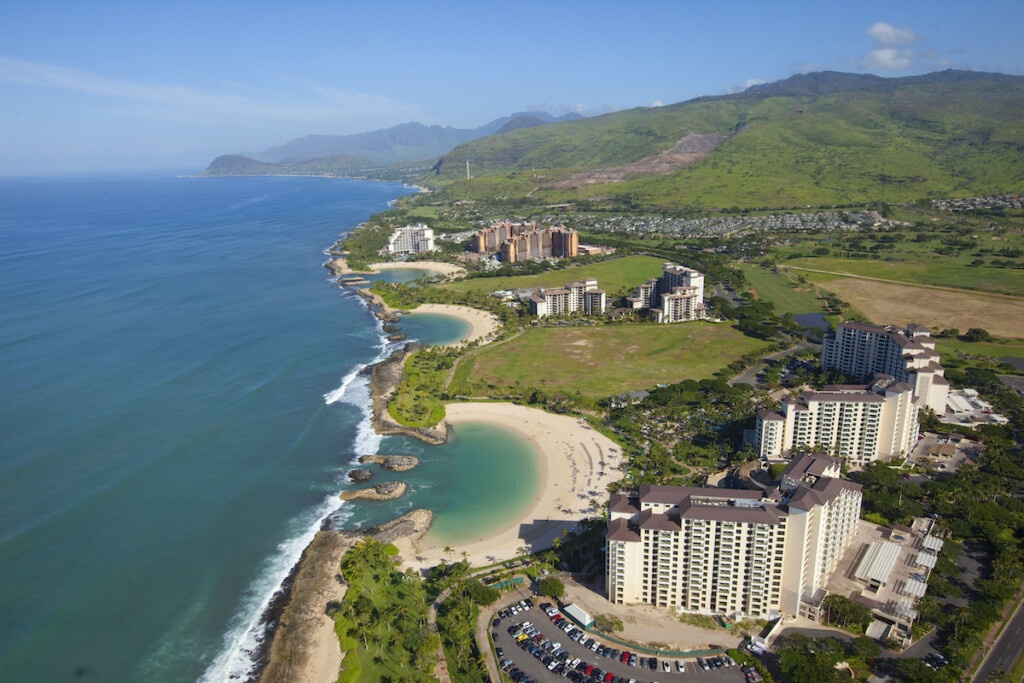
A short drive southwest of Kapolei brings visitors to the Ko Olina resort community, known for its row of four man-made beach lagoons sheltered from the open ocean. The resort corridor is home to hotels, the Aulani Disney Resort, golf courses, and a marina, and its calm, sandy lagoons are among the most popular family swimming spots on this side of the island. The drive from central Kapolei to the lagoons takes roughly 10 to 15 minutes.
To the east, about 20 to 25 minutes away, the Pearl Harbor National Memorial draws visitors with the USS Arizona Memorial, the Battleship Missouri Memorial, the Pacific Fleet Submarine Museum, and the Pearl Harbor Aviation Museum. The site is one of the most visited historical destinations in Hawaii and offers an accessible day trip from Kapolei, pairing naturally with Honolulu and other east-side attractions on the same outing.
Just inland from Kapolei lies the Honouliuli National Historic Site, a former wartime detention facility that held prisoners of war, civilian internees, and others during World War II. Designated as a National Historic Site in 2015 and managed by the National Park Service, the grounds are only opened to the public through limited guided tours, but the site adds an important historical layer to a Kapolei stay and is among the closest places to the city to learn about this period of Hawaiian history.
Kapolei's appeal as a short-term rental base lies in the contrast it offers to Waikiki and Honolulu: a quieter, more residential setting with plentiful parking, larger floor plans, and a noticeably sunnier and drier climate, while still sitting within a reasonable drive of Oahu's most iconic destinations. Guests who choose Kapolei gain easy access to beachfront resort lagoons, world-class historical sites, and the rugged Waianae Coast, all from a community that feels more like a neighborhood than a tourist district.
Want to know if a property in Kapolei is a good investment?
Enter an address to get instant revenue potential and comps.