
Tallahassee, Florida
Want to see how Tallahassee compares to other top cities in Florida? Explore all city regulations in Florida. →
Tallahassee, FL
Generally Investor Friendly
STR Regulations for Tallahassee, Florida
Short-Term Rental Investment Guide: Tallahassee, Florida (2025)
Executive Overview: Are Short-Term Rentals Allowed in Tallahassee, FL?
Yes, short-term rentals are explicitly allowed in Tallahassee, Florida. The City's Zoning Code regulates land use rather than occupancy type, meaning it makes no distinction between owned versus rented residential units, nor between different rental terms. Short-term rentals operate within the same zoning framework as traditional residential uses, provided they comply with all applicable state, county, and local regulations.
This permissive approach places Tallahassee among Florida cities that allow STR operations, though operators must navigate a multi-layered regulatory environment involving state licensing requirements, local tax obligations, and property-specific compliance standards.
What do Airbnb hosts actually earn in Tallahassee?
Tallahassee hosts earn a median $25,562/year with $183 ADR and 50% occupancy.
Top performers pull in $36,775+ per year.
See the full Tallahassee market breakdownHow to Start a Short-Term Rental Business in Tallahassee
Step 1: State Licensing Through DBPR
Obtain a Vacation Rental License from the Florida Department of Business and Professional Regulation (DBPR). This is mandatory for renting entire units more than three times per calendar year for periods less than 30 days or one calendar month, whichever is less.
Licensing Options:
- Vacation Rental - Dwelling: For single-family houses, townhouses, or units in duplex, triplex, or quadruplex buildings
- Vacation Rental - Condominium: For units in condominium or cooperative buildings
- Single License: One property owned/operated by the same individual/entity
- Group License: All units within a building or complex operated by a licensed agent
- Collective License: Group of separate properties (limited to 75 units max, same district only)
Application Process:
- Create DBPR Online Services account
- Submit online application with property details
- Pay application fees ($50 + $10 HEP fee + license fee)
- Receive digital license via email upon approval (typically 1-2 business days)
Step 2: Tax Registration and Setup
Florida State Sales Tax (6%): Register with Florida Department of Revenue to collect and remit state sales tax on all short-term rentals.
Leon County Tourist Development Tax (5%): Register with county authorities to collect this local tourism tax, funding local tourism infrastructure.
Combined Tax Rate: 11% total tax burden on short-term rentals (6% state + 5% local)
Step 3: Safety and Inspection Compliance
Required Safety Measures:
- Install smoke detectors in every living unit
- Install carbon monoxide detectors where applicable
- Provide functional fire extinguishers
- Ensure electrical systems meet safety standards (no extension cord use)
- Comply with NFPA 101 Life Safety Code requirements
Certificate of Inspection Requirements:
- Single-Family Homes: Annual general safety inspection
- Multi-Family Buildings (3+ stories): Balcony inspection every 3 years (unless common elements)
- Fire Safety Check: Required before license renewal
Step 4: Property Preparation and Operations
Physical Requirements:
- Display current license conspicuously on premises
- Maintain clean, safe, and physically sound conditions
- Provide clean, properly fitted bedding and linens
- Ensure soap availability (individual bars or dispensers)
- Sanitize dishes/glassware between guests (or post required notice)
- Maintain pest-free environment
Operational Considerations:
- Maximum rental periods typically 30 consecutive days
- Noise ordinance compliance mandatory
- Parking regulations adherence
- Neighbor relations management protocols
Required Documents, Permits, Licenses, and Guidelines
State-Level Requirements (DBPR)
Licenses:
- Vacation Rental License ($50 application + $10 HEP + license fee)
- License classifications: Single ($170-$350), Group ($180-$350), Collective ($150 + $10/unit)
Documentation:
- Proof of property insurance
- Property details and specifications
- Compliance verification certificates
- Tax registration confirmations
Local Requirements (Tallahassee/Leon County)
Tax Registrations:
- Florida Department of Revenue sales tax permit
- Leon County Tourist Development Tax registration
Property Compliance:
- Certificate of Inspection (annual for single-family, every 3 years for 3+ story buildings)
- Fire safety compliance documentation
- Zoning compliance verification
Operational Documentation
License Display: Current license must be prominently displayed in visible location on premises
Guest Information: House rules, local ordinances, emergency contact information, noise guidelines
Specific Regulations: City, County, and State Level
State Regulations (Florida)
Governing Body: Florida Department of Business and Professional Regulation (DBPR)
Key Requirements:
- License mandatory for entire unit rentals (>3 times/year, <30 days)
- Annual license renewal required
- Inspection compliance (fire safety, health standards)
- Human trafficking awareness training for housekeeping/reception staff
- Bedding and linens cleaning protocols (between guests or weekly)
- Dish sanitization requirements or guest notification
Fee Structure:
- Application: $50 + $10 HEP fee + license fee
- Annual renewal: $10 HEP + license fee
- License fees vary by type and unit count (Single: $170-$350, Group: $180-$350)
County Regulations (Leon County)
Tourist Development Tax: 5% levy on short-term rentals Zoning Authority: Leon County planning/zoning for unincorporated areas Enforcement: County code enforcement for non-compliance
City Regulations (Tallahassee)
Zoning Code: STRs permitted in all residential zones (same as traditional residential use) Noise Ordinances: Standard residential noise limits apply Parking Regulations: Must comply with residential parking requirements Duration Limits: Typically maximum 30 consecutive days for short-term rentals
HOA/Condo Considerations
Private Restrictions: Properties may be subject to additional rental restrictions through:
- Condominium declarations and bylaws
- HOA governing documents
- Private community rules and regulations
Compliance Required: STR operators must verify property-specific restrictions before licensing.
Contact Information for Local Authority
Florida Department of Business and Professional Regulation (DBPR)
Division of Hotels and Restaurants
- Director: Steven von Bodungen
- Address: 2601 Blair Stone Road, Tallahassee, FL 32399-1011
- Phone: (850) 487-1395
- TTY: (800) 955-8771
- Email: dhr.info@myfloridalicense.com
- Website: www2.myfloridalicense.com/hotels-restaurants/
- Online Services: www.myfloridalicense.com/datamart/mainMenuFLDBPR.do
City of Tallahassee - Growth Management
Planning & Zoning Division
- Address: 435 North Macomb Street, Tallahassee, FL 32301
- Phone: (850) 891-7001
- Contact: www.talgov.com/main/email.aspx?emailto=zoning
- Zoning Maps: www.talgov.com/growth/gm_zoning
- FAQ: www.talgov.com/growth/gm_faqs
Leon County Tax Collector
Tourist Development Tax Administration
- Website: www.leoncountytaxcollector.gov/
- Address: 918 Railroad Avenue, Tallahassee, FL 32301
- Phone: (850) 606-4400
Florida Department of Revenue
Sales Tax Registration
- Website: floridarevenue.com/
- Phone: (877) 357-3725
- Registration: floridarevenue.com/taxes/taxesfees/Pages/sales_tax.aspx
Important Regulatory Notes and Recent Developments
SB 280 Impact
Recent legislative attempts to further regulate STRs were vetoed by Governor DeSantis in 2024, maintaining the current regulatory framework with primary state oversight through DBPR and local tax collection authorities.
Compliance Monitoring
Active Enforcement: DBPR conducts regular inspections and maintains a searchable database of licensed vacation rentals (dbpr-publicrecords.myfloridalicense.com/qpr/single/)
Violation Consequences: Non-compliance can result in fines, license suspension, or revocation. Repeat violations may lead to permanent license denial.
Market Dynamics
STRs in Tallahassee operate within a competitive environment with approximately 11% combined tax burden and moderate regulatory oversight compared to other Florida markets, making it a relatively accessible market for new entrants while maintaining required compliance standards.
Sources and References
- City of Tallahassee Growth Management - STR FAQ
- Florida DBPR - Vacation Rental Licensing Guide
- Steadily - Tallahassee STR Laws Overview
- Vacation Rental License - Tallahassee Guide
- Florida Department of Revenue - Sales Tax Requirements
- DBPR Vacation Rental Database
This comprehensive regulatory framework positions Tallahassee as a viable market for short-term rental investment, provided operators maintain strict compliance with state licensing requirements, local tax obligations, and property-specific regulations. The explicit allowance of STRs in the city's zoning code, combined with clear state-level guidance through DBPR, provides a structured pathway for legitimate operations.
Next step
Found a property in Tallahassee?
Paste any address and get estimated revenue, cash-on-cash return, and comparable STR performance in under 5 minutes. 3 free analyses per day.
Free brief
Get the free Tallahassee STR Investment Brief
Revenue data, top neighborhoods, seasonal trends, and the key regulations for Tallahassee, Florida in one email.
Tallahassee
Market Saturation Score
Photos of Tallahassee



Overview of Tallahassee
Tallahassee, the capital of Florida and seat of Leon County, sits in the northern part of the state, often called the Panhandle. With a city population of approximately 200,000 and a metro area nearing 400,000, it has the dual character of a mid-size college town — anchored by Florida State University and Florida A&M University — and a working seat of state government. The city is unusually hilly and tree-shaded for Florida, laced with scenic canopy roads draped in live oaks and Spanish moss, and it serves as a gateway to both the Gulf Coast beaches and the wild forests and springs of the Big Bend region. The nearest major city is Jacksonville, roughly 160 miles to the southeast and about a two-and-a-half-hour drive.
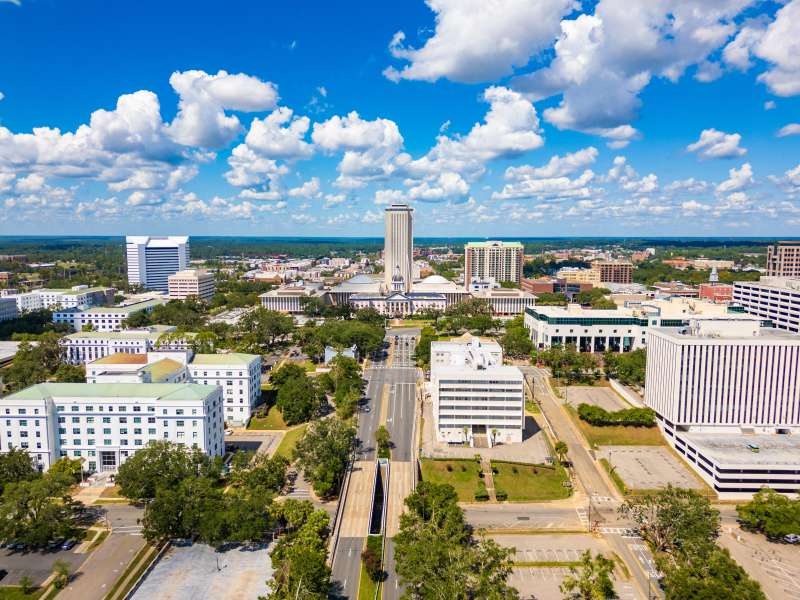
The Florida State Capitol complex is the city's most recognizable landmark, where the modern tower and restored historic capitol sit side by side in the heart of downtown. Visitors can tour the chambers, view the governor's office, and walk the surrounding grounds, which include a memorial to the 2018 shooting at Marjory Stoneman Douglas High School. Just south of downtown, Mission San Luis brings the 17th century to life, with a reconstructed Spanish mission and a nearby Apalachee council house where interpreters demonstrate the daily life of the Native and colonial residents who shared the site from 1656 to 1704.
A short drive from the city center, Alfred B. Maclay Gardens State Park offers a quieter counterpoint, with formal gardens, a walled brick courtyard, and lakeside walking trails that bloom spectacularly in late winter and early spring. About 25 minutes south of town, Edward Ball Wakulla Springs State Park is one of the largest and deepest freshwater springs in the world, where glassy emerald water draws glass-bottom boat tours, manatees in winter, and a vintage lodge that hosted Johnny Weismuller in the 1930s Tarzan films.
Beyond these in-town draws, Tallahassee works well as a base for exploring the surrounding region. The Apalachicola National Forest spreads to the southwest, with rivers, sinks, and the Bradwell Bay wilderness, while the Gulf of Mexico beaches — including St. George Island, Alligator Point, and the more developed Panama City Beach — are reachable in roughly 45 minutes to two hours. With Florida State and FAMU drawing year-round event traffic, state workers filling government roles, and visitors heading south to the springs, the forests, and the coast, Tallahassee offers a steady and varied stream of short-term-rental demand across business, sports, and leisure travelers alike.
Want to know if a property in Tallahassee is a good investment?
Enter an address to get instant revenue potential and comps.