
Norwalk, Connecticut
Want to see how Norwalk compares to other top cities in Connecticut? Explore all city regulations in Connecticut. →
Norwalk, CT
Very Investor Friendly
STR Regulations for Norwalk, Connecticut
Overview: Are short-term rentals allowed in Norwalk?
Explicit answer: Yes—short-term rentals are allowed in Norwalk, CT. As of 2024, Norwalk does not have a local ordinance or zoning regulations that prohibit short-term rentals. The Planning & Zoning Director has stated that the city treats short-term rentals like any other residential housing unit, provided the property complies with single-family (or multifamily, as applicable) housing requirements. Norwalk has not identified short-term rentals as an enforcement priority and has not adopted city-specific licensing, registration, or zoning restrictions for STRs. However, recent state-level developments have clarified that STRs can be a lawful “residence” use under Connecticut law, which affects municipal approaches going forward.
What do Airbnb hosts actually earn in Norwalk?
Norwalk hosts earn a median $34,155/year with $278 ADR and 59% occupancy.
Top performers pull in $52,167+ per year.
See the full Norwalk market breakdownHow to start a short-term rental business in Norwalk
- Confirm zoning and use compliance:
- Verify that your property’s current zoning permits the intended residential use (e.g., single-family, multifamily, condo). STRs are currently treated as residential uses; no special zoning approval is required unless you plan to operate a business type that needs other approvals.
- Review building, fire, and life-safety requirements:
- Ensure the dwelling meets the Connecticut Fire Safety Code and building standards for occupancy, means of egress, smoke/CO detection, and emergency egress. Nonconformance can create liability and code enforcement issues.
- Assess HOA/condo bylaw restrictions:
- Many multifamily buildings and HOAs prohibit transient rentals. Confirm your association’s rules before listing, as violations can result in fines or legal action.
- Structure your business and tax compliance:
- Although platforms collect Connecticut’s 15% room occupancy tax for STRs, confirm with the platform that your property is registered correctly and that tax remittance is handled. Keep meticulous financial records for state income and local tax reporting.
- Prepare for operations:
- Develop house rules to minimize noise, parking, trash, and nuisance issues. Maintain clear check-in/out procedures, emergency contacts, and a guest handbook. Secure appropriate general liability and property insurance; verify whether your policy covers short-term leasing.
- Consider accessory dwelling units (ADUs):
- If you own or plan to add an ADU on your property, note Norwalk’s explicit ADU rule: ADUs must be rented for a minimum of six months. Plan accordingly if you intend to use the ADU for short-term stays.
Required documents, permits, licenses, and guidelines
- Local licenses or permits:
- Norwalk does not currently require a city license or permit to operate a short-term rental. There is no city registration, inspection, or fee regime in place specifically for STRs.
- Safety and housing standards:
- Properties must meet applicable building, fire, and health codes. Investors should conduct or obtain verification that egress, life-safety devices (smoke/CO detectors), and occupancy limits are compliant.
- Connecticut room occupancy tax:
- Connecticut imposes a 15% room occupancy tax on short-term rentals. Platforms like Airbnb and VRBO typically collect and remit this tax on facilitated bookings. Verify platform compliance and your own state tax reporting obligations.
- Advertising and compliance:
- While not required locally, best practice is to include in your listing the maximum occupancy, quiet hours, parking rules, trash schedules, and contact information for local issues. Align any messaging with HOA/condo rules and local norms.
- State-level oversight context:
- Connecticut has no overarching STR statute beyond the occupancy tax; several bills have been proposed to grant municipalities authority to license/regulate STRs, but none have been enacted into law as of the latest reports.
Specific regulations: Norwalk, Fairfield County (region), and Connecticut
- Norwalk (municipal):
- Short-term rentals are allowed; the city treats STRs like any other residential use.
- ADUs have a six-month minimum rental duration under Norwalk’s zoning code; owners cannot legally rent ADUs on a short-term basis.
- No city-specific STR licensing, registration, or inspection requirements have been enacted.
- Fairfield County/region:
- Municipal approaches vary. Some neighboring towns have considered or adopted restrictions; others remain permissive or are studying the issue. If you own property in other county municipalities, check those towns’ zoning and ordinances individually.
- Connecticut (state):
- No state-wide licensing or registration scheme for STRs. The 15% room occupancy tax is collected by facilitators (e.g., platforms).
- In 2024, the Connecticut Supreme Court ruled (Wihbey v. Zoning Board of Appeals) that a “residence” can include short-term rentals and does not require a degree of permanency. This decision strengthened the argument that STRs can be lawful under existing residential zoning definitions in many communities.
- Proposed legislation has sought to empower municipalities to license/regulate STRs and to add local occupancy taxes; these bills have not been enacted. Municipalities remain in a wait-and-see posture or are crafting local rules case-by-case.
Contact information: Local authority and key resources
- Norwalk Planning & Zoning (primary local authority for STRs as residential uses)
- Phone (general): 203-854-7890
- Website: www.norwalkct.gov
- Notes: For questions on zoning compliance, ADU rules, and whether any special approvals apply to your property’s specific use. The department oversees zoning and land use matters; building/fire issues may be referred to other city departments.
- Connecticut Department of Revenue Services (DRS) – room occupancy tax
- Phone (general): 860-297-5962
- Website: portal.ct.gov/drs
- Notes: Confirm your state tax obligations and platform remittance status. Keep records to substantiate compliance.
- Norwalk Fire Marshal’s Office (life safety/fire code)
- Phone (general): 203-854-0200
- Website: www.norwalkct.gov/fire
- Notes: Verify egress, occupancy limits, and fire safety requirements for residential units.
- Norwalk Building Department (building code compliance)
- Phone (general): 203-854-7878
- Website: www.norwalkct.gov/building
- Notes: Confirm permitted use, occupancy, and any required inspections.
- Norwalk Health Department (health/sanitation, as applicable)
- Phone (general): 203-854-7776
- Website: www.norwalkct.gov/health
- Notes: For issues related to sanitation, waste management, and any health-related concerns in residential settings.
Note: Contact details reflect the information available from the cited sources. If a department’s direct STR contact is not publicly listed, call the main number and ask for the appropriate division (Planning & Zoning, Building, Fire Marshal, Health).
Links to source pages (for verification and deeper reading)
- Norwalk Hour article on STRs and housing supply (April 8, 2024): www.thehour.com/news/article/ct-housing-supply-short-term-rentals-airbnb-19310857.php
- CT Mirror coverage of the Connecticut Supreme Court ruling on STRs (Aug 1, 2024): ctmirror.org/2024/08/01/ct-supreme-court-airbnb-vrbo-short-term-rental/
- SCCOG report: Short-Term Rental Regulation in Connecticut (Oct 2023): secogct.gov/wp-content/uploads/2023/10/ShortTermRentalRegulationinConnecticutOctober-2023.pdf
- Norwalk Building Regulations (Zoning Code; includes ADU minimum rental duration): www.norwalkct.gov/DocumentCenter/View/32250/Norwalk-Building-Regulations-ART4-Bldg-Lot--Building-Site-Standards---Updated_FINAL
Practical takeaway for investors:
- Norwalk’s permissive stance and the state Supreme Court’s 2024 decision create a favorable legal climate for STRs. However, governance may evolve. Stay engaged with Planning & Zoning, verify HOA/condo restrictions, and maintain code-compliant, well-managed operations. Monitor any future municipal actions and state legislation that could introduce licensing, caps, or additional fees.
Next step
Found a property in Norwalk?
Paste any address and get estimated revenue, cash-on-cash return, and comparable STR performance in under 5 minutes. 3 free analyses per day.
Free brief
Get the free Norwalk STR Investment Brief
Revenue data, top neighborhoods, seasonal trends, and the key regulations for Norwalk, Connecticut in one email.
Norwalk
Market Saturation Score
Photos of Norwalk


Overview of Norwalk
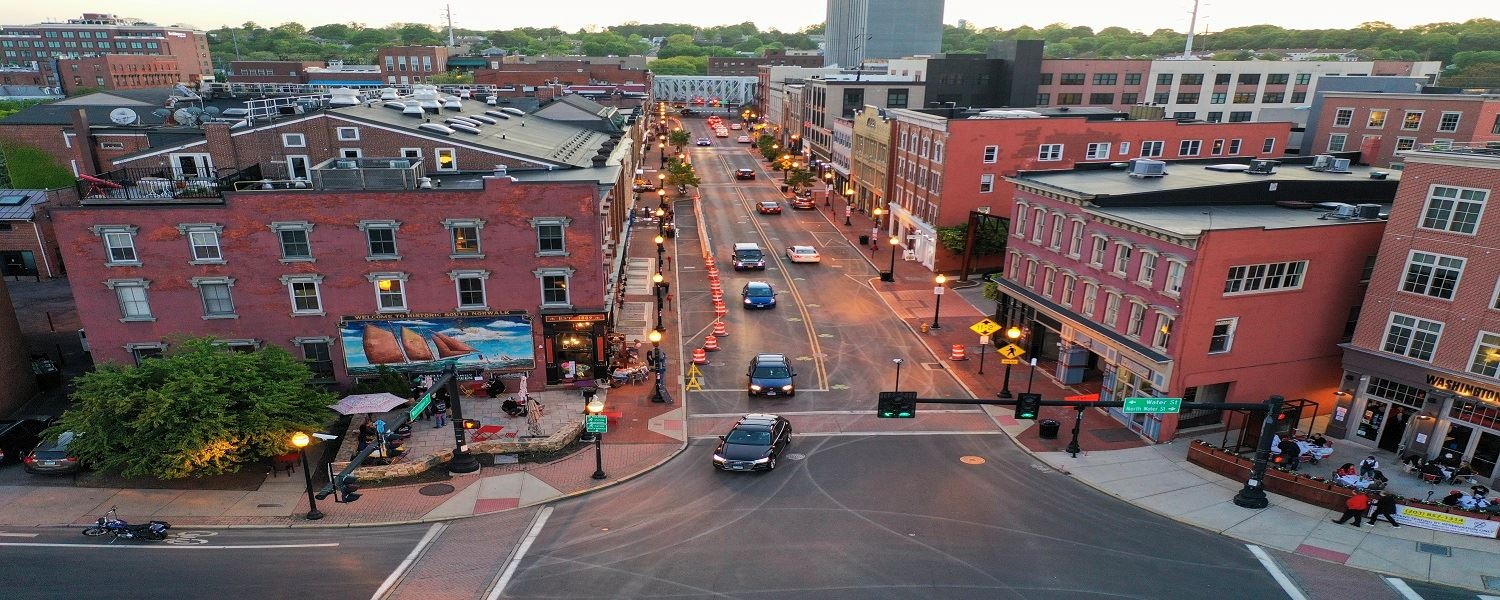
Norwalk is a coastal city in Fairfield County, Connecticut, situated along the western shore of Long Island Sound. With an approximate population of around 90,000 residents, it is one of the larger communities in the southwestern corner of the state and a key part of the New York metropolitan commuter belt. The city blends a working harbor and maritime heritage with revitalized downtown districts, suburban neighborhoods, and stretches of public beach, giving it a character that feels both distinctly New England and firmly tied to the rhythm of the New York metro area. Norwalk is best known for its aquarium, its active harbor, and its proximity to New York City, which lies roughly 50 miles to the southwest and is reachable by car or train in about an hour to an hour and a half depending on traffic.
One of the city's marquee attractions is The Maritime Aquarium at Norwalk, located right in the city on the Norwalk River just minutes from I-95. It focuses on the marine life of Long Island Sound and features touch tanks, harbor seals, and a working boat that takes visitors out on the Sound during warmer months. The aquarium is a major draw for families traveling through the region and serves as a natural anchor for any stay centered on Norwalk's waterfront.
A short walk from the aquarium brings visitors to the ferry dock in Norwalk Harbor, where seasonal boats run to the Norwalk Islands, a chain of small islands in Long Island Sound managed as a state park. The largest, Sheffield Island, has a historic lighthouse, sandy beaches, and picnic areas, and the ride itself takes only a few minutes. It is one of the easiest ways in the region to experience the Sound without a car.
South of the harbor, the SoNo (South Norwalk) district has become the city's dining and nightlife hub, with restored brick warehouse buildings, galleries, breweries, and restaurants lining the streets around the train station. Just a few minutes north, the Lockwood-Mathews Mansion Museum offers a quieter counterpoint: a lavishly restored 1868 Second Empire mansion recognized as one of the earliest and finest examples of that style in the United States. Both are within a short drive of one another and easy to reach from anywhere in the city.
For travelers, Norwalk is a compelling short-term rental base precisely because it offers so many distinct experiences within a small radius. Guests can spend a morning at the aquarium, an afternoon on a harbor island, and an evening in SoNo, then take a day trip into Manhattan or drive roughly 25 miles northeast to New Haven. Its balance of coastal recreation, commuter-rail access, and proximity to two major metropolitan areas gives the city year-round appeal for both leisure visitors and those visiting family or working in the region.
Want to know if a property in Norwalk is a good investment?
Enter an address to get instant revenue potential and comps.