
Boulder, Colorado
Want to see how Boulder compares to other top cities in Colorado? Explore all city regulations in Colorado. →
Boulder, CO
Generally Investor Friendly
STR Regulations for Boulder, Colorado
Overview: Are Short-Term Rentals Allowed in Boulder, CO?
Yes, short-term rentals are explicitly allowed in Boulder, CO, with specific regulations and requirements that vary between the City of Boulder and unincorporated Boulder County.
City of Boulder: Short-term rentals are permitted when the property serves as the owner's principal residence, defined as the dwelling unit where the owner resides for more than one-half of the year. Short-term rentals are defined as properties rented for 29 days or less at a time.
Boulder County (Unincorporated Areas): Two types of short-term dwelling rentals are permitted:
- Short-Term Rental License: For primary residences with the owner/tenant present during rentals (except up to 45 nights annually when not present)
- Vacation Rental License: For properties where the entire dwelling unit is rented to a single booking party for fewer than 30 days
What do Airbnb hosts actually earn in Boulder?
Boulder hosts earn a median $34,601/year with $199 ADR and 69% occupancy.
Top performers pull in $54,022+ per year.
See the full Boulder market breakdownHow to Start a Short-Term Rental Business in This Market
City of Boulder Process
- Verify Principal Residence Status: Confirm the property qualifies as your principal residence
- Determine Eligibility: Ensure compliance with zoning, occupancy limits, and any HOA restrictions
- Submit Application: Complete the Rental License Short-Term Application online or by mail
- Pay Fees: Submit $190 rental license fee plus $25 business license fee
- Obtain License: Receive your Rental Housing License (RHL) number
- Annual Compliance: Submit Short-Term Rental Annual Affidavit each year by anniversary date
- Maintain Business License: Ensure compliance with business licensing requirements
Boulder County Process
- Identify Property Type: Determine if your property qualifies for Short-Term Rental or Vacation Rental
- Review Zoning Compliance: Verify your property is in an eligible zone district
- Complete Application Packet: Use appropriate checklist (STR or VR)
- Schedule Inspection: Arrange required property inspection
- Pay License Fees: Submit appropriate fees ($350-$500 initial)
- Receive License: Obtain STR or VR license number
- Maintain Compliance: Complete biennial renewals and ongoing requirements
Required Documents, Permits, Licenses, and Guidelines
City of Boulder Requirements
Primary Documents:
- Rental License Short-Term Application
- Proof of principal residence (deed with matching name)
- Business License application ($25 fee)
- Short-Term Rental Annual Affidavit (annually)
Permits and Licenses:
- Rental Housing License (RHL) - $190
- Business License - $25 (one-time)
- Short-Term Rental Annual Affidavit - $20 annually
Safety Self-Certification:
- Smoke detectors verification
- Carbon monoxide detectors verification
- Other safety equipment compliance
Boulder County Requirements
Short-Term Rental License:
- Completed application via County portal
- Short-Term Rental License Checklist
- Short-Term Rental Affidavit (primary residence proof)
- Property inspection with approved checklist
- Proof of insurance
- Proof of property tax payment
- Parking plan documentation
Vacation Rental License:
- Completed application via County portal
- Vacation Rental License Checklist
- Property inspection with approved checklist
- Proof of insurance
- Proof of property tax payment
- Parking plan documentation
- Zoning compliance verification
Additional Guidelines:
- Good Neighbor Guidelines
- OWTS (Septic) Safety Guidelines
- Wildlife Safety Guidelines
- Wildfire Safety Guidelines
- Wildfire Partners Assessment/Certification (for West Boulder County properties)
Specific Regulations for Short-Term Rentals
City of Boulder Regulations
Operational Requirements:
- Maximum unrelated occupancy must be displayed in all advertisements
- Rental Housing License (RHL) number required in all advertisements
- Property must remain owner's principal residence
- Annual affidavit submission mandatory for license maintenance
Usage Limitations:
- Short-term rentals defined as 29 days or less
- No limit on rental days for principal residence when renting entire house
- ADUs limited to 120 days per year (if legally established prior to Jan 3, 2019)
- No short-term rentals permitted for non-owner-occupied properties
Compliance Requirements:
- License valid for 4 years
- No physical inspections required (self-certification model)
- Conversion between short-term and long-term rental licenses permitted
- SmartRegs/energy efficiency requirements do not apply to short-term rentals
Boulder County Regulations
Short-Term Rental (STR) Requirements:
- Primary residence requirement
- Owner/tenant must be present during rentals
- Exception: Up to 45 nights annually when owner not present
- Allowed in all subdivisions and zone districts
- Historic Accessory Dwelling Units are only ADU type eligible
- Two on-site parking spaces required
Vacation Rental (VR) Requirements:
- Entire dwelling unit rental to single booking party
- Limited to Forestry (F) and Mountain Institutional (MI) zone districts
- Not allowed in subdivisions within Bald Mountain CCD
- Allowed in subdivisions within Upper St. Vrain CCD
- Not permitted in Plains CCD
- License caps: 194 in Upper St. Vrain CCD, 83 in Bald Mountain CCD
Universal Requirements:
- Maximum 8 occupants or septic system capacity (whichever is fewer)
- License numbers must be posted in advertisements
- Parking space numbers must be disclosed
- Property inspections required for all licenses
- Biennial license renewals required
- Individual/entity limited to one STR and one VR license maximum
State-Level Colorado Regulations
Accommodation Taxes:
- All short-term rentals subject to Boulder accommodation taxes
- Must file quarterly accommodations tax returns
- Annual sales and use tax filing required
- Use Boulder Online Tax System for all filings
Contact Information
City of Boulder
Planning & Development Services - Rental Housing Licensing
- Phone: 303-441-3152
- Email: RHL@bouldercolorado.gov
- Mailing Address:
- Rental Licensing Program
- P. O. Box 791
- Boulder, CO 80306
- Website: bouldercolorado.gov/services/rental-housing-licensing-short-term
Tax & Licensing Division
- Email: salestax@bouldercolorado.gov
- Online Tax System: boulderonlinetax.gentaxcpc.net/
Code Violations
- Phone: 303-441-1880
- Online Reporting: Available through city website
Boulder County
Community Planning & Permitting
- Phone: 303-441-3930
- Email: planner@bouldercounty.gov
- STR Licensing Email: strlicensing@bouldercounty.gov
- Mailing Address:
- Community Planning & Permitting
- PO Box 471
- Boulder, CO 80306
- Office Location:
- Courthouse Annex Building
- 2045 13th St.
- Boulder, CO 80302
- Website: bouldercounty.gov/departments/community-planning-permitting/short-term-dwelling-vacation-rental-licensing/
Hours:
- Public Office: 8 a.m. to 3 p.m. (Mon, Wed, Thu), 10 a.m. to 3 p.m. (Tue)
- Virtual Service: 8 a.m. to 4:30 p.m. (Mon, Wed, Thu, Fri), 10 a.m. to 4:30 p.m. (Tue)
Wildfire Partners (West Boulder County Properties)
- Phone: 303-441-1420
- Email: info@wildfirepartners.org
- Website: wildfirepartners.org/
Source Links
- City of Boulder STR Regulations: bouldercolorado.gov/services/rental-housing-licensing-short-term
- Boulder County STR Regulations: bouldercounty.gov/departments/community-planning-permitting/short-term-dwelling-vacation-rental-licensing/
- Airbnb Host Guidance: www.airbnb.com/help/article/3586
- City Application Portal: beta.bouldercolorado.gov/rental-housing-licensing-short-term-application
- County Application Portal: accelapublic.bouldercounty.org/citizenaccess/customization/common/home.aspx
- Boulder Online Tax System: boulderonlinetax.gentaxcpc.net/
- Customer Self-Service Portal: bouldercolorado.gov/energovcss
- Licensed Properties Map: maps.bouldercolorado.gov/rental-inquiry
- County Licensed STR/VR Dashboard: bouldercounty.maps.arcgis.com/apps/dashboards/68f4fd280cef486b8c7446da11a9bae5
- Property Eligibility Tool: bouldercounty.maps.arcgis.com/apps/instant/lookup/index.html?appid=b871975faadf4328a86e5214358879ed
Important Notes for Investors
-
Market Differentiation: City and County regulations differ significantly; properties in incorporated areas follow City rules, while unincorporated areas follow County regulations.
-
Principal Residence Requirement: City properties must be owner-occupied as principal residence, limiting investment opportunities for non-resident investors.
-
County Vacation Rental Caps: Vacation rental licenses are capped by geographic area, creating potential supply constraints in popular mountain zones.
-
Inspection Requirements: County properties require physical inspections, while City properties use self-certification.
-
Fee Structure: County fees are higher ($350-$500) but licenses are valid for 2 years; City fees are lower ($190-$25) but require annual affidavits.
-
Tax Compliance: Both jurisdictions require accommodation tax filings through the Boulder Online Tax System.
-
Advertisement Compliance: All jurisdictions require specific information in online advertisements, including license numbers and occupancy limits.
-
Safety Requirements: County properties have additional wildfire, wildlife, and septic safety guidelines, particularly important for mountain properties.
Next step
Found a property in Boulder?
Paste any address and get estimated revenue, cash-on-cash return, and comparable STR performance in under 5 minutes. 3 free analyses per day.
Free brief
Get the free Boulder STR Investment Brief
Revenue data, top neighborhoods, seasonal trends, and the key regulations for Boulder, Colorado in one email.
Boulder
Market Saturation Score
Photos of Boulder



Overview of Boulder
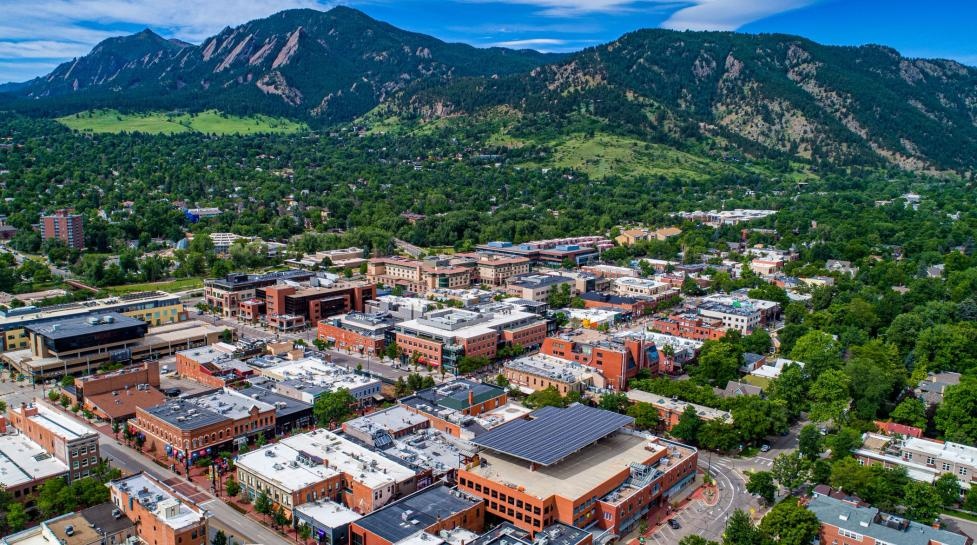
Boulder, Colorado sits in Boulder County at the eastern edge of the Front Range of the Rocky Mountains and is home to roughly 105,000 residents. Often described as a laid-back yet intellectually active college town, Boulder is best known as the home of the University of Colorado, the dramatic sandstone Flatirons that rise just west of the city, and a deeply outdoors-oriented culture. It also serves as a popular gateway to the high country of the Rockies, sitting about 30 miles northwest of Denver, the nearest major city. Its combination of walkable neighborhoods, a lively food and craft brewery scene, and immediate access to alpine hiking makes it one of the more recognizable small cities in the American West.
One of the most visited spots in Boulder is the Pearl Street Mall, a four-block pedestrian stretch in the heart of downtown. Lined with restaurants, independent boutiques, street performers, and outdoor patios, it functions as the city's social hub and draws both locals and visitors year-round. It lies within walking distance of most central accommodations, with no significant drive required.
Just southwest of downtown, Chautauqua Park anchors the base of the Flatirons and provides some of the most iconic hiking in the region. Trails such as the Flatiron Loop, Royal Arch, and the First and Second Flatirons offer relatively short climbs to dramatic viewpoints, making the park a favorite for both visitors and locals. It is about a five-minute drive or a pleasant walk from most parts of central Boulder.
A short drive south, Eldorado Canyon State Park offers nearly 500 acres of rugged cliffs, pine-covered slopes, and the South Boulder Creek, with hiking, rock climbing, picnicking, and trout fishing. Located roughly 15 minutes from downtown Boulder, it is especially popular with climbers drawn to its sandstone walls, and its proximity makes it an easy half-day excursion for short-term rental guests.
About 75 minutes by car to the northwest, Rocky Mountain National Park provides a full alpine experience, with Trail Ridge Road, Bear Lake, and a network of trails climbing toward 14,000-foot peaks. Many visitors use Boulder as a base for day trips into the park, particularly during summer and fall when Trail Ridge Road is open.
Boulder is a compelling base for short-term rentals because it pairs the amenities of a small, walkable city with immediate access to some of the country's most celebrated outdoor landscapes. Guests can spend mornings hiking the Flatirons, afternoons browsing Pearl Street, and evenings sampling the local food and brewery scene, with Rocky Mountain National Park and other mountain destinations within a comfortable day trip. That blend of urban character and high-country access keeps demand steady across much of the year.
Want to know if a property in Boulder is a good investment?
Enter an address to get instant revenue potential and comps.