
Trinidad, California
Want to see how Trinidad compares to other top cities in California? Explore all city regulations in California. →
Trinidad, CA
Challenging To Investors
STR Regulations for Trinidad, California
Overview: Are Short-Term Rentals Allowed in Trinidad, CA?
Yes. Short-term rentals (STRs) are explicitly allowed in Trinidad, California, but they are subject to detailed local controls and caps to preserve neighborhood character, housing availability, and environmental resources. The City of Trinidad permits three categories of STRs—Full-time, Resident, and Homeshare—each with specific standards, limits, and licensing requirements. Additionally, because Trinidad is within Humboldt County, a county STR permit is required and imposes its own rules, standards, and caps. Investors must comply with both the City’s Short-Term Rental Ordinance (Ordinance 2016-03) and Humboldt County Code § 314-60, and are also subject to applicable California state requirements (e.g., transient occupancy tax collection and remittance).
What do Airbnb hosts actually earn in Trinidad?
Trinidad hosts earn a median $68,858/year with $303 ADR and 75% occupancy.
Top performers pull in $92,658+ per year.
See the full Trinidad market breakdownHow to Start a Short-Term Rental Business in Trinidad, CA
The licensing and operational landscape involves two regulatory layers—City of Trinidad and Humboldt County. In practice, many properties within Trinidad will need a City STR license (if operating as a Short-Term Rental under the City ordinance) and a County Short-Term Rental Permit for any STR operation under the County code. Use the steps below to initiate and operate compliantly.
- Decide STR category and feasibility
- Full-time STR (City): A dwelling rented for fewer than 30 days, year-round, with City caps by zone.
- Resident STR (City): Owner’s primary residence, up to 59 nights per year.
- Homeshare STR (City): Owner rents up to one bedroom in their primary residence, and is present on-site between 10 p.m. and 7 a.m. while rented.
- Confirm that the dwelling is legally established and located in a zoning district where STRs are permitted under City standards (City limits: UR/SR caps; other zones may not have caps but must meet location and density standards). For County permits, confirm the zoning allows residential use and that the STR is not prohibited by County provisions (e.g., ADUs permitted after 1/1/2020, SB9 lots, certain recorded affordability restrictions).
- Apply for a City STR License (if operating within City ordinance limits)
- Initial application to the City includes: site/floor plans to scale; sample rental agreement and Good Neighbor Contract; proof of $1 million general liability insurance; evidence of primary residence for Homeshare/Resident STR applications; inspection by the Building Inspector prior to issuance; designation of a Local Contact Person (LCP) within 20 miles able to respond in 30 minutes; posting a 24-hour contact number inside the STR.
- City posts STR license information on its website and notifies neighbors within 300 feet.
- Licenses must be renewed annually by February 1. If you receive a license after October 1, renewal is due the following February.
- Apply for a County STR Permit (required for all STR operations countywide)
- Prepare a complete application (materials are in addition to basic permit filing requirements).
- County permit types:
- Administrative Permit: Standard compliance with all applicable standards.
- Special Permit: Required for exceptions (e.g., access below Category 3; occupancy above formula; certain parking standards) and must meet specific findings.
- Maintain a posted Good Neighbor Guide for tenants and file an affidavit confirming distribution to neighbors (within 300 feet “as the crow flies” and nearest five along access roads).
- Taxes and business compliance
- Register and remit Transient Occupancy Tax (TOT) to the City (City TOT registration and compliance are mandated).
- Register with the County if the County levies a TOT or other required taxes for STR operations.
- Operational requirements
- Post emergency preparedness information (earthquakes, tsunami siren testing, fire department siren), keep a guest registry with names and vehicle plates, enforce occupancy, parking, and noise limits, and maintain septic/water use records consistent with City standards.
- Renewal and maintenance
- City license renewals are due February 1. County permits lapse after two years unless you submit a statement of continued operation, proof of hosting stays, no outstanding violations or taxes, and pay a review fee.
- Monitor your property’s compliance status; repeated significant violations or failure to respond to complaints can result in fines, placement on a watch list, and license revocation.
Required Documents, Permits, Licenses, and Guidelines
City of Trinidad STR License ( Ordinance 2016-03):
- Initial application with site and floor plans to scale.
- Sample rental agreement and Good Neighbor Contract (City form).
- Proof of general liability insurance ($1,000,000).
- Evidence of primary residence for Homeshare/Resident STR licenses.
- Building inspection prior to issuance; necessary code corrections as required by Building Inspector.
- Designation of a Local Contact Person (LCP) within 20 miles and a 24-hour contact number.
- Annual renewal by February 1 (post-October 1 licenses renew the following February).
- City posting and neighbor noticing (website, Police, Sheriff, Fire, neighbors within 300 feet).
Humboldt County Short-Term Rental Permit ( § 314-60 ):
- Grant deed for the subject parcel.
- Good Neighbor Guide (content defined in the code) and signed affidavit confirming delivery to neighbors (within 300 feet and nearest five along the access road).
- If the applicant is not the owner: notarized property owner consent; if owner is an LLC or corporation, a roster/operating agreement identifying ownership/control.
- If accessed via shared private road: access route documentation; special noticing to all owners/occupants using the shared road.
- Farm Stay applications: documentation of educational activities/immersive agricultural experiences.
- Proof of insurance and safety equipment (fire extinguisher; working smoke and CO detectors).
- Occupancy and parking plans consistent with code standards.
- County permit renewal (every two years) with a statement of continued operation, hosting evidence, clearance of violations and taxes, and fee payment.
Taxes and Business Compliance:
- City Transient Occupancy Tax (TOT) registration, collection, recordkeeping, and remittance.
- County TOT registration/remittance if applicable (confirm with Humboldt County).
- Keep annual water use records for City review (max average daily consumption tied to 150 gallons per bedroom; 30% allowance for landscaping).
Specific Regulations for Short-Term Rentals
City of Trinidad ( Ordinance 2016-03 )—Key Standards:
- STR Types:
- Full-time STR: Generally not limited by total nights; subject to City caps by zone.
- Resident STR: Up to 59 nights/year; primary residence.
- Homeshare STR: Rent up to one bedroom in primary residence; host must be present 10 p.m.–7 a.m.
- Caps and Access:
- UR Zone: Up to 19 Full-time STR licenses; up to 6 Resident STR licenses; if a new Full-time license becomes available, the City allocates by lottery from a waiting list.
- SR Zone: Up to 6 Full-time STR licenses; otherwise, no new Full-time licenses once this cap is reached; Resident STR licenses not capped by this subsection, but Homeshares are exempt from caps.
- Other zones: No cap in the City ordinance for Full-time STRs (but location and other standards still apply).
- Location: No more than one STR per parcel; in UR zone, no new STR may share a property boundary with another STR in UR zone (exception via Planning Commission).
- One license per owner in UR/SR zones (renewals are exempt); renewals of existing licenses are allowed.
- Occupancy and Parking:
- General occupancy: Two persons per bedroom plus two additional, excluding children 12 or under.
- UR Zone lots under 10,000 sq. ft.: Two persons per bedroom (no additional two).
- SR Zone floor area bonus: If STR floor area exceeds 800 sq. ft. per bedroom, one additional occupant is allowed for each additional 500 sq. ft., up to two additional occupants.
- Off-street parking: One space per two occupants; spaces must be on the STR property and not on septic fields unless rated for traffic. On-street spaces cannot be used to meet the minimum off-street requirement. Occupants must be directed to use onsite parking first.
- Water Use and Septic:
- Annual domestic water use shall not exceed 150 gallons per bedroom per day equivalent (7,324 cubic feet per year), with a 30% allowance for landscaping; maintain records and implement adaptive measures if exceeded.
- Septic system must be functioning properly; post appropriate use instructions in each kitchen/bathroom.
- Noise and Conduct:
- Noise after 10 p.m. and before 7 a.m. must be contained inside and not audible to neighbors.
- Good Neighbor Contract required; a Good Neighbor Brochure summarizing rules must be posted inside the STR.
- Visitor limits: Visitors cannot stay overnight; maximum combined occupants and visitors on site is 20; visitors not allowed between 11 p.m. and 7 a.m.
- Guest registry required (names, plate numbers, dates).
- Tenancy minimum: Two successive nights.
- Good Neighbor Requirements:
- Provide and post emergency preparedness information (local hazards, tsunami siren testing schedule, fire siren signals, and real emergencies).
- Licensing and Transfer:
- Licenses are not transferable upon sale/transfer except limited spousal/trust exceptions; for entities, a change of 50%+ ownership revokes the license.
- Operation and Inspection:
- The City may audit/inspect during normal business hours with 24-hour notice.
- Enforcement and Violations:
- Administrative penalties up to $1,000/day (cap $100,000) for continuing violations.
- Significant violations (examples include unresponsiveness to complaints within 30 minutes, occupancy/parking/noise violations, failure to maintain guest registry, failure to pay TOT or fees, false information, health code violations, repeated minor violations) can lead to placement on a watch list and revocation after City Council action.
- Appeals are to the City Manager under § 17.72.100 (not appealable to the Coastal Commission as STR licenses are not coastal development permits).
Humboldt County ( § 314-60 )—Key Standards:
- Permit Types and Term:
- Administrative Permit required; Special Permit required for exceptions (to standards such as access, occupancy, and parking).
- Permit term is two years; renewal requires a statement of continued operation, evidence of hosting, clearance of violations and taxes, and fee.
- Caps and Limits:
- Within the “Greater Humboldt Bay Area Short-Term Rental Cap Area” (includes Trinidad-Westhaven CPA): Not more than 2% of the housing stock may be permitted as STRs, and not more than 2% within each Community Plan Area. Farm stays and historic properties are exempt. If the cap is exceeded, new permits are not issued until the number falls below the cap (existing operations may receive permits first).
- Outside the Greater Humboldt Bay Area: Not more than 5% of housing stock may be permitted as STRs, with the exception of Shelter Cove (no limit). If the cap is exceeded, a Special Permit may allow approval.
- Per-person cap: An individual or business may not own more than three parcels with County STR permits.
- Prohibitions:
- STRs are prohibited in dwellings subject to recorded affordability restrictions or covenants prohibiting STRs; on SB9 lots; in ADUs permitted after 1/1/2020; and in dwellings permitted under Alternative Owner Builder provisions (with narrow after-the-fact pathways for AOB).
- Home-Share Standards:
- Caretaker must reside in the dwelling and be present when rooms are occupied by guests.
- Occupancy: Two persons per bedroom plus one, excluding children under 12.
- Noise: 65 dB 8:00 a.m.–10:00 p.m.; 60 dB 10:00 p.m.–8:00 a.m.
- Good Neighbor Guide and affidavit confirming delivery to neighbors.
- Parking: One off-street space per rented bedroom; one on-street legal space may count toward the minimum.
- Whole-Dwelling STR Standards:
- Occupancy: Two persons per bedroom plus one, excluding children under 12.
- Noise and lighting: Same decibel thresholds; no direct light spill onto adjacent properties or glare above the property line.
- Parking: One off-street space per rented bedroom; one legal on-street space may count toward the minimum.
- Road access must function at a Category 3 equivalent; if an RMA exists for a private road, permit-holder must be a member in good standing.
- Neighborhood concentration limits: Within Community Plan Areas on parcels less than 10 acres and within 1,000 feet of nearest residence:
- Parcels with ≥ 1 dwelling unit per acre: STRs cannot exceed 10% of dwellings on the access road (minimum one STR for roads with fewer than 10 dwellings) and cannot be within 600 feet of another STR (measured from the center of the dwelling).
- Parcels with < 1 dwelling unit per acre: STRs cannot exceed 20% of dwellings on
Next step
Found a property in Trinidad?
Paste any address and get estimated revenue, cash-on-cash return, and comparable STR performance in under 5 minutes. 3 free analyses per day.
Free brief
Get the free Trinidad STR Investment Brief
Revenue data, top neighborhoods, seasonal trends, and the key regulations for Trinidad, California in one email.
Trinidad
Market Saturation Score
Photos of Trinidad


Overview of Trinidad
Trinidad, California is a small coastal city in Humboldt County, perched on a rocky headland above the Pacific Ocean in the far northern reaches of the California coast. With a population of roughly 300 to 400 residents, it has the feel of a quiet fishing village, though its dramatic setting has long drawn visitors traveling the scenic stretch of Highway 101. Trinidad is best known as a southern gateway to the redwood country that surrounds it, and for the sweeping ocean views from its namesake headland. It sits about 25 miles north of Eureka, the nearest sizable city, with a typical drive between the two taking roughly 30 to 40 minutes.
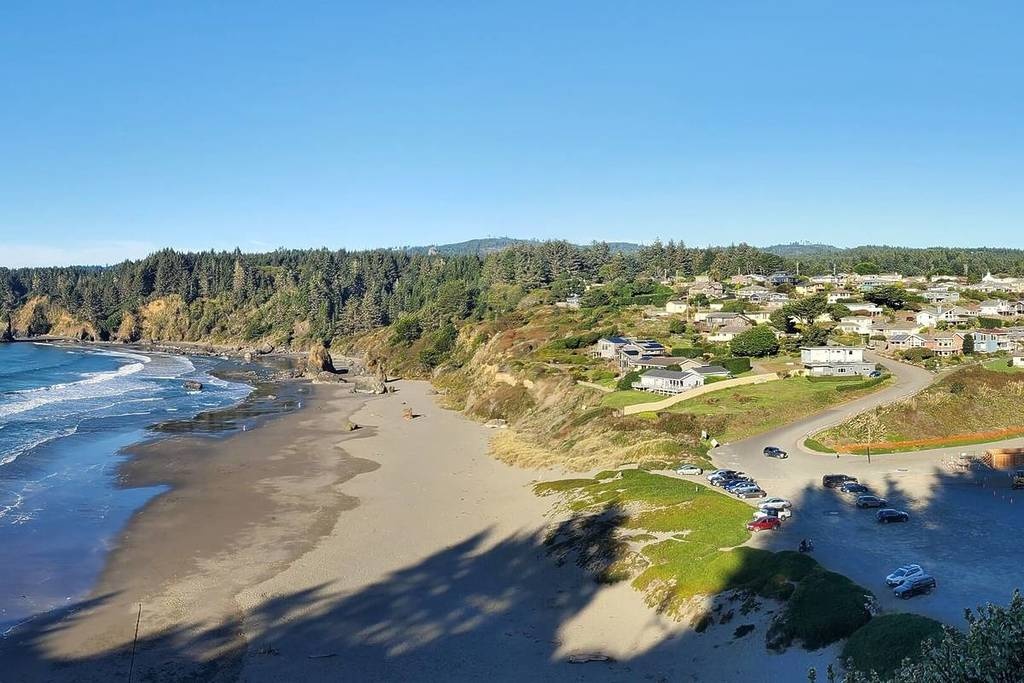
Just offshore and within walking distance of the town, Trinidad State Beach wraps around a small cove at the base of Trinidad Head. The beach features a protected curve of driftwood-strewn sand, tide pools at low tide, and a short fishing pier that doubles as a popular crabbing spot. Above it, the Trinidad Head trail loops around the bluff, offering panoramic views of the Pacific, the harbor below, and on clear days a long curve of coastline stretching both north and south. The combination of easy hiking and immediate beach access makes this one of the most rewarding short walks in the area.
A few miles to the north and south of town, the Redwood National and State Parks preserve some of the tallest and oldest trees on the planet, along with the fern-filled river valleys they depend on. Prairie Creek Redwoods State Park, roughly 20 to 30 minutes north along Highway 101, is home to old-growth groves, herds of Roosevelt elk grazing in the meadow, and the popular Newton B. Drury Scenic Parkway. The broader park system stretches all the way to the Oregon border and includes dozens of miles of hiking trails that range from short boardwalk strolls among the giants to multi-day backcountry routes.
Just north of Trinidad, the bluff-and-beach park formerly known as Patrick's Point was returned to its Yurok name of Sue-meg State Park in 2021. About a ten-minute drive from town, the park spreads across a series of headlands with campgrounds, a recreated Yurok village, tide pools, and dramatic cliff-top lookouts over the ocean. Its renaming and ongoing partnership with the Yurok Tribe have made it as much a cultural destination as a scenic one, giving visitors a deeper sense of the people who have lived along this coast for centuries.
For travelers who want a base that pairs small-town character with some of the most striking natural scenery in the continental United States, Trinidad makes a compelling setting for a short-term rental. Guests can step out the door to hike a coastal headland, drive a short distance into old-growth redwood groves, watch commercial boats return to the harbor, and end the day with fresh seafood as the sun sets over the Pacific — a rhythm of nature and small-scale community that is increasingly hard to find elsewhere on the California coast.
Want to know if a property in Trinidad is a good investment?
Enter an address to get instant revenue potential and comps.