
Palo Cedro, California
Want to see how Palo Cedro compares to other top cities in California? Explore all city regulations in California. →
Palo Cedro, CA
Generally Investor Friendly
STR Regulations for Palo Cedro, California
Overview: Are Short-Term Rentals Allowed in Palo Cedro?
Yes. Short-term rentals are allowed in Palo Cedro, which is located in the unincorporated area of Shasta County. Shasta County does not maintain a city- or county-level Short-Term Rental ordinance; therefore, operation is not specifically restricted by local ordinance at this time. However, operators must comply with all applicable state laws and county land use/zoning standards, health and building code requirements, and any applicable tax collection obligations.
Note: Short-Term Rental regulations are addressed differently in the City of Shasta Lake. Your STR must follow the more permissive rules in unincorporated Shasta County unless located within an incorporated city that has its own STR rules.
What do Airbnb hosts actually earn in Palo Cedro?
Palo Cedro hosts earn a median $31,206/year with $292 ADR and 40% occupancy.
Top performers pull in $39,021+ per year.
See the full Palo Cedro market breakdownHow to Start a Short-Term Rental Business in This Market
- Verify zoning and land use compatibility
- Confirm the property is allowed residential lodging use under county zoning. If the property is in a residential district (e.g., R-1, R-3, Rural Residential, Agricultural), operation is generally allowed, but confirm no HOA/CC&R restrictions apply and that local utility capacity is adequate.
- Prepare the property for guest safety and serviceability
- Ensure life-safety systems are maintained (smoke detectors, CO detectors where applicable, emergency egress, extinguishers).
- Comply with state fire-safe defensible space and vegetation management requirements if the property is in a fire risk area.
- Review grading, drainage, and parking to avoid nuisance conditions that could trigger code enforcement.
- Review state lodging/tax obligations
- Understand California’s Transient Occupancy Tax (TOT) framework at the state level and any local measures. If TOT applies where your property is located, register and collect TOT.
- Obtain any required sales tax permits if renting tangible goods or offering taxable services (e.g., cleaning fees if separately charged and taxable).
- Guest-facing compliance and recordkeeping
- Adopt occupancy standards consistent with local code, provide local contact information, and maintain guest logs in case of emergencies or inquiries from authorities.
- Implement anti-nuisance protocols (noise, trash, parking, occupancy limits) and communicate them to guests.
- Consider business insurance appropriate for short-term lodging operations.
Required Documents, Permits, Licenses, and Guidelines
- Shasta County zoning verification
- Verify permitted use and any development standards with the Shasta County Planning Division.
- Building and safety compliance
- Maintain safe electrical, mechanical, and structural systems. If significant alterations are contemplated, confirm whether building permits are needed (e.g., conversion of space to sleeping areas, installation of kitchen facilities).
- TOT and sales tax registration (as applicable)
- For state-level lodging tax administration, the California State Board of Equalization (BOE) manages TOT. However, TOT is typically imposed at the local level (city/county). Confirm the tax environment for your specific location with Shasta County.
- Local contact and emergency response readiness
- Provide a local contact who can respond within a reasonable time; keep contact information posted inside the property and available to neighbors.
Note: No “STR permit” is required at the county level in unincorporated Shasta County as of the information provided. If city rules apply within city limits (e.g., City of Shasta Lake), different licensing and permitting requirements apply.
Specific Regulations for Short-Term Rentals
City Level (City of Shasta Lake)
- STRs are allowed with permits. The City of Shasta Lake has a formal process for Vacation Homes/STRs that became effective October 1, 2020.
- Key requirements include:
- Permit application and inspection checklist
- Transient Occupancy Tax form and collection/remittance obligations
- Compliance with city ordinances and municipal code
- Operators within City of Shasta Lake limits must follow this permit pathway. Investors targeting Palo Cedro should note that the City of Shasta Lake’s rules do not apply to the unincorporated county area.
County Level (Shasta County)
- No county-level STR ordinance or permit requirement exists for Palo Cedro (unincorporated area).
- STRs must comply with general zoning, building, health, and fire requirements.
- TOT may apply; consult Shasta County for current tax administration. If your property falls within a special district or community services district, additional lodging taxes or assessments may apply.
State Level (California)
- Comply with California Building Code, Fire Code, health and safety requirements, and local defensible space rules in fire-prone areas.
- Transient Occupancy Tax (TOT): California allows local jurisdictions to levy TOT on lodging. If TOT applies where your property is located, registration and collection obligations typically attach to the operator.
Contact Information
-
Shasta County Planning (Zoning/Land Use)
- Phone: 530-225-5532
- Address: Shasta County Department of Resource Management, Planning Division, 1855 Placer Street, Redding, CA 96001
- Website: (see Reference List)
-
Shasta County General Contact
- Phone: 530-225-5550
- Website: (see Reference List)
-
California State Board of Equalization (State-level TOT guidance)
- Phone: 1-916-445-4082
- Website: (see Reference List)
Source Pages (Important)
-
City of Shasta Lake: Short-Term Rentals and Vacation Homes
-
City of Shasta Lake Municipal Code
-
Shasta County Department of Resource Management – Planning Division
-
Shasta County Housing Element 2020–2028 (for background on constraints, public input, infrastructure considerations)
-
California State Board of Equalization (Transient Occupancy Tax)
- URL: www.cdtfa.ca.gov/ (refer to BOE/Tax sections; tax program information under BOE/TOT on the state tax portal)
Practical investor note: Because Palo Cedro is in unincorporated Shasta County without a dedicated STR ordinance, focus on zoning suitability, safety and code compliance, and the local tax environment. If you intend to operate across multiple locations, check each jurisdiction (e.g., City of Shasta Lake) for separate rules.
Next step
Found a property in Palo Cedro?
Paste any address and get estimated revenue, cash-on-cash return, and comparable STR performance in under 5 minutes. 3 free analyses per day.
Free brief
Get the free Palo Cedro STR Investment Brief
Revenue data, top neighborhoods, seasonal trends, and the key regulations for Palo Cedro, California in one email.
Palo Cedro
Market Saturation Score
Photos of Palo Cedro


Overview of Palo Cedro
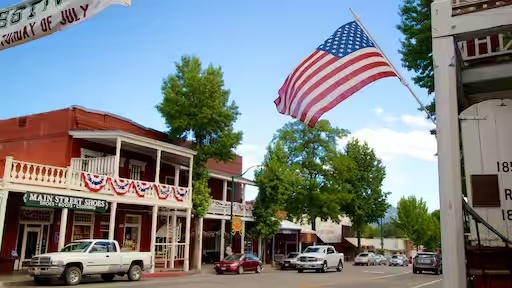
Palo Cedro is a small, unincorporated foothill community in Shasta County in Northern California, with a population of roughly 1,300 residents. Tucked into the pine- and oak-dotted landscape east of Redding, it has a quiet, rural character defined by country roads, equestrian properties, and a tight-knit small-town feel. The community sits at the transition between the Sacramento Valley and the surrounding Cascade and Sierra foothills, making it a useful launchpad for visitors exploring the region's outdoor scenery, lakes, and volcanic landscapes. Redding, the nearest major city and the regional hub of far Northern California, is about ten miles to the west, a short fifteen- or twenty-minute drive down the highway.
A few miles west and north of Palo Cedro lies Shasta Lake, one of the largest reservoirs in California and the centerpiece of the region's summer recreation scene. The lake offers houseboating, sailing, fishing, and shoreline camping, with marinas and launch ramps scattered along its many arms. Most popular access points are within roughly a half-hour drive from town.
Farther west, beyond Redding, Whiskeytown National Recreation Area spreads across about 42,000 acres of forested hills surrounding a clear blue reservoir. Visitors come for swimming at the beach, paddleboarding, and the multi-tiered cascade known as Whiskeytown Falls, reached by a moderate hike. The recreation area is roughly forty minutes from Palo Cedro via Redding.
To the east, Lassen Volcanic National Park is one of the closest true alpine parks to Palo Cedro, about an hour and a half by car. The park preserves a still-active volcanic landscape of boiling mud pots, steaming fumaroles, sulfurous hot springs, and high-elevation lakes, with hiking trails ranging from easy boardwalk walks to strenuous summit climbs of Lassen Peak itself. It is a year-round draw, with cross-country skiing and snowshoeing adding to the appeal in winter.
Closer to home, the Sundial Bridge and Turtle Bay Exploration Park sit on the Sacramento River in Redding, only a short drive away, offering a striking piece of public architecture, riverfront gardens, and a family-oriented natural history campus. The bridge's working sundial, designed by Spanish architect Santiago Calatrava, has become a signature landmark of the region and a popular stop for visitors passing through.
What makes Palo Cedro appealing as a base for short-term rentals is its combination of small-town calm and easy access to some of Northern California's most varied landscapes. Guests can spend a morning houseboating on the lake, an afternoon walking among steaming volcanic vents, and an evening back at a quiet country property under the oaks, all without the noise and traffic of a larger tourist town. For travelers who want a relaxed Northern California stay with a different kind of adventure in reach each day, the community offers a comfortable and well-located home base.
Want to know if a property in Palo Cedro is a good investment?
Enter an address to get instant revenue potential and comps.