
Douglas City, California
Want to see how Douglas City compares to other top cities in California? Explore all city regulations in California. →
Douglas City, CA
Generally Investor Friendly
STR Regulations for Douglas City, California
Executive overview:
- Are STRs allowed in Douglas City, CA? Yes—short‑term rentals (rentals under 30 days) are permitted in California and therefore in Douglas City, provided the use is allowed by the city’s zoning, the unit meets safety and habitability standards, and all required state and local taxes/fees are collected and remitted. Douglas City does not appear to have adopted its own dedicated STR ordinance; absent city‑specific rules, California state‑level requirements apply.
- The information in the provided sources focuses on the Lake Tahoe region (Placer, El Dorado, Washoe/Douglas County NV, Town of Truckee). Those sources are not directly about Douglas City, Trinity County, CA. Treat them as background context only.
- If you intended Douglas County (NV) instead of Douglas City (CA), see the supplemental notes at the end. Otherwise, proceed with the California state‑level requirements summarized below.
How to start a short‑term rental business in Douglas City, CA
- Confirm zoning and use permissions:
- Verify with Trinity County Planning that short‑term rental use is permitted on the subject parcel (many California jurisdictions treat STRs as a lodging use subject to zoning and potential conditional use permits).
- Assess HOA/CC&R restrictions:
- If the property is in a common‑interest community, obtain and review HOA covenants; many HOAs prohibit transient rentals.
- Safety and habitability:
- Ensure smoke detectors, carbon monoxide detectors (if applicable), fire extinguishers, and basic habitability standards are in place. Follow California Building and Fire codes.
- Taxes and registration:
- Register for Transient Occupancy Tax (TOT) with the city/county that collects it for your address (if any). In unincorporated areas, Trinity County may collect TOT.
- If you engage a platform (Airbnb/VRBO), California law requires the platform to collect and remit TOT and certain fees; you may still need to register for a TOT certificate or similar local tax account.
- Register for California Department of Tax and Fee Administration (CDTFA) if you will be the merchant of record; obtain a seller’s permit if required.
- Insurance:
- Carry appropriate general liability and property insurance. Some insurers restrict or exclude short‑term rental use—confirm coverage and consider an STR‑specific policy.
- Guest screening and rules:
- Establish house rules, occupancy limits, quiet hours, parking, snow/weather readiness, and contact procedures for guest issues.
Required documents, permits, licenses, and guidelines (California; local confirmation recommended)
- Local approvals (confirm with Trinity County Planning):
- Zoning clearance or use permit, if required.
- Business license/registration, if the city/county requires it for STRs.
- Transient Occupancy Tax (TOT) registration/certificate (if applicable to your jurisdiction).
- State and tax filings:
- CDTFA seller’s permit (if acting as the merchant of record).
- TOT collection and remittance to the local collecting agency (city or county).
- Platform registration, if using an STR platform that collects/remits taxes.
- Routine state business filings (e.g., Statement of Information with the California Secretary of State if operating as an entity).
- Insurance and safety:
- Liability and property insurance certificates.
- Fire safety and habitability compliance documents as applicable.
- Operations:
- House rules, guest check‑in/out instructions, emergency contacts, local contact requirements if mandated, occupancy limits, and parking rules.
Specific regulations: California state‑level rules relevant to STRs
- TOT and platform obligations:
- California jurisdictions commonly impose a Transient Occupancy Tax on stays under 30 days. As of recent state reforms, many platforms are required to collect and remit TOT and certain fees directly; hosts remain responsible for proper registration and compliance. Some local jurisdictions also collect additional assessments (e.g., tourism improvement district fees).
- Zoning and local control:
- California leaves most STR regulation to cities and counties. Hosts must follow local zoning, permit/registration requirements, occupancy caps, and any ban/permit caps an ordinance may impose.
- Health, safety, and habitability:
- Units must comply with state health and safety standards (smoke/CO detection, fire safety equipment). Check with the local fire authority for any inspection requirements.
- Coastal and sensitive areas:
- If a property is in the California Coastal Zone, a Coastal Development Permit may be required for STR activity depending on local Coastal Commission policies. Confirm with Trinity County or the Coastal Commission.
- Tenant protections and advertising:
- Local ordinances may restrict listings, require registration numbers on advertisements, or impose guest‑contact requirements. Always place the local registration number (if required) on all listings.
- Insurance and nuisance:
- Maintain adequate liability coverage; comply with local noise, parking, and anti‑nuisance rules. Violations can lead to fines or enforcement action.
Contact information for the local authority in charge of STRs (for Douglas City, Trinity County, CA)
- Trinity County Planning Department
- Phone: (530) 623-1353
- Email: [email protected]
- Website: co.trinity.ca.us/planning
- Trinity County Sheriff’s Office (for nuisance/public safety issues)
- Phone: (530) 623-2611
- Website: co.trinity.ca.us/sheriff
- California Department of Tax and Fee Administration (CDTFA)
- Website: cdtfa.ca.gov
- California Department of Consumer Affairs (Legal guidance on short‑term rentals, real estate, and business practices)
- Website: dca.ca.gov Note: You should confirm whether Douglas City requires a city business license or collects TOT directly. If so, obtain that agency’s contact details and any required local STR forms.
Links to source pages (provided content; context only)
- Team Blair Tahoe – Lake Tahoe Short‑Term Rental Regulation Guide
- Cole Mizak – Lake Tahoe Short‑Term Rental Guide
- Tahoe Lifestyle Team – Short‑Term Rentals in the Lake Tahoe Region Explained
- www.tahoelifestyleteam.com/short-term-rentals-in-the-lake-tahoe-region-explained/ These sources are Lake Tahoe‑area specific (Placer County, El Dorado County, Washoe/Douglas County NV, Town of Truckee). They do not provide Douglas City, CA rules. Use them for regional context only.
Supplemental note if you meant Douglas County, Nevada (Lake Tahoe side)
- If the intended jurisdiction is Douglas County, NV (Stateline, Zephyr Cove, Glenbrook), the following applies per the provided content:
- Douglas County, NV caps STR permits at 600 and uses a waitlist; new permits are only available as inventory opens.
- STRs are defined as 28 days or fewer.
- A fire safety inspection is required to obtain a permit.
- Strict advertising and enforcement, with significant civil penalties for unpermitted rentals.
- Douglas County STR resources:
- Neighborhoods & waitlist: www.douglascountynv.gov/cms/One.aspx?portalId=12493103&pageId=17804436
- Douglas County website: www.douglascountynv.gov/
- If you meant Douglas County, NV, note that Nevada state rules apply, not California’s.
Final reminder
- Always verify current local requirements with Trinity County (or the appropriate city) before purchasing or listing a short‑term rental. Local ordinances, caps, taxes, and enforcement practices change frequently.
What do Airbnb hosts actually earn in Douglas City?
Douglas City hosts earn a median $21,271/year with $192 ADR and 44% occupancy.
Top performers pull in $37,344+ per year.
See the full Douglas City market breakdownNext step
Found a property in Douglas City?
Paste any address and get estimated revenue, cash-on-cash return, and comparable STR performance in under 5 minutes. 3 free analyses per day.
Free brief
Get the free Douglas City STR Investment Brief
Revenue data, top neighborhoods, seasonal trends, and the key regulations for Douglas City, California in one email.
Douglas City
Market Saturation Score
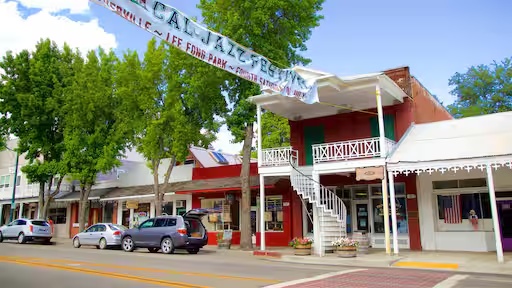
Photos of Douglas City
Overview of Douglas City
Douglas City is a small unincorporated community in Trinity County, in the rugged, forested heart of northwestern California. With a population of only a few hundred residents, it has the quiet, laid-back feel of a rural mountain settlement, with a general store, a handful of local businesses, and homes spread along the Trinity River and State Route 299, the scenic byway that links the North Coast to the Central Valley. Travelers passing through often pause for the river access and the sense of stepping off the main tourist track, and the community serves as a low-key gateway to one of the state's least-crowded outdoor recreation regions. The nearest major city is Redding, which sits roughly 60 to 70 miles to the east along Highway 299, while the larger community of Weaverville, the Trinity County seat, is only about ten minutes to the west.
Just up the road, Weaverville offers a step into Gold Rush history with its preserved downtown, the Trinity County Historical Park, and the striking Joss House State Historic Park, a nineteenth-century Chinese temple that is one of the oldest continuously used Chinese temples in California. The drive from Douglas City is only a few minutes, making it an easy morning or evening outing for visitors based in the area. Weaverville also serves as the main service hub for the surrounding mountains, with restaurants, lodging, and outfitters catering to anglers, rafters, and hikers.
A short distance to the east and west of Douglas City, the Shasta-Trinity National Forest and the surrounding wilderness areas offer some of the most expansive backcountry in the state. The Trinity Alps Wilderness, with its granite peaks, alpine lakes, and network of trails, is accessible via roads branching off Highway 299 and from the communities farther up the canyon. The Trinity River itself is a major draw, known for salmon and steelhead fishing, swimming holes, and calm stretches suitable for kayaks and rafts. Together, the forest, the river, and the wilderness provide a year-round menu of hiking, camping, and fishing without the crowds found in more famous California ranges.
Farther to the east, about an hour's drive, Whiskeytown National Recreation Area wraps a large reservoir with swimming beaches, waterfalls, and a network of trails near the city of Redding. On the other side of Douglas City, the road continues west through the forests toward the North Coast, eventually reaching the redwoods and Pacific beaches several hours away. This position, at the crossroads of river, forest, mountains, and historic Gold Country towns, gives Douglas City a compelling mix of solitude and access that resonates with travelers looking for an outdoors-focused Northern California experience. For short-term rental owners, the appeal lies in offering guests a quiet, scenic base from which to explore Trinity County's rivers, trails, and Gold Rush history while remaining within reasonable reach of Redding and the broader network of regional attractions.
Want to know if a property in Douglas City is a good investment?
Enter an address to get instant revenue potential and comps.