
Clearlake Oaks, California
Want to see how Clearlake Oaks compares to other top cities in California? Explore all city regulations in California. →
Clearlake Oaks, CA
Challenging To Investors
STR Regulations for Clearlake Oaks, California
This guide consolidates the relevant regulations that govern short‑term rentals in the City of Clearlake, which includes the Clearlake‑Oaks area. The City’s vacation rental rules are codified at Clearlake Municipal Code (CMC) §18‑19.280 (Vacation Rentals). State‑level rules (California) apply in addition to City requirements. Where the materials do not include Clearlake‑specific statutes, applicable California standards are referenced.
Overview: Are Short‑Term Rentals Allowed in Clearlake‑Oaks?
Yes. Short‑term rentals (STRs) are explicitly permitted in Clearlake as “vacation rentals” when they meet the standards in CMC §18‑19.280 and all other applicable City requirements. Vacation rentals are allowed in all residential and mixed‑use zones in the City, subject to issuance of a zoning permit and compliance with the performance and operational standards summarized below. CMC §18‑19.280 was recently amended by Ordinance 271‑2025 (codified August 2025). The City’s municipal code also provides specific STR permit and Transient Occupancy Tax (TOT) registration portals.
What do Airbnb hosts actually earn in Clearlake Oaks?
Clearlake Oaks hosts earn a median $30,524/year with $218 ADR and 49% occupancy.
Top performers pull in $39,052+ per year.
See the full Clearlake Oaks market breakdownHow to Start a Short‑Term Rental Business in Clearlake
-
Verify zoning eligibility. Confirm the subject property is in a residential or mixed‑use zone where vacation rentals are permitted and not restricted by covenants, affordable housing agreements, Williamson Act contracts, or similar restrictions. If the zone’s permitted uses are unclear, review CMC §18‑18.030 (Use Regulations—Allowed by Zones) and/or consult the City’s GIS Zoning Map.
-
Confirm owner‑occupancy status. Vacations rentals must be owner‑occupied at least 51% of the year (see “Owner Occupancy” below).
-
Obtain the zoning permit for the vacation rental. Submit the “Short Term Vacation Rental (STVR) Permit” application through the City’s online portal. A zoning permit is required for all STRs and runs with the land; it automatically expires upon sale or transfer of the property. The Director of Planning may add, delete, or modify conditions to further the intent of the section.
-
Register for Transient Occupancy Tax (TOT). Submit the “Transient Occupancy Tax Operators Registration” through the City’s online portal. You must maintain a TOT certificate, include its certificate number on all contracts/agreements and in all advertising/websites, and remain current on required reports and payments.
-
Designate and verify a 24/7 property manager. Every STR must have a verified property manager available 24 hours per day, 7 days per week while the property is rented on a transient basis. The manager must be located within a 30‑mile radius of the STR and be able to respond to complaints at all times during the rental period. Any change to the property manager must be submitted via a new vacation supplemental application, signed by the manager, and include the effective date of the change.
-
Set occupancy and posting requirements. Post the approved permit and all performance standards within six feet of the front door and include them in all rental agreements. Post mailed notices to property owners and immediate neighbors within a standard 300‑foot mailing list at the permit holder’s expense.
-
Compliance with performance standards. Ensure compliance with all performance standards (occupancy, noise, parking, pets, trash/recycling, septic/sewer, outdoor fires, amplified sound, advertising disclosures, and emergency access), as detailed below.
-
Operate and monitor. During rentals, ensure the 24/7 property manager responds to complaints within 60 minutes (or 30 minutes during quiet hours) and reports complaints/resolutions to the City within 24 hours. Prepare for City monitoring and enforcement.
Required Documents, Permits, Licenses, and Guidelines
-
Vacation Rental Zoning Permit (STVR)
- Issued by the Director of Planning (CMC §18‑19.280(c))
- Runs with the land; expires upon sale/transfer (CMC §18‑19.280(d))
- Application and issuance via City online portal
-
Transient Occupancy Tax (TOT) Operators Registration
- Registration required; certificate number must be included on all contracts, agreements, advertising, and websites (CMC §18‑19.280(e)(12))
- Registration via City online portal
-
Use Permits (when applicable)
- Use Permit from Planning Commission may be required for:
- STRs with more than five guest rooms/sleeping rooms (subject to sewage capacity and neighborhood compatibility) (CMC §18‑19.280(e)(1))
- STRs with larger overnight occupancies than standard (CMC §18‑19.280(e)(2))
- Use Permits are processed under CMC Chapter 18‑28
- Use Permit from Planning Commission may be required for:
-
Performance Standards and Guidelines
- Owner‑occupancy (51% of the year) (CMC §18‑19.280(e)(4))
- Occupancy limits: two per sleeping/guest room plus two per property (maximum 12), excluding children under three (CMC §18‑19.280(e)(2))
- Daytime visitor limits: up to six additional persons during daytime (maximum 18 total), excluding children under three; no daytime visitors during quiet hours (CMC §18‑19.280(e)(3))
- Parking: comply with CMC §18‑20.090 (CMC §18‑19.280(e)(5))
- Quiet hours: 10:00 p.m. to 7:00 a.m.; outdoor amplified sound prohibited at all times (CMC §18‑19.280(e)(6)–(7))
- Pets: if allowed, must be secured; continual nuisance barking prohibited (CMC §18‑19.280(e)(8))
- Trash and recycling: bins not stored in public view unless complying with neighborhood standards; returned to screened storage within 24 hours of pickup (CMC §18‑19.280(e)(9))
- Outdoor fire areas: limited to three feet in diameter; on noncombustible surface; covered by a fire screen; extinguished when no longer in use or by 10:00 p.m., whichever is earlier; at least 25 feet from structures or combustible material; prohibited when State or local fire bans apply (CMC §18‑19.280(e)(10))
- Septic/Sewer: maintain properly functioning septic system or sewer connection; per‑room sewer fee may apply in some cases (CMC §18‑19.280(e)(11))
- Emergency access: provide gate code or lockbox for exclusive use by law enforcement or fire services (CMC §18‑19.280(e)(14))
- Posting and neighbor notification: post permit/standards at the front door and include in rental agreements; City mails notice to property owners within 300 feet at the permit holder’s expense (CMC §18‑19.280(e)(15))
- Advertising disclosures: must include maximum occupancy, maximum number of vehicles, quiet hours, prohibition of outdoor amplified sound, and the TOT certificate number (CMC §18‑19.280(e)(16))
- 24/7 property manager: required and must be verified on permit application and all agreements (CMC §18‑19.280(e)(13))
-
Prohibited Structures and Uses
- STRs are not permitted in nonhabitable structures, secondary/accessory/junior accessory dwelling units, or structures/dwellings with covenants/agreements restricting their use (e.g., affordable housing, agricultural employee units, farmworker housing, farm family units, or lands under a Williamson Act Contract). Tents, yurts, RVs, and other temporary occupancy provisions are not allowed as part of a vacation rental (CMC §18‑19.280(b))
-
Annual Monitoring and Enforcement Fee
- An annual fee may be adopted by the City Council and collected by the City to pay for monitoring and enforcement of vacation rentals (CMC §18‑19.280(g))
Specific Regulations for Short‑Term Rentals (City, County, State)
City of Clearlake—Key Provisions
-
Owner Occupancy Requirement
- The owner must occupy the vacation rental dwelling unit at least 51% of the time during the year (CMC §18‑19.280(e)(4))
-
Occupancy and Guest Limits
- Maximum overnight occupancy: two persons per sleeping/guest room plus two per property, up to a maximum of 12 persons, excluding children under three (CMC §18‑19.280(e)(2))
- Daytime visitors: maximum total guests and visitors allowed at any time equals the maximum overnight occupancy plus six additional persons during daytime (maximum 18 total), excluding children under three; daytime visitors are not permitted during quiet hours (CMC §18‑19.280(e)(3))
- For homes with conditional or nonstandard septic systems, or capacity limited by a voluntary repair, maximum overnight occupancy must equal the design load of the septic system (CMC §18‑19.280(e)(2))
- Property owner must ensure contracts and online listings clearly set forth the maximum number of overnight guests permitted at the property (CMC §18‑19.280(e)(2))
-
Guest Rooms
- Maximum of five guest rooms or sleeping rooms. More than five may be allowed only if adequate sewage disposal capacity exists and neighborhood compatibility can be demonstrated; requires a use permit from the Planning Commission (CMC §18‑19.280(e)(1))
-
24/7 Property Manager
- Required; must be located within 30 miles; available by phone 24/7 during rentals; must respond to tenant issues within 60 minutes (or 30 minutes during quiet hours), including visiting the site if necessary, and report complaints/resolutions to the City within 24 hours (CMC §18‑19.280(e)(13); CMC §18‑19.280(f)(1))
-
Noise, Quiet Hours, Amplified Sound
- Quiet hours: 10:00 p.m. to 7:00 a.m.; outdoor amplified sound prohibited at all times (CMC §18‑19.280(e)(6)–(7))
-
Parking
- Must comply with City parking requirements (CMC §18‑20.090) (CMC §18‑19.280
Next step
Found a property in Clearlake Oaks?
Paste any address and get estimated revenue, cash-on-cash return, and comparable STR performance in under 5 minutes. 3 free analyses per day.
Free brief
Get the free Clearlake Oaks STR Investment Brief
Revenue data, top neighborhoods, seasonal trends, and the key regulations for Clearlake Oaks, California in one email.
Clearlake Oaks
Market Saturation Score
Photos of Clearlake Oaks

Overview of Clearlake Oaks
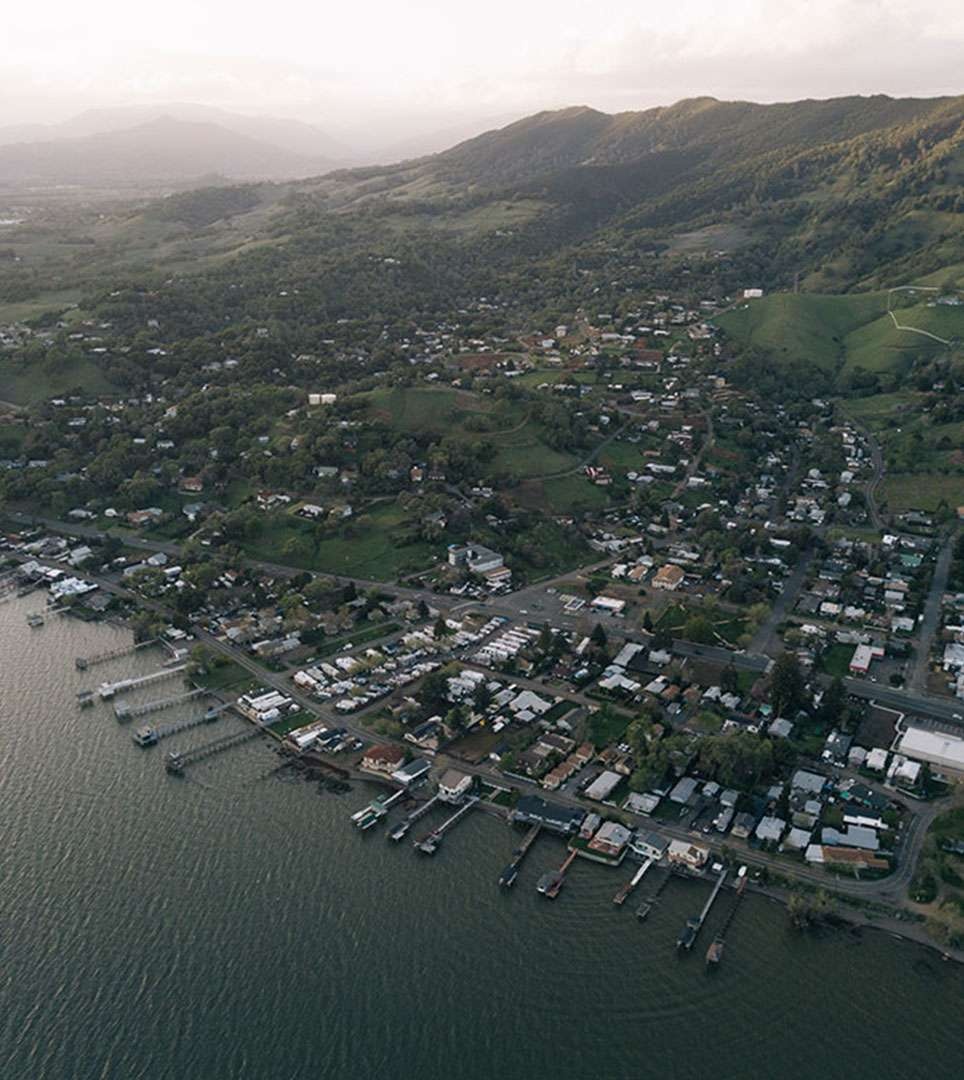
Clearlake is a small city in Lake County, in the northern interior of California, situated along the southeastern shore of the lake for which it is named. With a population of roughly 15,000 to 16,000 residents, it is one of the larger communities in the rural and sparsely populated Lake County, a region characterized by rolling oak-studded hills, vineyards, and a relaxed pace that contrasts sharply with the Bay Area to the south. Clearlake is best known as a year-round outdoor recreation base on the shores of Clear Lake, the largest natural freshwater lake entirely within the state of California, and is often associated with bass fishing, boating, and lake-side living. The city lies approximately 110 to 120 miles north of San Francisco, typically reached via U.S. Route 101 and State Route 20 or State Route 29, with drive times of roughly two and a half to three hours in normal traffic.
The defining natural feature of the area is Clear Lake itself, a vast, ancient body of water that supports extensive fishing, water sports, and lakeside resorts. Often called the "Bass Capital of the West," the lake draws anglers for largemouth and smallmouth bass, crappie, catfish, and bluegill, while visitors also enjoy kayaking, swimming, and birdwatching along its approximately 100 miles of shoreline. Clear Lake State Park, located on the lake's western side within a short drive of the city, provides campgrounds, a swimming beach, and hiking trails that offer an accessible introduction to the surrounding oak woodland and wetland habitats.
Rising just south of town, Mount Konocti is a roughly 4,300-foot dormant or potentially active volcano and one of the most recognizable landmarks on the Clear Lake horizon. A network of trails, including the Wright Peak and Howard Peak routes within the Konocti Regional Trails system, leads hikers through chaparral and pine forest to viewpoints that, on clear days, reportedly reach as far as the Sierra Nevada and the Pacific Ocean. The mountain is a centerpiece of local identity and a popular outdoor activity for visitors based in the area.
To the north, the broader Lake County landscape is dotted with vineyards and tasting rooms that form part of the Clear Lake AVA, a designated American Viticultural Area known for its high-elevation Cabernet Sauvignon, Sauvignon Blanc, and Zinfandel. Travelers based in Clearlake can spend an afternoon driving scenic back roads to small, family-run wineries and tasting rooms in communities such as Kelseyville, Lakeport, and Finley, all within about 30 minutes. A short drive to the northwest also opens onto the Mendocino National Forest, where hiking, camping, and fall-season mushroom hunting offer a quieter complement to the lake's warmer summer appeal.
Clearlake is a compelling base for short-term rentals because it combines an accessible rural setting with a remarkable natural centerpiece and a year-round calendar of outdoor activity, all within a few hours' drive of the San Francisco Bay Area and the Mendocino Coast. Its affordability, lake-side character, and proximity to both water-based recreation and inland wine country give it a broad appeal for travelers seeking an off-the-beaten-path Northern California experience.
Want to know if a property in Clearlake Oaks is a good investment?
Enter an address to get instant revenue potential and comps.